Introduction
The upcoming FATF Plenary in October 2026 will once again place global anti-money-laundering and counter-terrorist-financing frameworks under scrutiny. FATF’s October meeting is scheduled for 26-30 October in Paris, where member jurisdictions review measures taken against money laundering, terrorist financing and proliferation financing. (FATF)
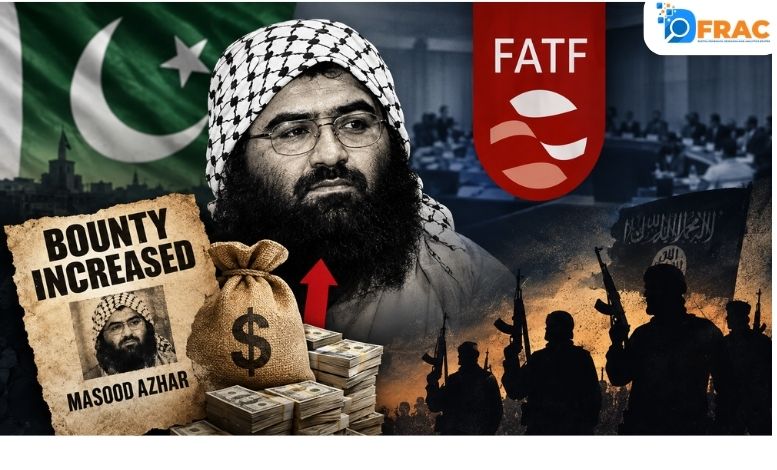
Pakistan presents an important case for examination as, a month before the meeting, it increased the bounty on JeM founder and UN-designated terrorist Masood Azhar. FATF removed Pakistan from its increased-monitoring process in October 2022 after it completed the formal counter-terror financing measures. But the on-the-ground visibility of these measures can be seen through Pakistan’s political lens. The current ruling establishment of Pakistan clearly shows a radical wherewithal aimed at India’s security vulnerabilities. This report uncovers their emerging nexus with Salafi-styled Lashkar-e-Taiba (LeT) and Deoband-oriented Jaish-e-Muhammad (JeM). Both are UN-designated terror outfits, including their offshoots, involved in carrying out many terror attacks in India over the years.
| Lashkar-e-Taiba (LeT) | Jaish-e-Mohammad (JeM) |
| Red Fort attack, Delhi (22 Dec 2000): Militants attacked the Red Fort complex, killing three people. The attack was attributed to LeT. | J&K Legislative Assembly attack, Srinagar (1 Oct 2001): A suicide attack on the Assembly complex killed 38 people. The attack was attributed to JeM. |
| Parliament attack, Delhi (13 Dec 2001): Indian authorities attributed the attack to both LeT and JeM. | Parliament attack, Delhi (13 Dec 2001): JeM was among the groups held responsible for the attack on the Indian Parliament. |
| Kaluchak massacre, J&K (14 May 2002): Militants attacked a military residential area, killing more than 30 people, including soldiers and family members. The attack was attributed to LeT. | Pathankot airbase attack, Punjab (2 Jan 2016): Armed terrorists attacked the Indian Air Force base. The NIA investigation linked the attackers to Pakistan-based JeM. |
| Delhi serial blasts (29 Oct 2005): Explosions in crowded markets in Delhi during the Diwali period killed around 60 people and injured hundreds. LeT was linked to the attack. | Sunjwan Army camp attack, Jammu (10-12 Feb 2018): JeM militants attacked the Army camp, killing soldiers and family members. |
| Mumbai attacks (26-29 Nov 2008): Ten LeT-trained terrorists carried out coordinated attacks at multiple locations in Mumbai, killing more than 160 people. | Pulwama attack, J&K (14 Feb 2019): A suicide bomber attacked a CRPF convoy, killing 40 personnel. India identified Pakistan-based JeM as responsible. |
| Pahalgam terror attack, J&K (22 Apr 2025): Terrorists killed 26 people in the Baisaran area. The NIA subsequently filed a chargesheet against Pakistan-based LeT/TRF and described the case as involving the Pakistan-based LeT/TRF. | Red Fort/Delhi car blast (10 Nov 2025): A vehicle exploded near the Red Fort area, killing people and injuring others. Investigators examined a JeM-linked module in connection with the attack; the NIA subsequently took over the case and arrested multiple accused. The investigation should be described as a JeM-linked case rather than stating that JeM’s organisational responsibility has been conclusively established. |
The report uses open-source evidence to trace the activities, political connections, public appearances, statements and threats attributed to these individuals and groups designated by the UN or listed by other international authorities. Based on the evidence, it will be tested whether FATF can curb money laundering for terror financing in Pakistan, or whether there will be an exception like last year, even after the Pahalgaam terror attack.
Lashkar-e-Taiba (LeT):
Lashkar-e-Taiba (LeT) is a Pakistan-based jihadist organisation that has carried out numerous terrorist attacks against military and civilian targets in India and elsewhere. The group was listed by the UN Security Council in May 2005 under its sanctions regime for its association with Al-Qaeda and involvement in terrorist activities. LeT has operated through various associated or front organisations, most notably Jamaat-ud-Dawa (JuD) and the Falah-i-Insaniat Foundation (FIF), both of which are included as aliases/associated entities in the UN listing. Its leadership has included Hafiz Muhammad Saeed, who is also individually designated by the UN. Including the USA and India, the United Kingdom, the European Union, Australia, and Russia have also designated him as a global terrorist.
Hafiz Saeed:
Hafiz Muhammad Saeed is an internationally designated Pakistani terrorist and the co-founder of Lashkar-e-Taiba (LeT), a radical Islamist militant group. He is best known as the mastermind behind the catastrophic 2008 Mumbai terror attacks (26/11), which resulted in the deaths of 166 individuals. Because of his role in global terrorism, the United States has placed a $10 million bounty on his head through the U.S. Rewards for Justice programme. Saeed was arrested by Pakistani authorities in 2019. Held in the high-security Kot Lakhpat Jail in Lahore, he was subsequently convicted of multiple counts of terror financing, resulting in an aggregated prison sentence of over 30 years. He has been serving time in a Pakistani prison since 2020.
It seems that Hafiz Saeed’s network and operations are still in play even after his sentencing by Pakistani courts. Time and again, his speeches and open threats are posted online, which reveals Pakistan’s weak law enforcement and maladministration. Last year, in June 2025, he gave a threatening speech against India for adopting militant action when India placed the Indus Water Treaty (IWT) in abeyance. Hafiz Saeed stated in Urdu/Hindi: “If you stop the water, God willing, we will stop your breath, and then blood shall follow in these rivers.”
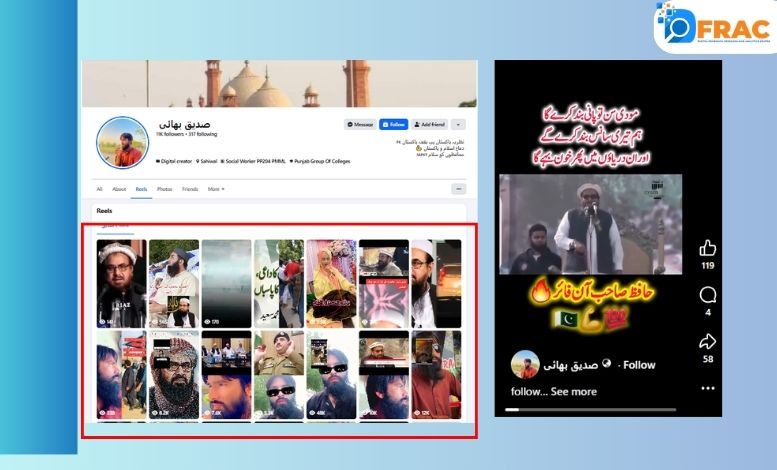
A month later, in May 2025, Pakistan Army spokesperson Lieutenant General Ahmed Sharif Chaudhry renewed the statement made by Hafiz Saeed; he used nearly identical rhetoric during a university speech criticising India’s suspension of the Indus Waters Treaty. (Link)
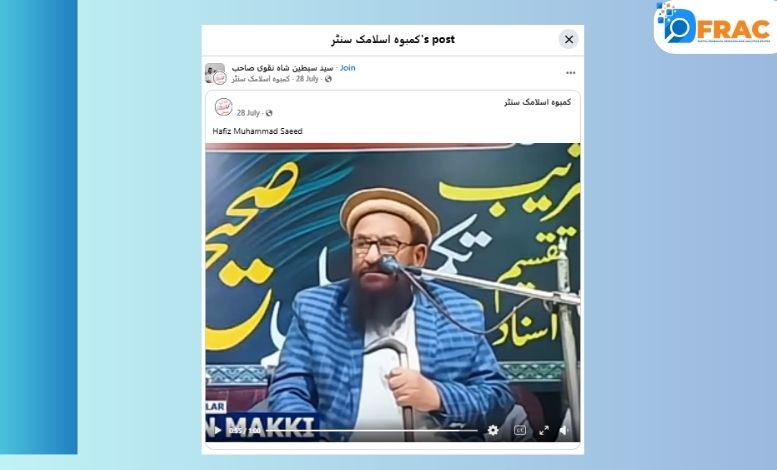
From this Facebook account, we found many other controversial videos:
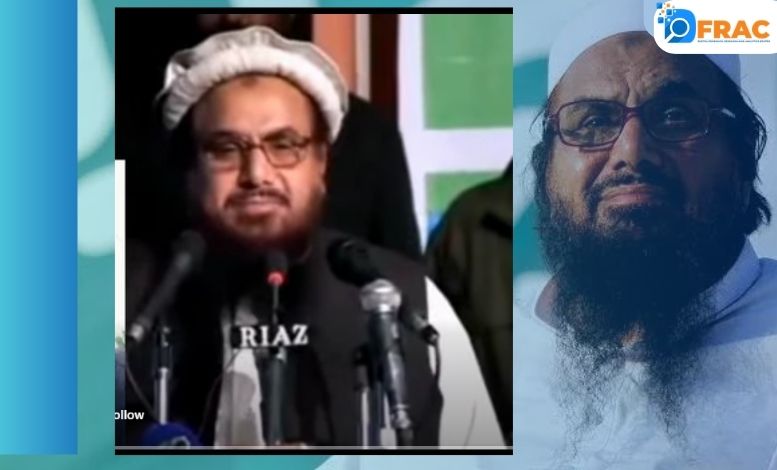
Hafiz Saeed revealed at a press conference that he had a meeting with some politicians. He also referred to some ‘Mohtram Qazi Sahab’ as highly educated and a top government official. Saeed claimed that this person hailed the Jihad, which Hafiz Saeed adopted.
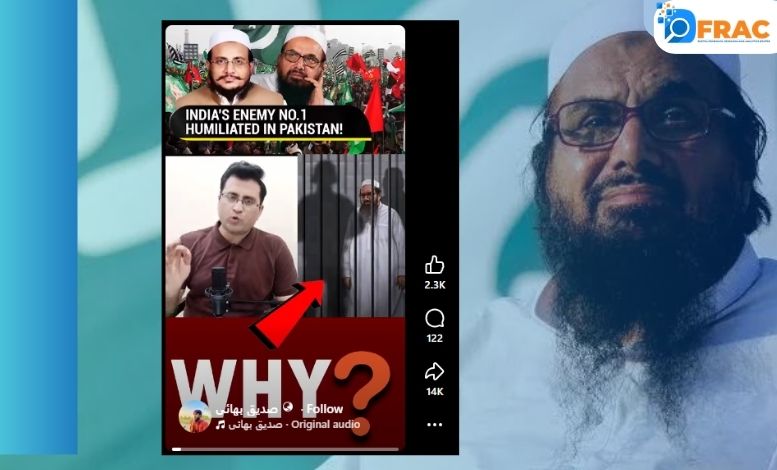
A clip of an influencer claiming that Hafiz Saeed should be released from jail as he is the biggest enemy of India, not Pakistan, and he has done much social and religious work in Pakistan, which should be appreciated.
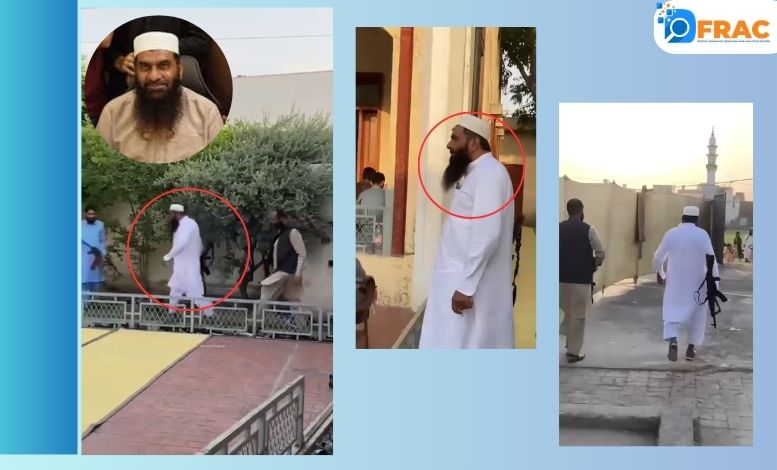
After airstrikes by India on Masjid-e-Muridke, a terror hub of Lashkar-e-Taiba, Maulana Abu Zar, senior commander and wanted terrorist of the LeT, was activated alongside figures like Yunus Shah Bukhari to manage the internal fallout, coordinate external procurement, handle construction material supply lines, and steer operations. He has been tied to orchestrating charitable and “flood relief” fundraising campaigns used to funnel money into the reconstruction and sustenance of LeT infrastructure. Even after maintaining a near-zero digital footprint, we traced him to the Facebook LeT page. Video of him and his subordinates roaming with Light Machine Guns (LMGs) was posted by this page account.
Saifullah Kasuri:
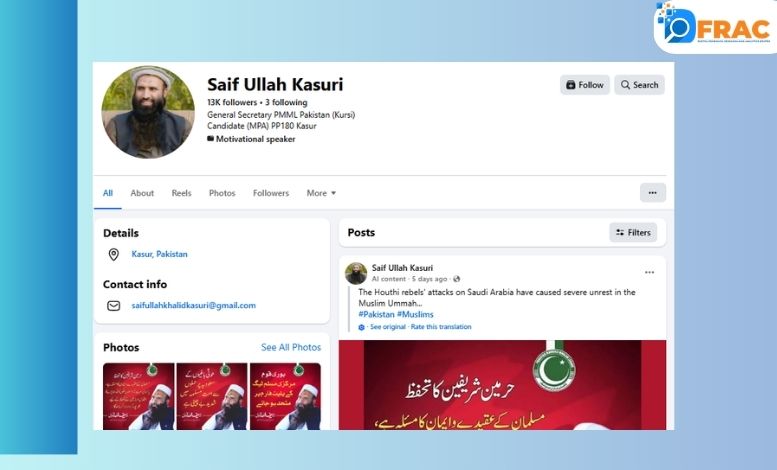
An important figure within Pakistan’s Terror-Political nexus is also a LeT commander, Hafiz Saeed’s close associate and the Pahalgaam terror attack mastermind, Saifullah Kasuri. In its official Press Release/ chargesheet, the NIA (National Investigation Agency) has accused Sajjid Jatt/Saifullah of planning and plotting the Pahalgaam terror attack in April last year. He is termed a Pakistan-based ‘handler’ and terrorist for directing and cooperating with the Kashmir-based terror group TRF (The Resistance Front), an offshoot/proxy of LeT. In our initial investigation, we found that Saifullah Kasuri, General Secretary of the Pakistan Markazi Muslim League (PMML), is Sajjid Jatt/Khalid, the terrorist behind the Pahalgaam terror attack.
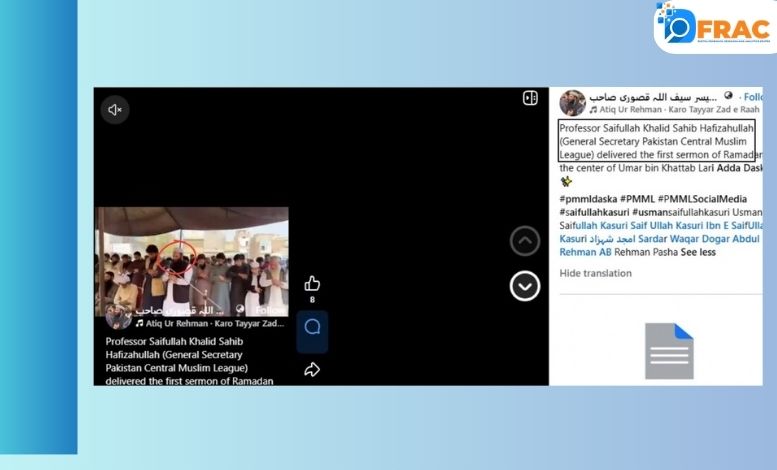
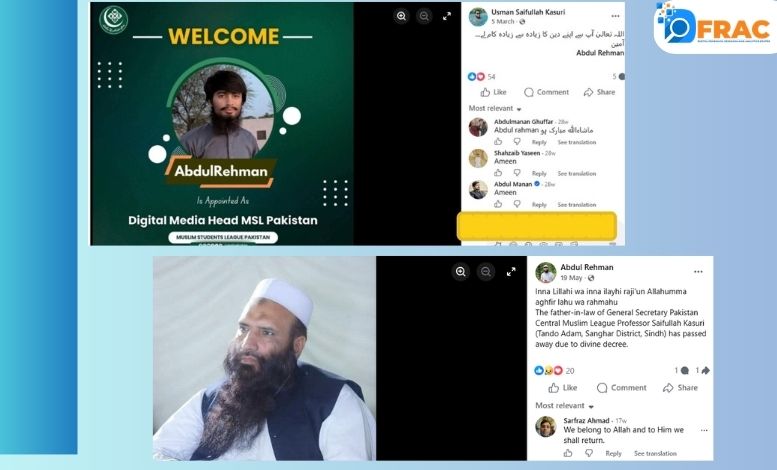
The evidence for his involvement in the Pahalgaam terror attack was revealed when we found that he is married to an adopted daughter of Abdul Saleem Rather. Rather was formerly a laboratory bearer in the Jammu and Kashmir Higher Education Department, whom the government terminated for recruiting and establishing the terror network of Hizbul Mujahideen and LeT. He was accused of facilitating and maintaining a close relationship with LeT commander Saifullah Kasuri, who later planned and executed several terror attacks on security personnel and Kashmiri Pandits through his newly created terror group, the TRF. (Link)
On 19th May, 2026, the news of the death of Kasuri’s father-in-law, Abdul Saleel Rather, was posted by Abdul Rehman, an official digital head of MSL (Muslim Student League), students’ unit of PMML.
Kasuri’s connection with the LeT:
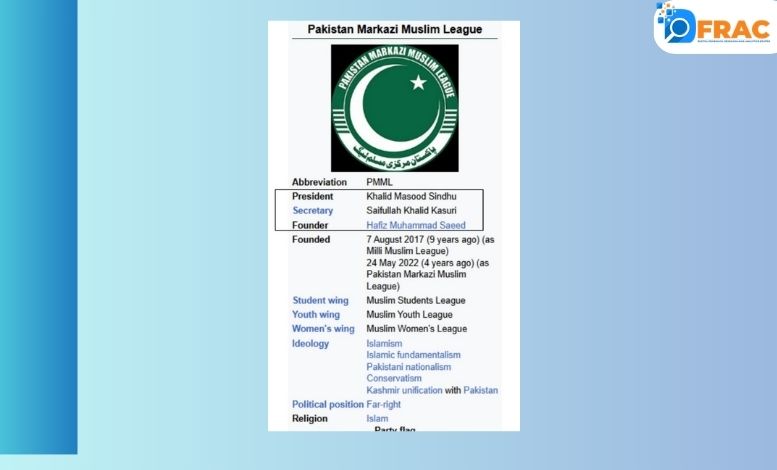
Saifullah Kasuri is the General Secretary of the Pakistan Markazi Muslim League (PMML) political party. The PMML is an Islamist political party in Pakistan regarded by international observers as a political front for the banned terror organisation Lashkar-e-Taiba (LeT) and Jamaat-ud-Dawa (JuD), led by Hafiz Saeed. Even the US Department of the Treasury has imposed sanctions and subsequently banned the Milli Muslim League (MML), and has also named 7 other individuals under its sanctions, including Saifullah Kasuri. The PMML party was originally launched in 2017 as the Milli Muslim League (MML). The Election Commission of Pakistan (ECP) refused to register the MML for the 2018 general elections due to its links to banned groups, forcing its candidates to run under the banner of the Allah-o-Akbar Tehreek. The group reorganised and registered under the name Pakistan Markazi Muslim League (PMML) prior to the February 2024 general elections, fielding candidates across Punjab, Sindh, and other provinces. Talha Saeed, son of Hafiz Saeed, contested a seat in Lahore during the 2024 elections. The PMML publicly claims its objective is to turn Pakistan into an “Islamic and welfare state” or a Madina-style State, referencing it to Salafism (the original ideology of LeT) using the slogan “Hamari Siyasat, Khidmat-e-Insaniyat” (Our Politics, Service to Humanity).
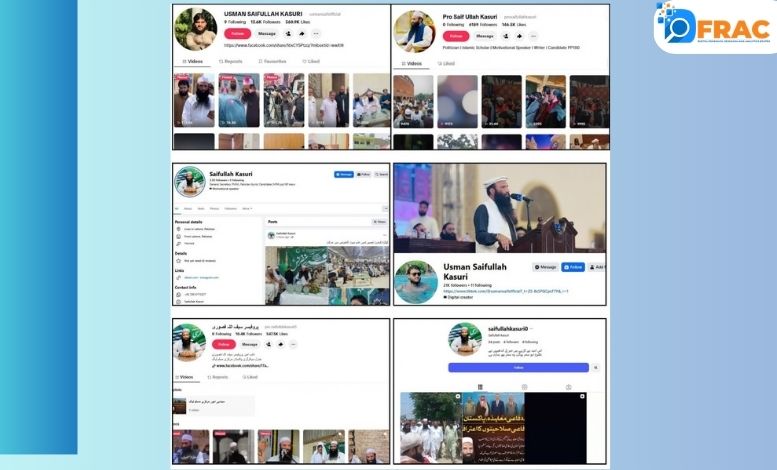
LeT’s influence in the current regime of Pakistan is widely recognised and visible, as individuals linked to the PMML openly issue threats to India and operate freely all over Pakistan. There are several TikTok and Facebook fan accounts of Saifullah Kasuri, providing updates on his movements and glorifying him through edits and videos.
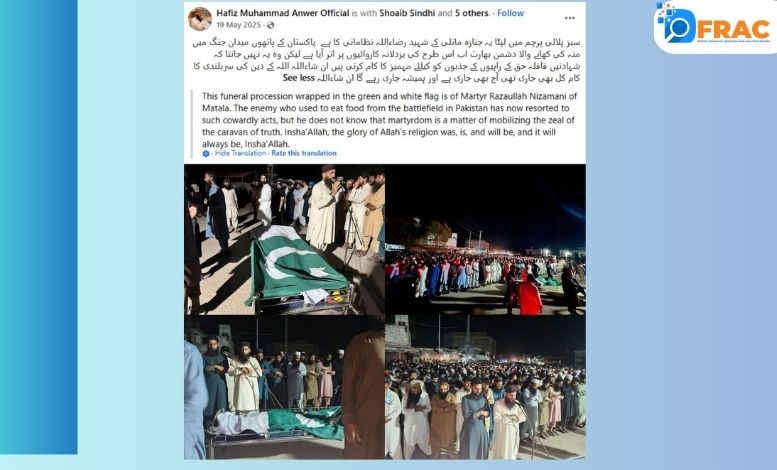
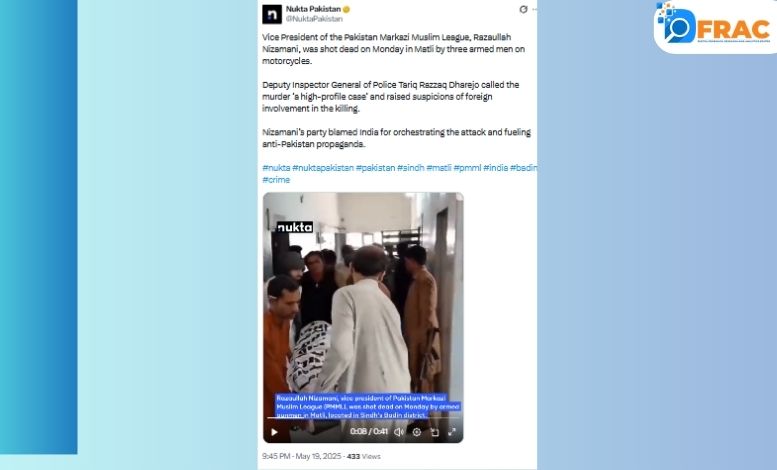
The official account of Saifullah Kasuri on Facebook was tagged in a post where a funeral was organised for the Vice President of the Pakistan Markazi Muslim League (PMML), Razaullah Nizamani, alias Abu Saifullah Khalid. He was a top LeT terrorist, responsible for the 2006 attack on the RSS headquarters in Nagpur, the Indian Institute of Science (IISc) attack in Karnataka’s Bengaluru in 2005, and the terror attack on the CRPF camp in Rampur, U.P., in 2001. He was killed on 19th of May 2025 by unidentified gunmen, and his funeral procession was wrapped with the official Pakistani flag, as if he were an Army personnel. The update on his death was also posted by Pakistani media.
Kasuri is a close associate of Hafiz Saeed:
Saifullah Kasuri is widely regarded as the deputy chief of the terror group Lashkar-e-Taiba and a close associate of Hafiz Saeed.
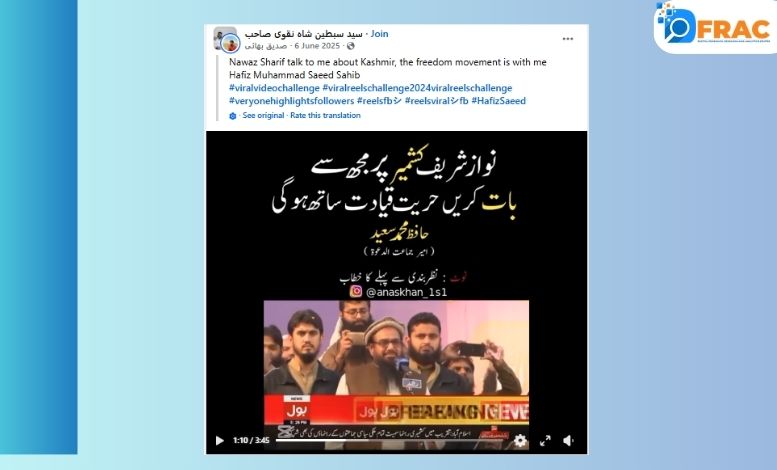
The foremost evidence of Kasuri’s connection with Saeed is that he was made the President of the MML (former name of PMML) in 2017, and the party’s founder was Saeed. An old video featuring Hafiz Saeed was uploaded by a fan account, in which he can be seen showing his disapproval of Nawaz Sharif’s diplomatic peace talks regarding the Kashmir issue, and claims that he conveyed his militant strategy to the former Prime Minister (June 5, 2013 – July 28, 2017). This video was recorded after his release from house arrest, and soon after that he launched his official political party, MML.
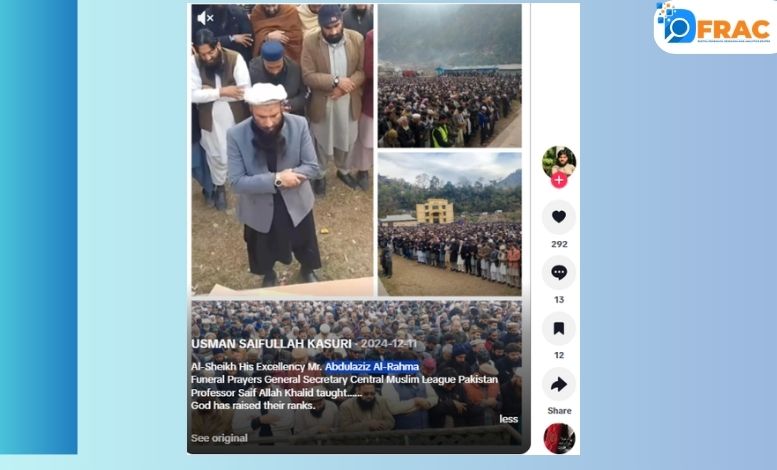
A more direct association with Kasuri and Saeed was seen when Kasuri attended recent funeral prayers attributed to Hafiz Saeed’s brother-in-law and PMML member Hafiz Abdul Rehman Makki. Pakistani radical Islamist, the deputy leader and head of foreign relations for the militant group Lashkar-e-Taiba (LeT) and Jamaat-ud-Dawah (JuD), died of a heart attack in Lahore on December 27, 2024. Indian and international authorities linked him to planning major terror attacks against India, including the 2008 Mumbai attacks.
We also found an old video of Makki where he openly claims that Hafiz Saeed did not let India take any decision regarding Jammu and Kashmir. He even claimed that Western countries, including the US and even Islamabad, knew about what Saeed was capable of and where he was; still, they were not able to take action against him.
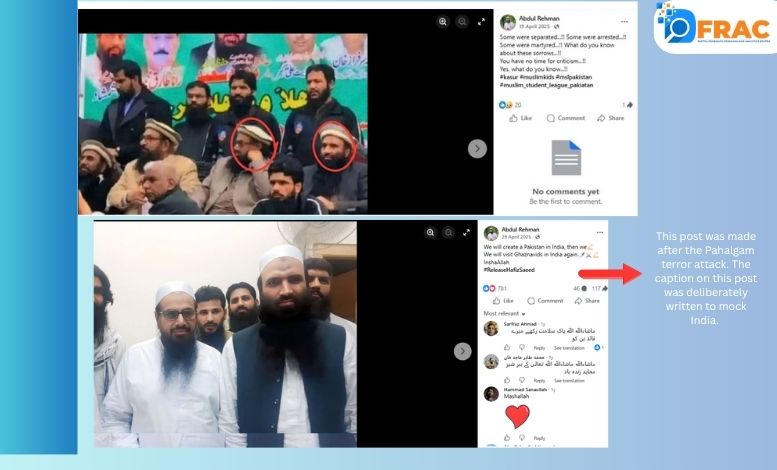
Still not convinced? The digital head of MSL (Muslim Student League), a student unit of PMML, Abdul Rahaman, posted images of Hafiz Saeed alongside Saifullah Kasuri. The post indicated dissatisfaction because Hafiz Saeed had been arrested. While this Facebook account of Abdul Rahaman actively posted images of Hafiz Saeed, after the Pahalgaam terror attack, the posts featuring Saeed were limited and have now completely stopped.
Rana Muhammad Ashfaq:
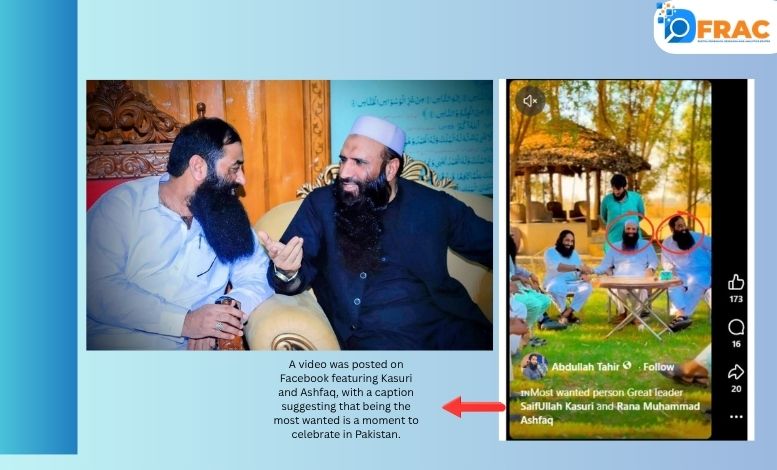
Lashkar-e-Taiba (LeT) commander Rana Mohammad Ashfaq, one of India’s most-wanted terrorists, is currently leading a modernised terror network that integrates hybrid digital technology with advanced physical combat tactics. Operating under the banner of the Pakistan Markazi Muslim League (PMML), the political front of LeT, Ashfaq has transformed traditional recruitment by establishing specialised training camps focused on modern capabilities.
He made headlines earlier this year in Indian news outlets when he issued threats to Hindus and Hindu Gods. (Link)
He is also a close associate of Saifullah Kasuri:
PMML engagement with Pakistan’s current regime and ISI:
The current regime of Pakistan is actively engaging and protecting the LeT-linked PMML; in return, it is providing support to the Pakistan government and Pakistan’s Field Marshal Asim Muneer.
The present Federal Minister of Religious Affairs, Sardar Muhammad Yousuf, visited LeT’s IT cell, called Quba Islamic Centre, in Islamabad, and Saifullah Kasuri exhibited the structure on 20th May, 2026.
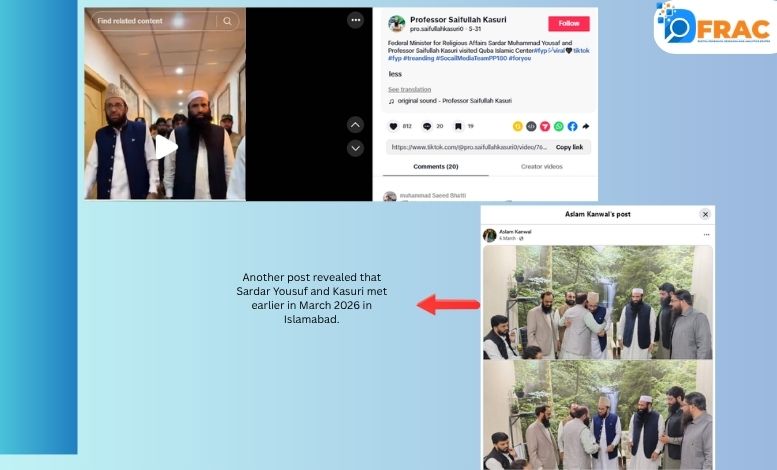
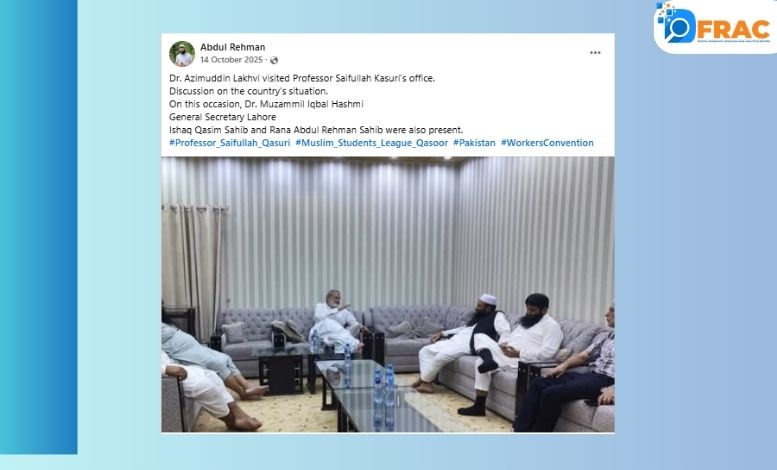
Saifullah Kasuri have also met with Dr Azim-ud-Din Zahid Lakhvi in his office in October 2025. Dr Lakhvi is a Pakistani politician and a member of the National Assembly of Pakistan from Kasur district of Punjab, the same district Kasuri is from.
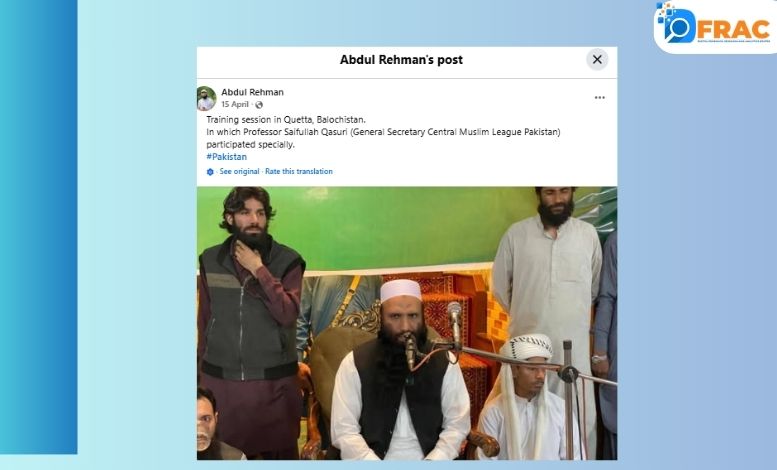
Another revelation suggests that there was a meeting of LeT and ISI in Quetta, Balochistan, on 14th April, 2026. The Resonant News posted this update, while we found a Facebook post revealing that Saifullah Kasuri was also in Quetta, Balochistan, on the same date.
Jaish-e-Muhammad (JeM):
Jaish-e-Mohammad (JeM) is a Pakistan-based jihadist terrorist organisation founded by Masood Azhar in 2000. Designated by the UN in 2001, JeM has been implicated in major attacks in India, including the 2001 Parliament attack, the Pathankot attack and the Pulwama attack. Its associated network has included Harakat-ul-Mujahideen (HUM), Harakat-ul-Jihad Islami (HUJI), Al-Akhtar Trust International and Alkhair Trust; all are Deoband-oriented.
Masood Azhar himself was designated by the UN in 2019 for his association with JeM and Al-Qaeda.
Maulana Fazlur Rahman Khalil:
The leader of Harkat-ul-Mujahideen (an offshoot of Jaish-e-Muhammad) in Pakistan, who has been designated as an international terrorist because of his close ties to al-Qaeda, has travelled to Kabul to mediate between the Afghan Taliban in March this year. This shows that JeM is also connected with the Afghan Taliban.
In past, he has also extended support to the Pakistan Tehreek-e-Insaf (PTI). The PTI’s official President was former Pakistan Prime Minister Imran Khan, a staunch critic of the current regime and of the USA’s influence in Pakistan. He is now serving jail time for the corruption allegations against him.
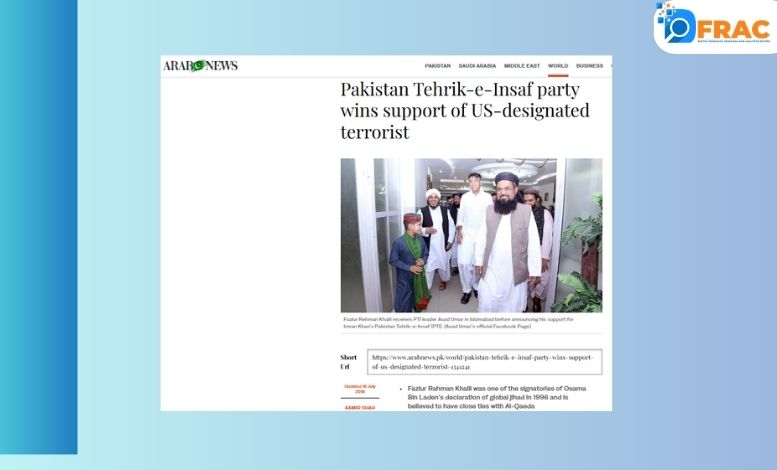
In an interview, he revealed that he was trained by the US security forces, including the Mujahideen of Afghanistan against the occupation of the Soviet Union. While those Mujahideen were called ‘Freedom Fighters’ by former American President Ronald Regan, afterwards they were the greatest enemies of the USA, as they formed the Taliban group. The Taliban had support from people like Khalil who were based in Pakistan against the Americans. (Link)
Massod Azhar
Masood Azhar is the founder of Pakistan-based Jaish-e-Mohammad (JeM) and a former leader of Harakat-ul-Mujahideen (HuM). He was released from an Indian prison in 1999 in exchange for 155 hostages from the hijacked IC-814 flight and was designated by the UN in 2019 for his association with Al-Qaeda and JeM.
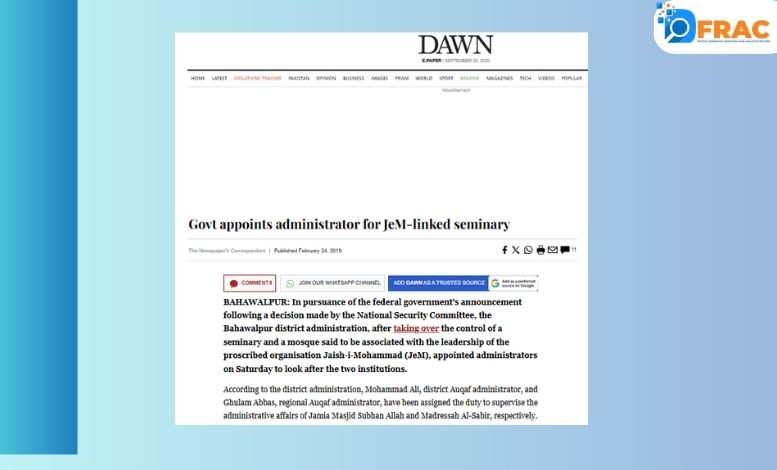
Pakistan government have recently increased the bounty on Masood Azhar to 70 Lakh Pakistani rupees. It has been widely anticipated that the move was triggered by the approaching FATF meeting and bypassing its sanctions. While Pakistan refuted Indian claims that it had not struck any terror facility during Operation Sindoor in Bahawalpur, but rather religious infrastructure, its own news outlet previously covered that the JeM facility was in Bahawalpur and was linked to UN-designated terrorist Masood Azhar.
After the air strikes on JeM’s headquarters last year, it was also revealed in certain media reports that Masood Azhar lost some of his family members, including the husband of his sister. Later, in October 2025, his sister launched the first women’s wing of JeM called Jaish-al-Mu’minaat.
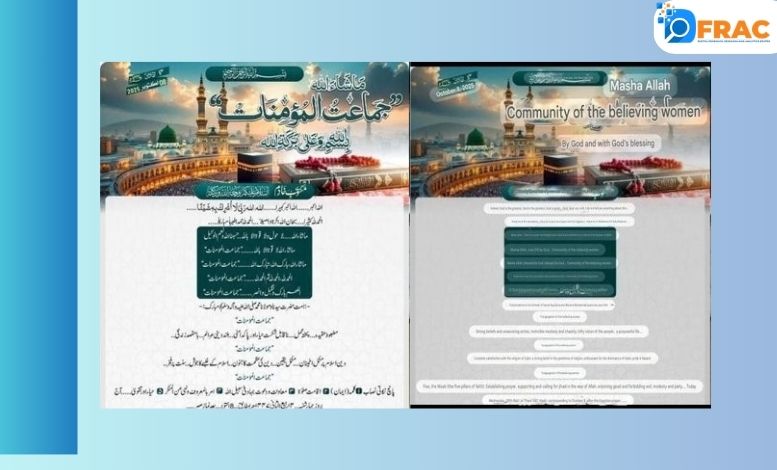
An audio clip was published by media reports that revealed the audio of Masood Azhar, in which he claimed that 1000’s of suicide bombers are ready to attack all over India under his direction. (Link)
Conclusion
The evidence examined in this report points to a wider issue beyond Pakistan’s formal counter-terror financing measures. While Islamabad has taken steps to meet FATF requirements and has publicly acted against certain terrorist figures, organisations such as Lashkar-e-Taiba (LeT) and Jaish-e-Mohammad (JeM) continue to remain relevant to Pakistan’s security and political environment. Both organisations have been linked to major attacks in India, while their leadership and associated networks have continued to feature in regional security concerns.
The case of Masood Azhar further illustrates this contradiction. Despite being a UN-designated terrorist and the founder of JeM, his organisation remains part of the broader militant ecosystem operating from Pakistan. Similarly, LeT and its associated networks have repeatedly appeared in investigations into major attacks against India, including the 2008 Mumbai attacks and the 2025 Pahalgam attack.
This raises a broader question for the FATF: should assessment of Pakistan’s counter-terror financing commitments be limited to financial controls, or should it also consider whether designated terrorist organisations and their networks continue to retain an operating, political or public space within the country? The answer will be significant in determining how effectively Pakistan’s formal commitments translate into action against the wider ecosystem supporting terrorist activity.
Ultimately, the FATF review provides an opportunity to examine not only what Pakistan has done on paper, but also what its actions and the continuing presence of designated terrorist networks indicate on the ground.