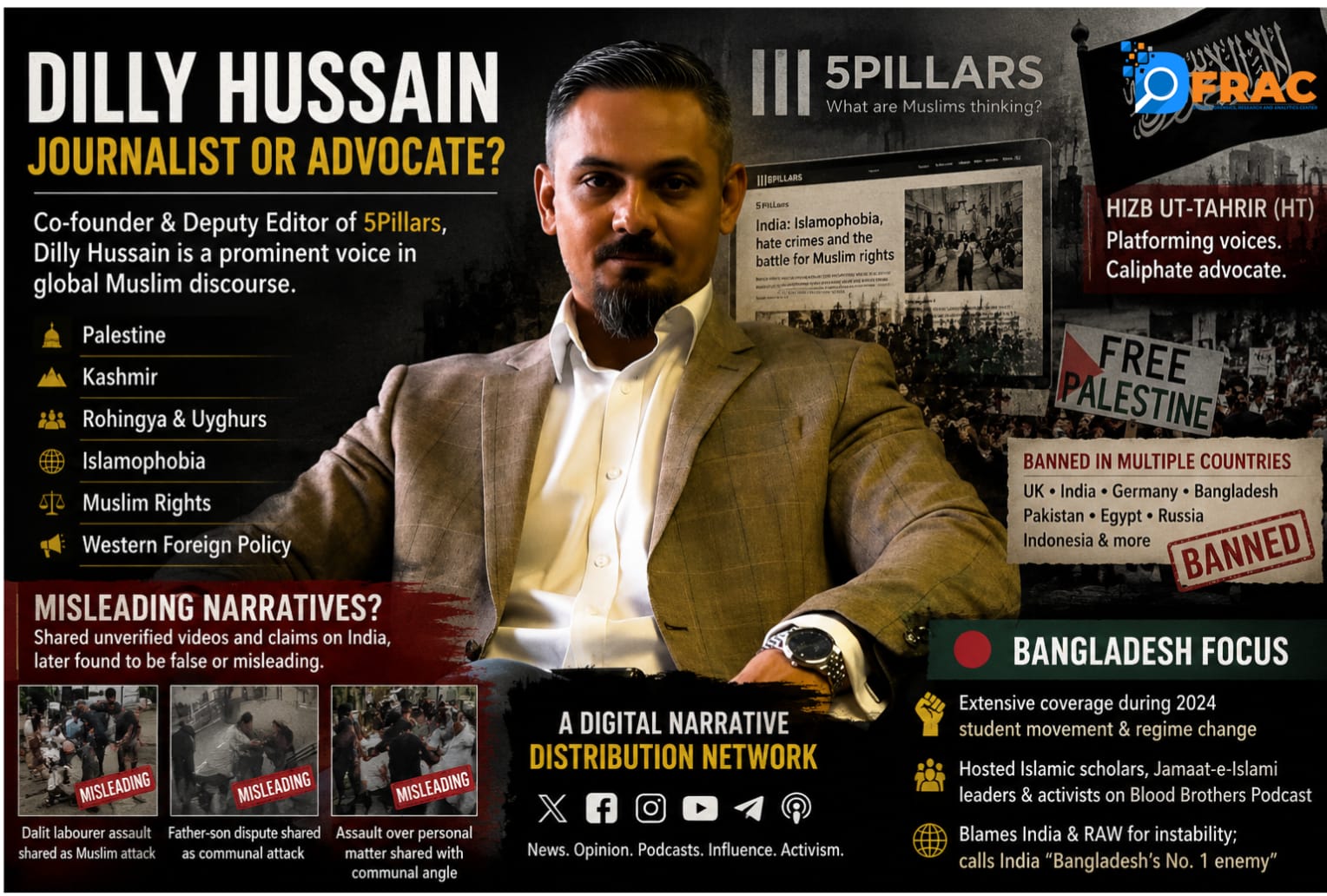
Dilli Hussain, also known as Muhammad Dilawar Hussain, is a well-known and influential figure associated with the global Muslim Brotherhood discourse. He is among a select group of journalists whose presence is frequently seen in discussions, debates, and coverage related to major issues concerning the Muslim world. By profession, Hussain is a journalist and serves as the co-founder and Deputy Editor of the UK-based Muslim media platform 5Pillars. In addition, his articles, commentaries, interviews, and opinion pieces are regularly published by several Arab and Gulf-based media outlets with international reach. Ideologically, Hussain is associated with the Salafi-Wahhabi school of Islamic thought.
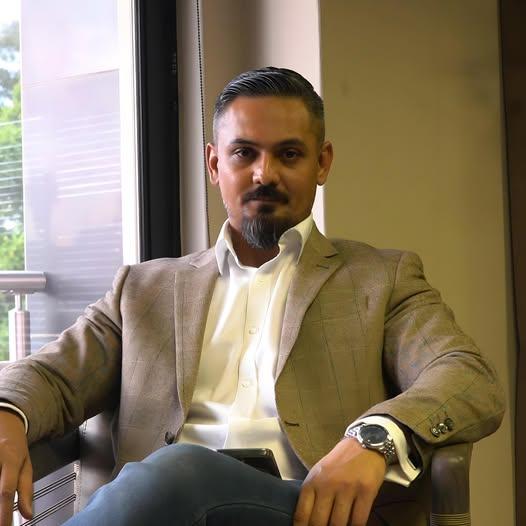
He is widely recognized as a vocal commentator on issues such as Palestine, Kashmir, the Rohingya crisis, Uyghur Muslims, Islamophobia, Western foreign policy, and Muslim rights. His identity extends beyond that of a conventional journalist; he is also known as a commentator who presents news through a distinct ideological lens.
For this reason, it would not be entirely accurate to describe Dilli Hussain as a neutral journalist in the traditional sense. Based on his content and public interventions, he is more appropriately understood as an advocacy journalist—someone who not only reports on events but also actively advances and publicly advocates for the causes and issues he considers significant.
1.Dilli Hussain and His Journalism
Dilli Hussain began his journalism career after earning a BA (Hons) in Politics from the University of East Anglia, Norwich, in 2009. In 2010, he joined the Bedfordshire on Sunday newspaper, where he also completed the National Council for the Training of Journalists (NCTJ) Certificate in Print Journalism. He left the newspaper in 2012, and in 2013 co-founded 5Pillars with Roshan Muhammad Salih. Today, 5Pillars is regarded as one of the most prominent alternative media platforms serving British Muslims and the wider Muslim world.
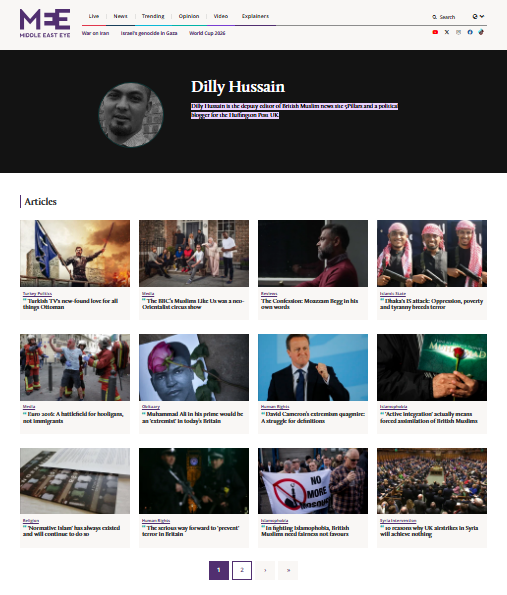
A British journalist of Bangladeshi origin, Hussain’s work extends well beyond 5Pillars. He has appeared on major media platforms including Sky News, Channel 4, BBC, CNN, TalkTV, and BBC Radio, offering commentary on issues relating to the Middle East, North Africa, and British Muslims. He is also a regular columnist for Middle East Eye. His articles have appeared in Al Jazeera English, Ceasefire Magazine, and Foreign Policy Journal, among other international publications. Over the course of his career, Hussain has reported from more than 13 countries. His notable reporting includes coverage of the reconversion of Turkey’s Hagia Sophia into a mosque in 2020, on-the-ground reporting marking the first anniversary of the U.S. withdrawal from Afghanistan in 2022, and field reporting on the political upheavals in Bangladesh and Syria in 2024.
2. 5Pillars
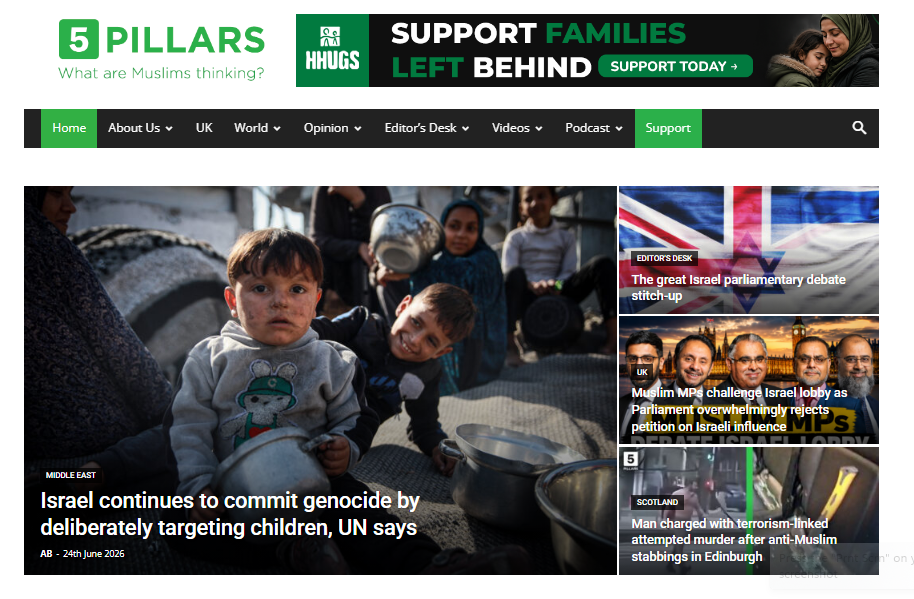
Founded in April 2013 by Roshan Muhammad Salih and Dilly Hussain, 5Pillars presents itself as an independent Muslim media platform. According to its website, the platform was established at a time when its founders believed that the mainstream Western media did not adequately represent issues affecting Muslim communities. Its tagline, “What are Muslims thinking?”, reflects both its editorial approach and its intended audience.
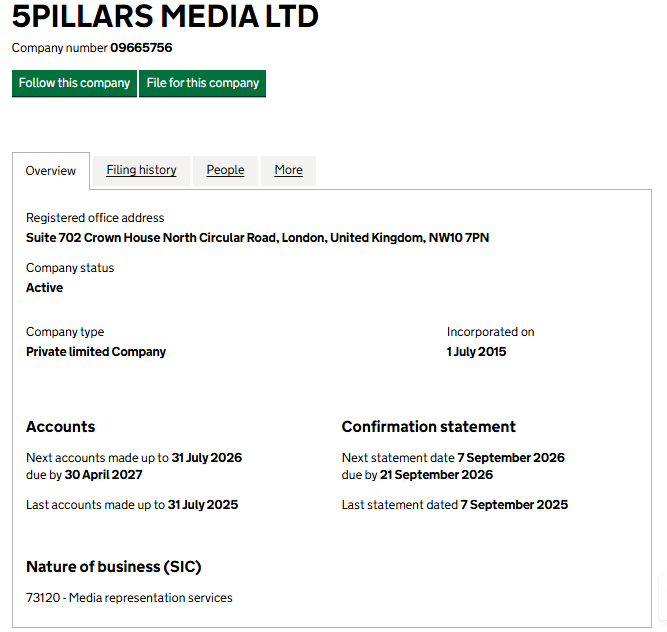
According to publicly available records, 5Pillars is operated by 5PILLARS MEDIA LTD, a company incorporated in the United Kingdom on 1 July 2015. The company is registered under registration number 09665756, with its registered office located at Suite 702, Crown House, North Circular Road, London, NW10 7PN. The company’s official business classification falls under “Media Representation Services.”
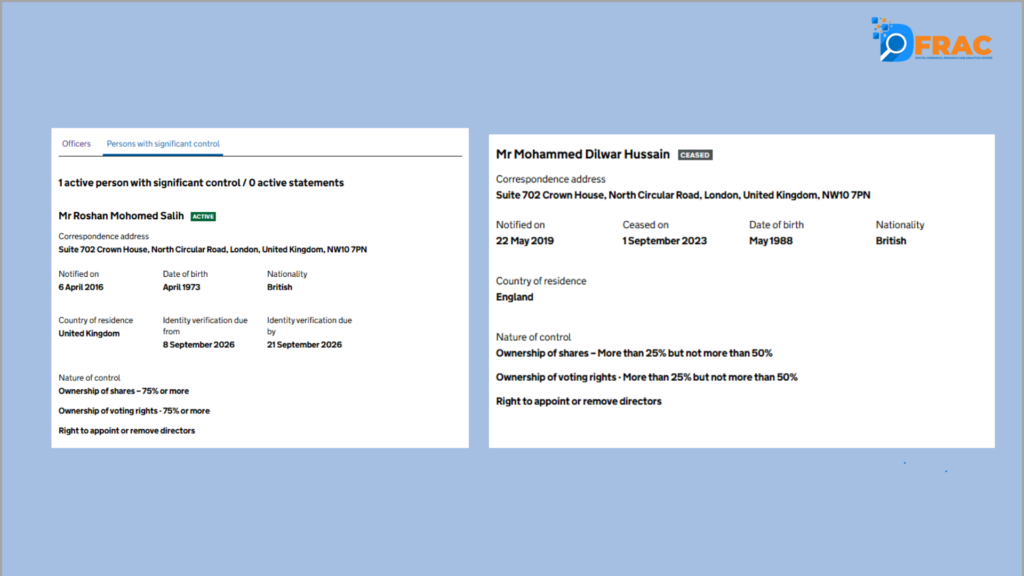
Corporate records indicate that 5Pillars co-founder Roshan Muhammad Salih is the company’s Person with Significant Control (PSC), holding more than 75% of the ownership and voting rights. Dilly Hussain has also previously served as one of the company’s significant shareholders and directors.

The content strategy of 5Pillars operates across four primary pillars. First, it produces news reporting; second, it publishes political and ideological analysis; third, it offers in-depth discussions through videos and podcasts; and fourth, it amplifies these themes through social media to reach a wider audience. A central component of this strategy is the Blood Brothers Podcast, hosted by Dilly Hussain. The podcast serves not only as a platform for interviews and discussions but has also become one of the principal channels for extending 5Pillars’ ideological messaging and audience engagement.
Articles published on the website are frequently repurposed into videos, podcast episodes, social media posts, and broader digital campaigns. This multi-format approach enables the same topic to be disseminated repeatedly across different platforms, thereby increasing both its reach and its overall impact.

From a technical and strategic perspective, one of 5Pillars’ greatest strengths lies in its multi-platform distribution network. Content published on the website is rapidly disseminated through X, Facebook, Instagram, YouTube, Telegram, and podcast platforms, allowing it to reach hundreds of thousands of users within a short period. As a result, 5Pillars is viewed not merely as a media website but also as a “Narrative Distribution Network,” where news reporting, opinion, digital influence, and community-based activism function in an integrated manner.
3.Dilly Hussain’s X Account
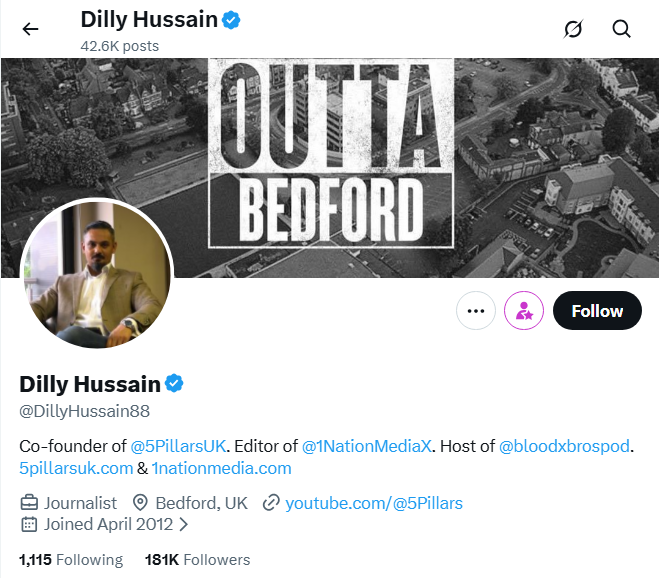
Dilli Hussain has been active on X (formerly Twitter) since April 2012. He has more than 181,000 followers and has established a strong digital presence over the past decade by posting on issues related to Muslim affairs, international politics, human rights, and current events.
He has also been actively engaged in discussions concerning India. His posts frequently focus on topics such as Kashmir, issues affecting Indian Muslims, communal violence, religious freedom, and Hindutva politics. However, while commenting on these issues, he has also shared content that has been identified as false or misleading.
4. 5Pillars and India
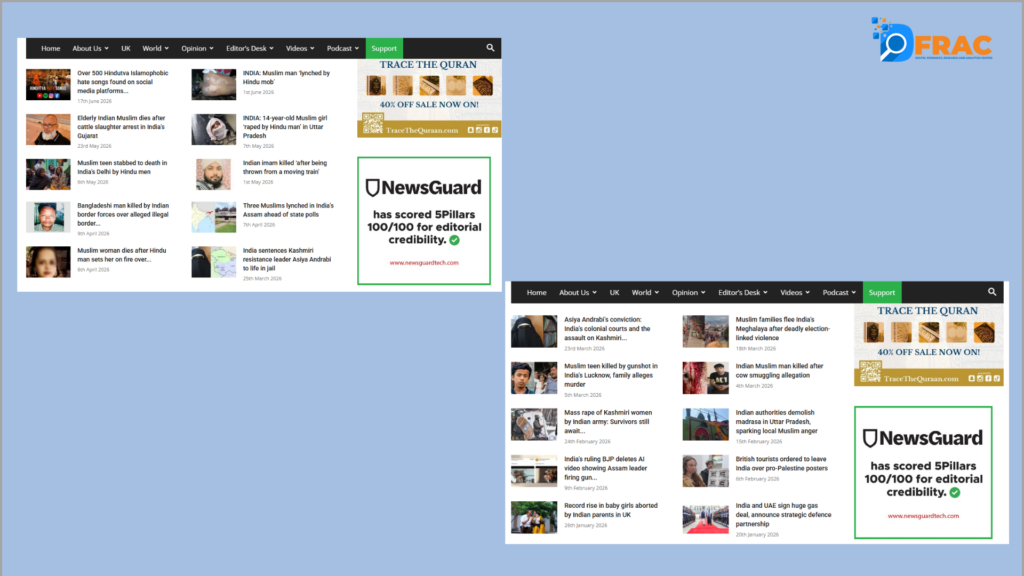
More than 800 articles related to India have been published on the 5Pillars news portal. A search for the keyword “India” on the website’s search section returns a substantial number of news reports, analyses, and opinion pieces. A review of this content indicates that a significant portion of the platform’s coverage of India focuses on issues concerning Indian Muslims, religious minorities, and Hindutva politics.
The material published on the website consistently highlights topics such as Islamophobia, hate crimes, cow vigilantism, religious polarization, bulldozer demolitions, the hijab controversy, the I Love Muhammad campaign, government action against mosques and madrasas, and developments related to Kashmir.
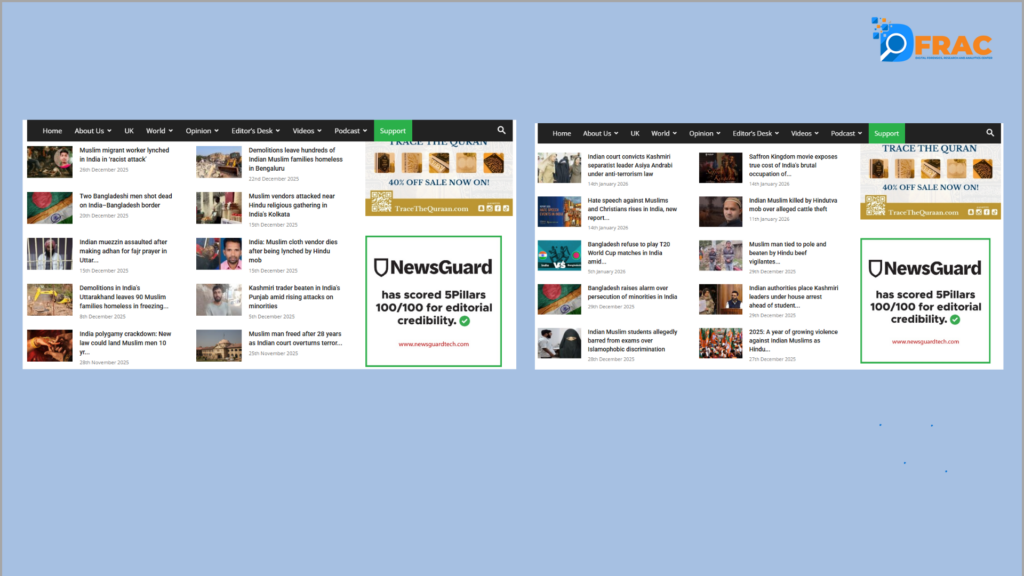
A notable feature of 5Pillars‘ reporting on India is that it frequently frames issues affecting Indian Muslims within the broader context of global Muslim discourse. Several articles draw comparisons between developments in India and issues such as Palestine, the Rohingya crisis, the persecution of Uyghur Muslims, and Islamophobia in Western countries. In doing so, local developments are presented as part of a wider debate concerning global Muslim identity, religious freedom, and human rights. Consequently, events in India are portrayed not merely as domestic social or political developments but as part of a broader international discourse on the rights and alleged persecution of Muslim communities worldwide.
5.Hizb ut-Tahrir and Dilli Hussain
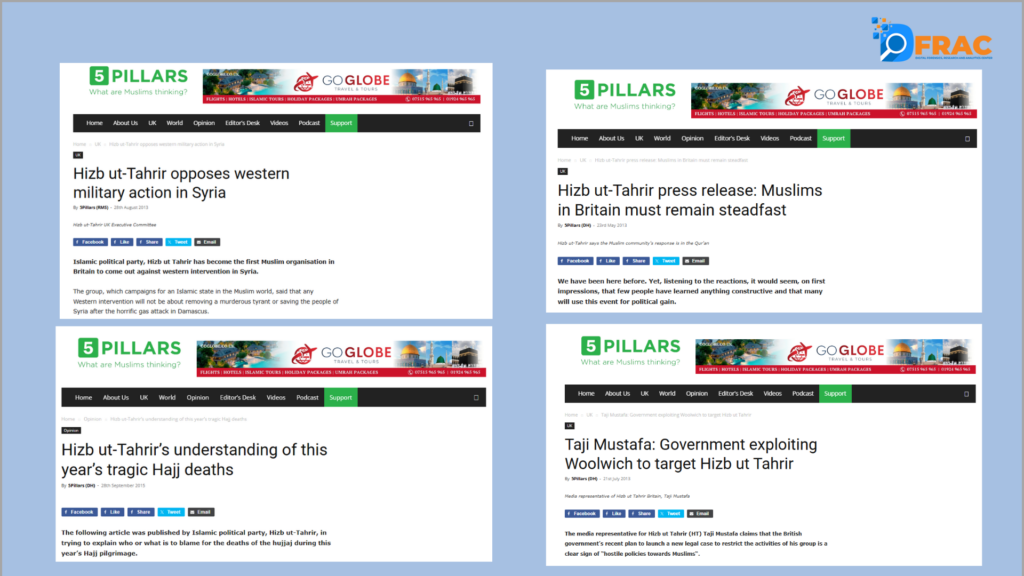
Hizb ut-Tahrir (HT) is an international pan-Islamist political organization founded in 1953 by the Palestinian Islamic scholar Taqi al-Din al-Nabhani in East Jerusalem. The organization’s stated objective is to unite Muslims worldwide under a single political entity through the re-establishment of the Caliphate and the implementation of a governance system based on Sharia. HT is a strong critic of the nation-state model, democracy, and Western liberal political systems. The organization has been banned in several countries over concerns related to extremism and national security. Countries that have imposed bans include Indonesia—the world’s largest Muslim-majority nation—as well as the United Kingdom, India, Germany, Bangladesh, Pakistan, Egypt, and Russia, among others, for various reasons.
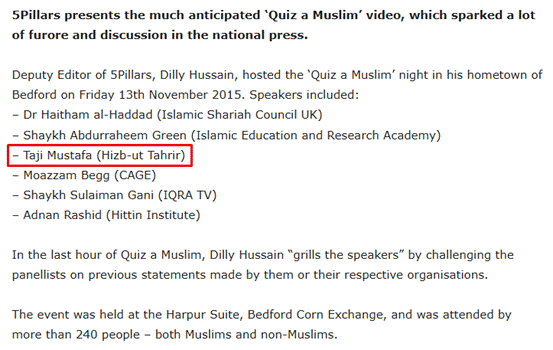
As the co-founder and Deputy Editor of 5Pillars, Dilli Hussain has provided a platform to representatives associated with Hizb ut-Tahrir. In 2015, while hosting the “Quiz a Muslim” programme, Hussain invited Taji Mustafa, then spokesperson for Hizb ut-Tahrir UK, as a guest speaker. In addition, 5Pillars has, on various occasions, published articles and opinions authored by individuals associated with Hizb ut-Tahrir. This editorial approach attracted criticism, prompting questions about Hussain’s relationship with the organization. In response to these criticisms, Hussain denied having organizational links with Hizb ut-Tahrir. However, he has publicly expressed support for the concept of the Caliphate.
6.Bangladesh and Dilli Hussain
Link : 1,2,3,4
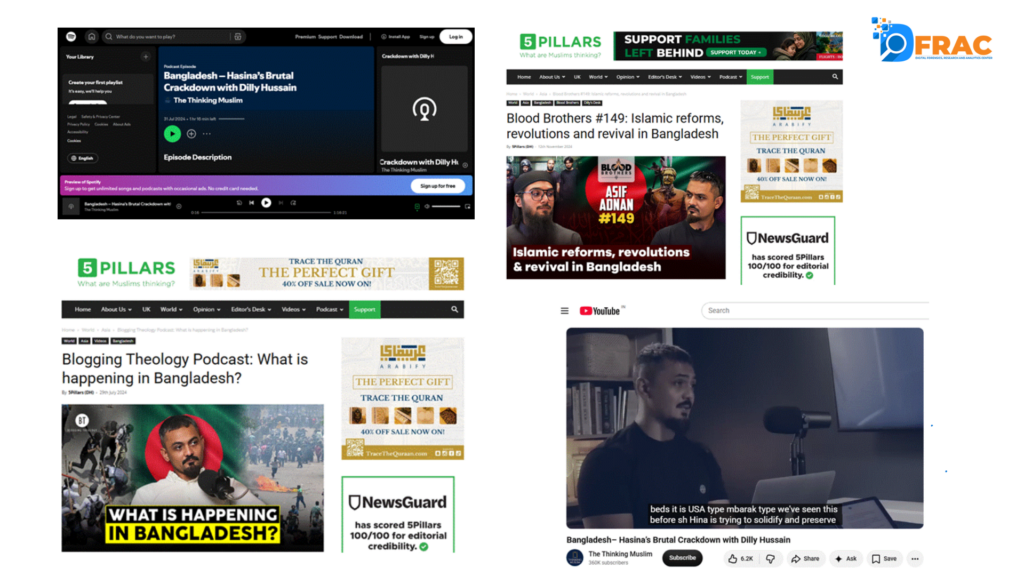
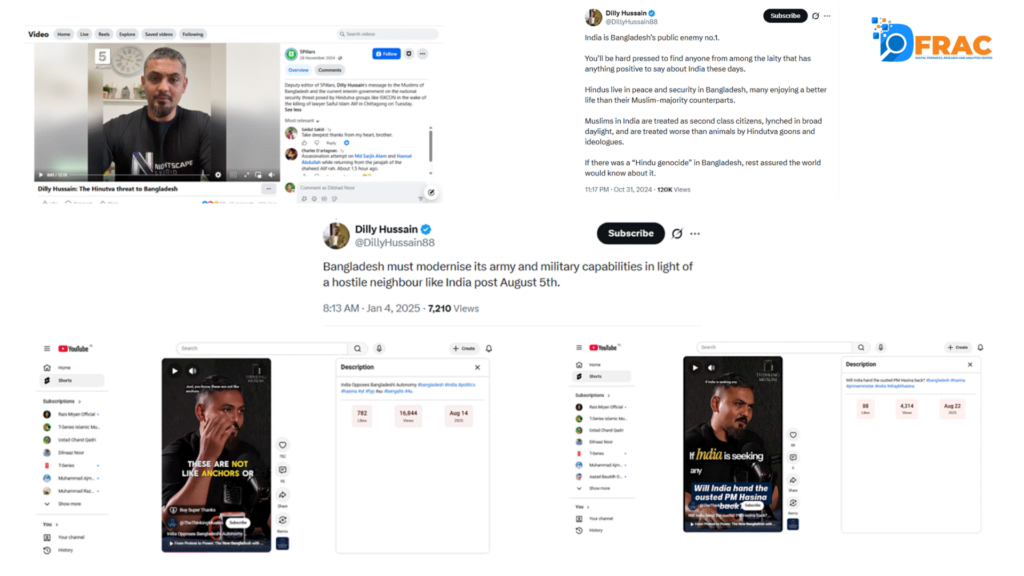
Owing to his Bangladeshi heritage, Bangladesh has been one of the principal subjects of Dilli Hussain’s journalism, alongside Palestine and India. During the 2024 student-led protests against the Sheikh Hasina government and the subsequent political transition, Hussain published a large volume of news reports, articles, analyses, and commentary on Bangladesh through 5Pillars, the Blood Brothers Podcast, and his X account.In his reporting, Hussain was highly critical of Sheikh Hasina’s government, particularly its actions against opposition leaders, Islamist organizations, journalists, and student protesters. Across his articles and podcast discussions, he consistently focused on themes such as Muslim identity, Islamic revival, and the future role of Islam in Bangladesh. On the Blood Brothers Podcast, he explored these issues through discussions with Islamic scholars, leaders of Jamaat-e-Islami, writers, and social activists.
Link: 1,2,3,4,5
Hussain has also argued that India has played a significant role in Bangladesh’s domestic political turmoil. According to his public statements, he has described India as Bangladesh’s “number one enemy” and has alleged that India, through its external intelligence agency Research and Analysis Wing (RAW), has sought to foment instability and unrest in Bangladesh.
7.False and Misleading Content
Dilli Hussain’s engagement with issues related to India has extended beyond commentary and criticism. In several instances, he has shared content concerning communal incidents and other sensitive issues in India that was later found to be misleading or factually inaccurate. On multiple occasions, he posted viral videos, images, and claims on his X account without sufficient verification. This pattern is particularly evident in his posts relating to Hindutva, communal violence, Indian Muslims, and Kashmir. In a number of cases, the content he shared was subsequently found to be false, misleading, or presented without adequate context.
7.1 Video of Assault on Dalit Labourer Shared as an Attack on a Muslim Worker
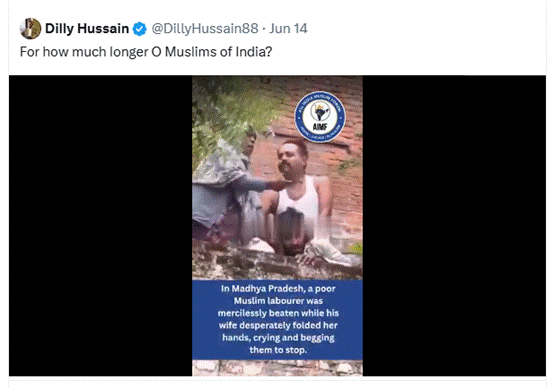
Link
Dilli Hussain shared a video showing a man being assaulted and claimed that “A poor Muslim labourer in Madhya Pradesh was brutally beaten while his wife pleaded with folded hands, begging the attackers to stop.”
Fact Check
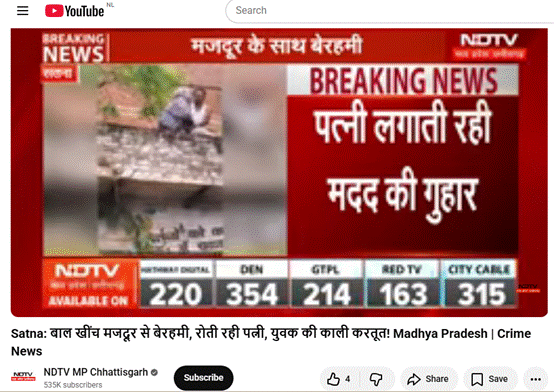
Our investigation found that the viral video was from Satna, Madhya Pradesh. However, the victim was not a Muslim, but a member of the Dalit community. According to reports by NDTV MP-Chhattisgarh and Dainik Bhaskar, the incident occurred while labourer Dheeru Chaudhary was repairing the roof of a bookshop at the Nagod bus stand. He was allegedly assaulted, dragged by his hair, and forced to kneel. During the assault, his wife repeatedly pleaded with the attackers to spare him. Police subsequently registered a case under the Scheduled Castes and Scheduled Tribes (Prevention of Atrocities) Act.
7.2 Fact Check: Saharanpur Incident Shared with a Misleading Communal Narrative
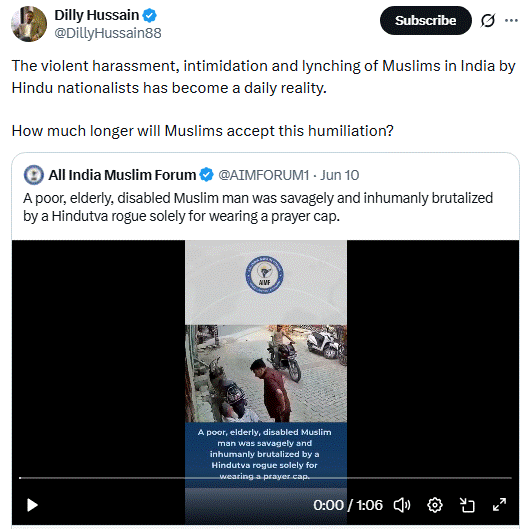
Link
Dilli Hussain shared a video showing a young man assaulting an elderly individual and claimed:«”A poor, elderly, disabled Muslim man was brutally and inhumanely assaulted by a Hindutva extremist simply because he was wearing a prayer cap.”He further wrote:”Harassing, intimidating, and lynching Muslims by Hindu nationalists has become a daily reality in India. How long will Muslims continue to tolerate this humiliation?”
Fact check
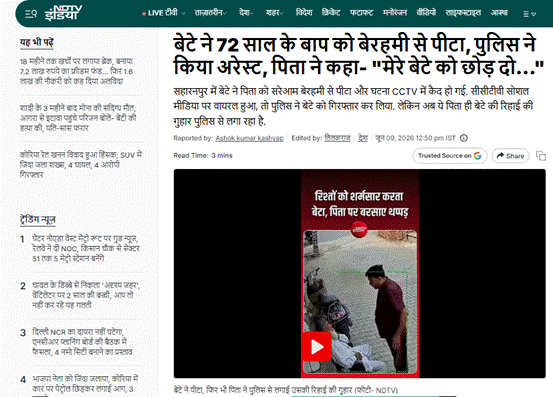
Our investigation established that the incident took place in Saharanpur, Uttar Pradesh. According to NDTV India, CCTV footage captured a domestic dispute in which Gulfishan assaulted his father, Haji Tahseen, following an argument. The video showed the son slapping and attempting to choke his father. Reports indicated that the assault stemmed from a family dispute and was unrelated to religion or communal violence.
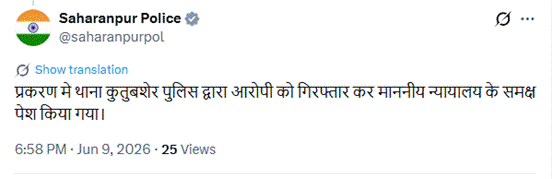
The Saharanpur Police also confirmed that the accused had been arrested and produced before the court. Police stated that the accused was suffering from mental health issues. They further informed us that the father and son had since reconciled, although legal action for breach of peace had been initiated against the accused
7.3 Fact Check: Misleading Claim About Assault on a Muslim Boy Returning from School
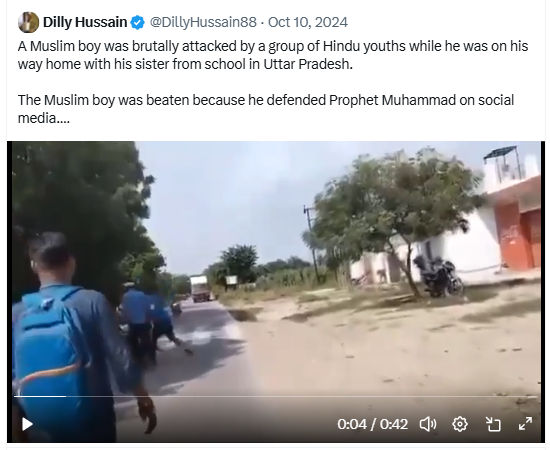
Dilli Hussain shared a video showing a young man being assaulted in the middle of a road and claimed:”A Muslim boy in Uttar Pradesh was brutally attacked by a group of Hindu boys while returning home from school with his sister. He was assaulted because he had defended Prophet Muhammad on social media. The attackers also assaulted his sister.”
Fact check
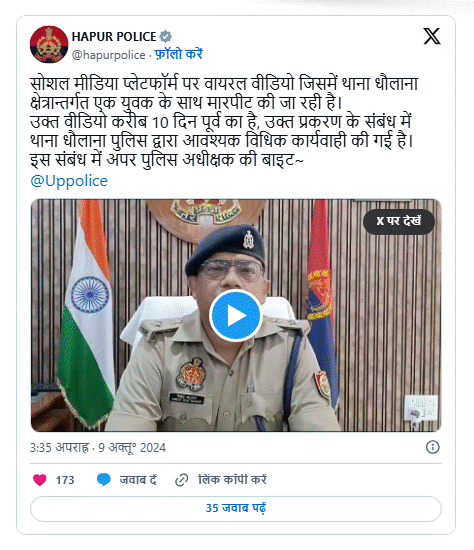
Our investigation found this claim to be misleading. According to Vineet Jaiswal, Additional Superintendent of Police, Hapur, a complaint had been registered on 28 September alleging that a young man from another community had lured and sexually assaulted a girl. Following the police investigation, the accused was arrested and sent to jail. The viral video actually showed the accused being assaulted by the girl’s relatives and was unrelated to the communal narrative presented in the social media claim.
Conclusion:
DFRAC’s analysis indicates that Dilly Hussain is not merely a journalist but also an influential digital figure with a significant role in shaping discourse on issues concerning Muslims at the international level. Through digital media, he has been able to amplify his views on Muslim-related issues to a global audience.With regard to India, his content extends beyond conventional reporting on issues such as Muslims, Kashmir, Hindutva, religious freedom, Islamophobia, and the rights of minorities and Dalits. Instead, his reporting frequently incorporates a distinct ideological perspective. Within this framework, local developments are often contextualized within broader international narratives, presenting them as part of wider debates concerning Muslim rights, religious freedom, and global political issues.