Executive Summary
This report presents DFRAC’s investigation into the social media activity of Riddhima Sharma, an Instagram-based influencer who has accrued a significant following through content focused on religion, Hindu nationalism, cultural identity, and political commentary. The account was created in February 2024 and has grown rapidly, gaining visibility through associations with senior members of India’s ruling party.
DFRAC’s analysis identified five recurring patterns across the account’s content: communal framing of political and social events; religious identity mobilization; emotional amplification; selective contextualization; and partisan political messaging. Taken individually, many of these elements reflect legitimate forms of political and ideological expression. However, their systematic combination — particularly the consistent framing of political developments through a Hindu-Muslim binary — carries a measurable risk of deepening social divisions and contributing to online radicalization.
This report documents specific examples of each pattern with supporting evidence and assesses their potential impact on public discourse and social cohesion.
1. Introduction
Among India’s growing ecosystem of online political influencers, Riddhima Sharma has emerged as a recognizable figure within right-wing digital spaces. Through a consistent stream of reels, short-form commentary videos, and event-based content, she has cultivated a substantial and engaged audience on Instagram.
DFRAC examined publicly available content associated with Riddhima Sharma’s social media presence to:
- Understand the narratives promoted through her platforms;
- Identify recurring content patterns and communication techniques;
- Assess their potential impact on online discourse and social cohesion.
This report draws exclusively on publicly available material and does not make claims beyond what the content itself evidences.
2. Profile Overview
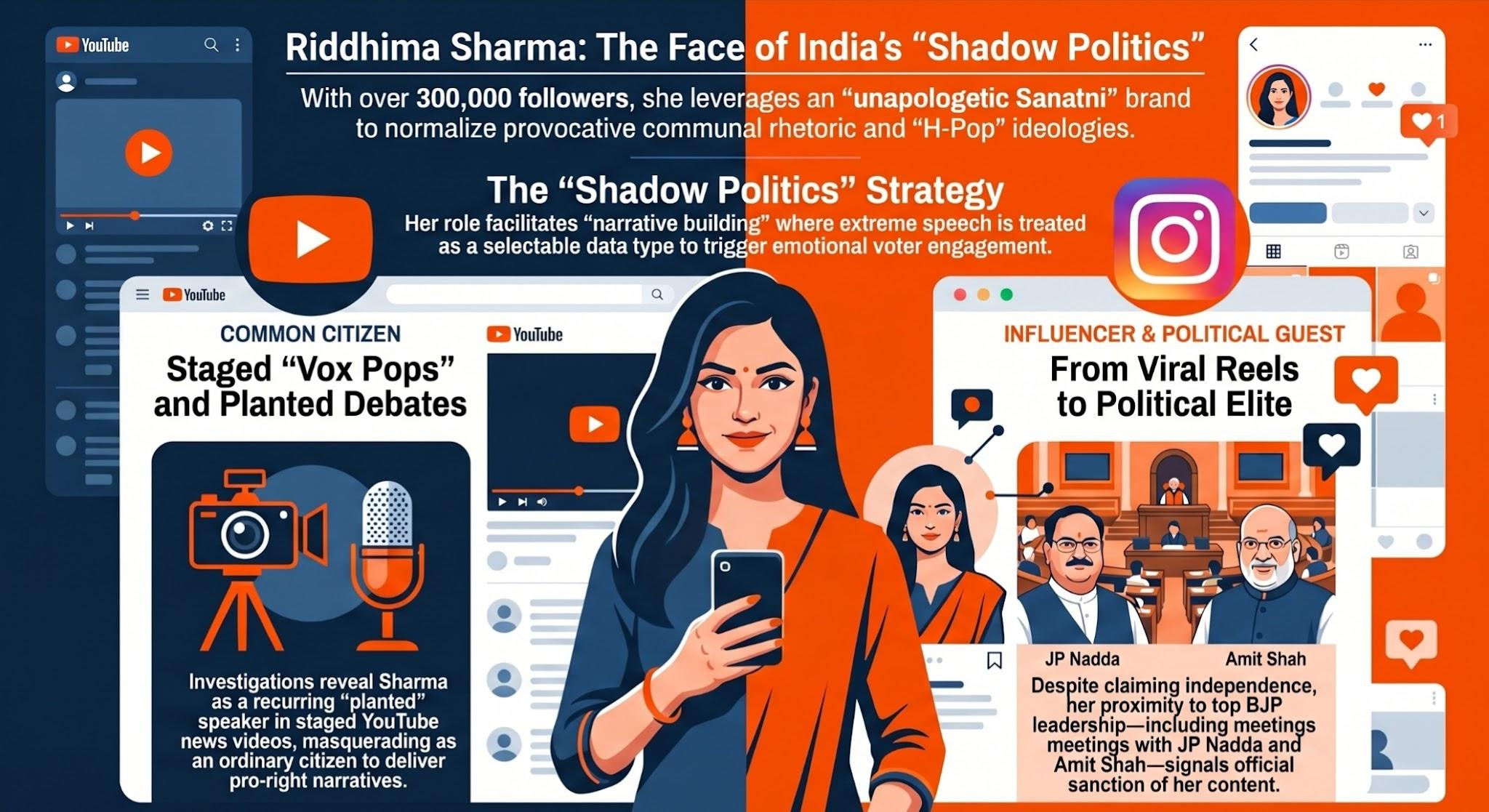
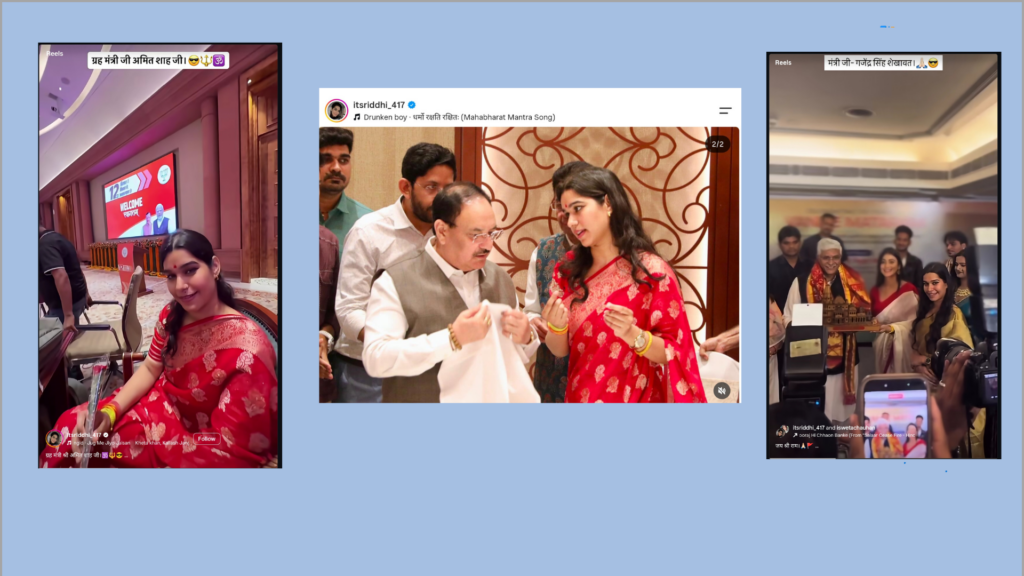
Riddhima Sharma is primarily active on Instagram, which serves as her principal platform for audience engagement and content dissemination. Her content regularly features appearances at political gatherings attended by prominent leaders, including BJP National President J.P. Nadda and Union Home Minister Amit Shah. These associations have significantly elevated the account’s political visibility and contributed to rapid audience growth.
The account demonstrates a structured and deliberate communication strategy, with consistent posting frequency, curated use of emotionally engaging captions, and strategic deployment of religious, nationalist, and political hashtags.
3. Recurring Narrative Patterns
DFRAC’s review identified five principal recurring themes and communication techniques across the account’s content.
3.1 Communal Framing of Social and Political Issues
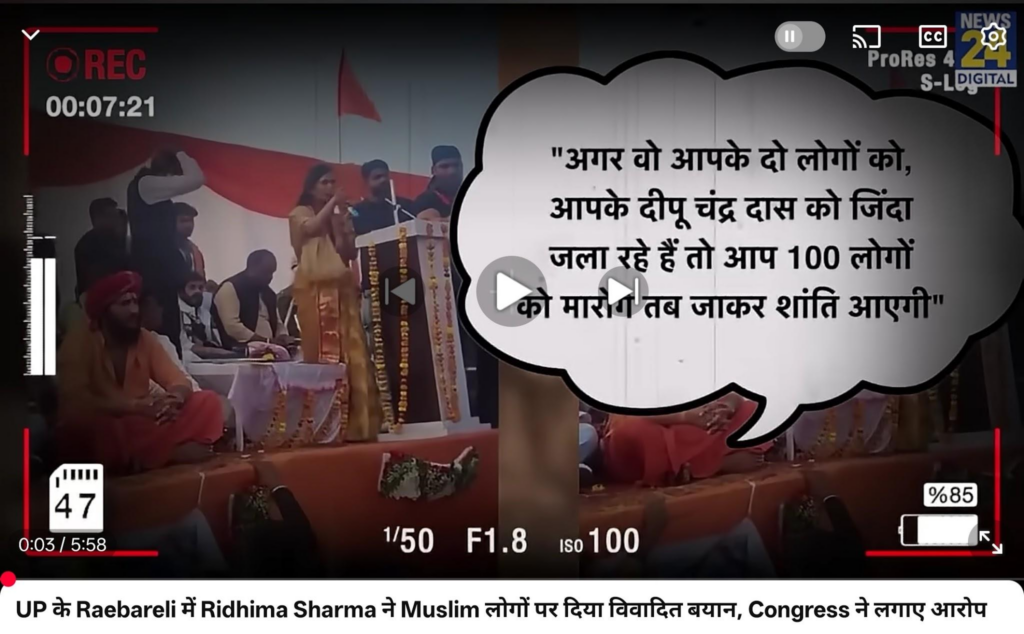
A significant portion of the content examined presents social, legal, and political events through an explicit Hindu-Muslim framework. Complex public controversies are routinely reduced to binary communal narratives, encouraging audiences to interpret public life primarily through the lens of religious identity. This pattern is one of the most consistent features of the account.
Example: As per News 24 broadcast Sharma can be seen stating: “”Agar woh tumhare do logon ko maarte hain, toh tum unke 100 logon ko maaro,” aur “Agar woh ek Hindu behen ko le jaate hain, toh tum unki 100 behnon ko bhagao.”
Such framing reinforces existing social divisions and may encourage followers to evaluate public events not on their merits but through the prism of religious identity.
3.2 Religious Identity Mobilization
There are posts that emphasize narratives of threat to Hindu identity, traditions, and cultural heritage. While the expression of religious beliefs is a legitimate aspect of democratic discourse, repeated portrayals of a community as perpetually under threat can function as a mechanism of grievance-based mobilization
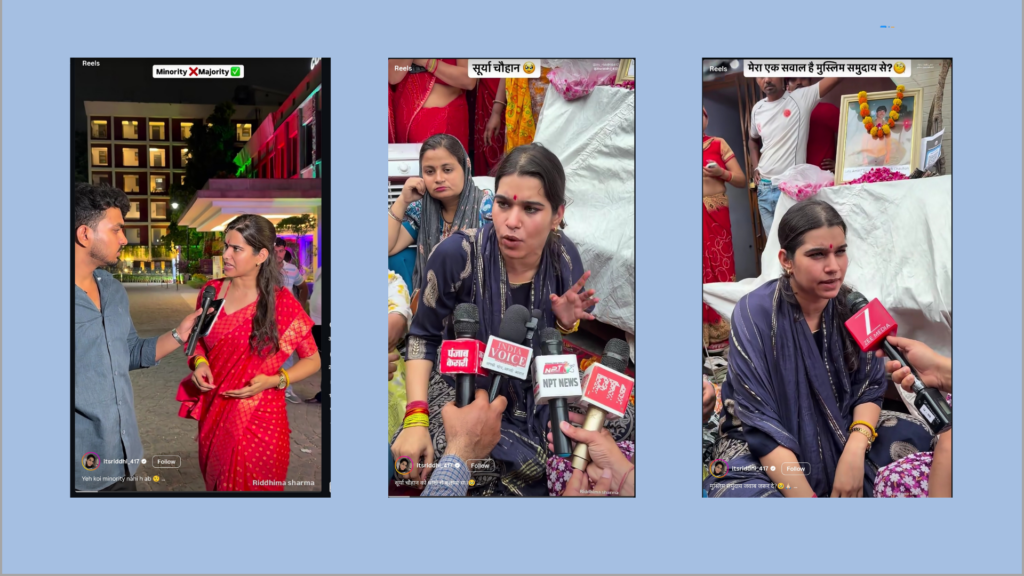
Example: Following the murder of Surya, Sharma visited the victim’s family home and made statements in a media interaction that attributed criminality to the Muslim community as a whole. She stated: “What are their children learning in madrasas? They get bombs and grenades from madrasas.” She further contrasted Hindu and Muslim households, claiming that Hindu homes do not possess weapons while Muslims keep sharp knives capable of killing people.
In a separate media interaction, Sharma used derogatory language to question Muslims’ minority status, stating: “They are not minorities; they are even more than goats. They are equal to us (Hindus) in numbers. They have taken all the benefits by presenting themselves as minorities.”These statements constitute blanket generalizations about an entire community and deploy dehumanizing language, moving beyond religious advocacy into content that may incite hostility toward a minority group.
3.3 Emotional Amplification and Engagement-Driven Content
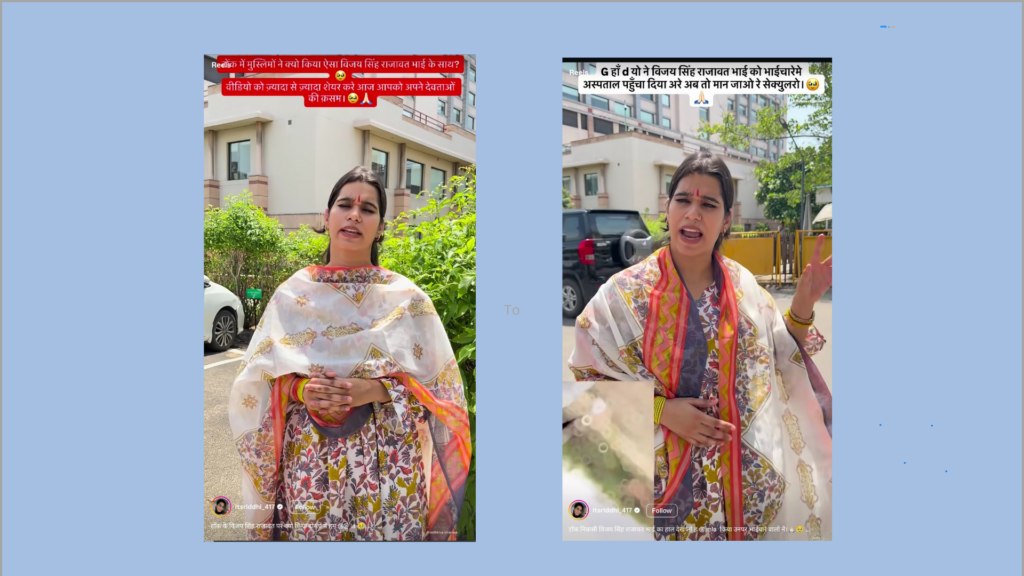
The account frequently employs emotionally charged language, dramatic visual presentation, and provocative framing techniques. Content designed to evoke strong emotional responses — including anger, fear, outrage, and indignation — consistently attracts higher engagement. This reflects broader trends in social media ecosystems, where algorithmic incentives reward emotionally stimulating content over informational or analytical material. Example: In a video following an alleged attack on Vijay Singh Rajawat, Sharma addressed Hindus directly using communal rhetoric: “Hinduon, tumhara khoon kab kholega? In jihadiyon ne chaakuon se hamare Vijay Singh Rajawat par hamla kar diya… Waise bhi Hinduon ke marne-jeene se Hinduon ko koi fark nahi padta, kyunki bhaichaare ki ghutti jo pi rakhi hai.” [“Hindus, when will your blood boil? These jihadis attacked our Vijay Singh Rajawat with knives… Hindus don’t care about the lives of Hindus anyway, because they have been fed the milk of false brotherhood.”] This framing positions fellow Hindus as dangerously passive in the face of threat, and labels the alleged attackers using religiously charged terminology.
3.4 Selective Context and Information Framing
Several posts reviewed during the investigation appeared to emphasize selected aspects of events while omitting contextual information that would complicate the narrative. While not all such content constitutes misinformation in a strict definitional sense, the consistent omission of context has the practical effect of skewing audience understanding toward specific ideological conclusions.
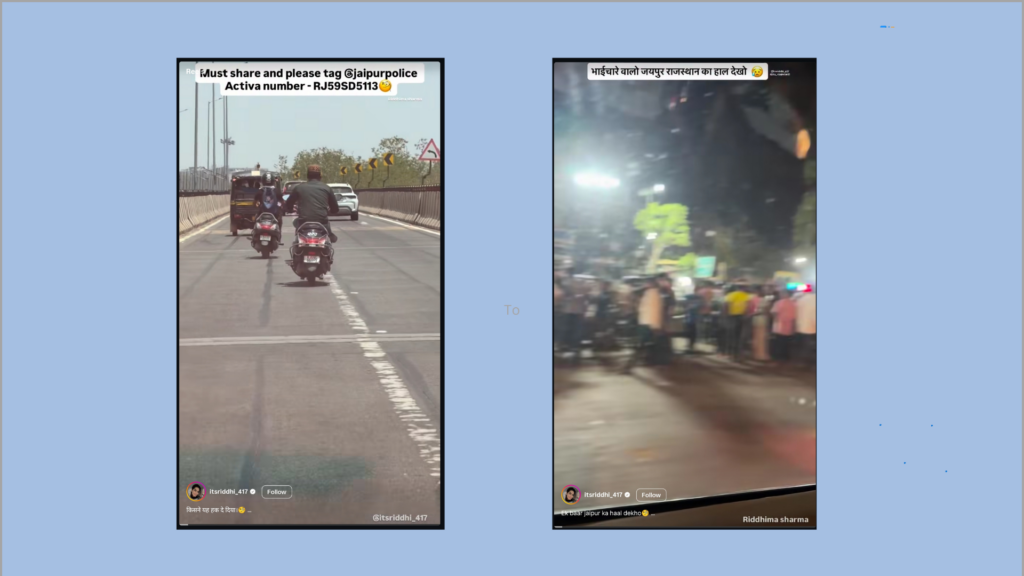
Example: In a video filmed at a crowded location in Jaipur, Sharma stated: “You may think this is Bangladesh, Pakistan, or some Islamic country, but this is Jaipur, and look at the crowd here. They are being given complete protection and effectively have a licence to slaughter voiceless animals. Some people are still living under the misconception that Hindu women and girls can safely pass through these areas.” The video provides no corroborating evidence for claims of criminality or danger, relying instead on visual association between Muslim presence and implied threat.
In another video, Riddhima Sharma is seen recording a man riding a scooter without wearing a helmet. During the recording, she points the camera toward the individual and makes derogatory remarks while questioning how he had been allowed to ride without a helmet.
3.5 Political Polarization and Partisan Messaging
The account regularly expresses support for right-leaning political viewpoints while criticizing ideological opponents. Political advocacy is a protected and legitimate form of expression. However, when political disagreements are systematically framed as civilizational or religious conflicts rather than policy differences, the risk of broader social polarization rises substantially.
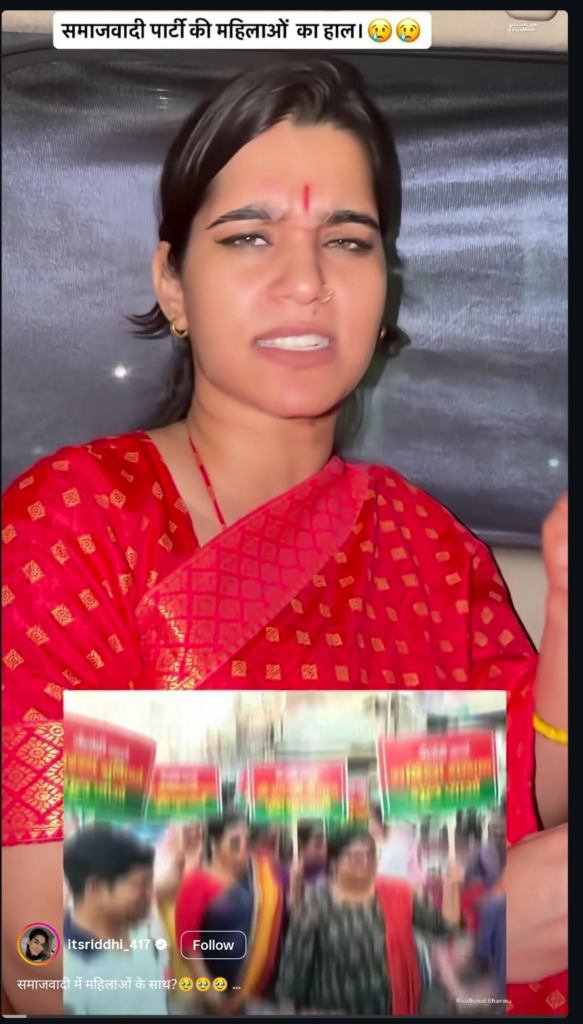
Example: In one video, Sharma referred to Samajwadi Party leader Akhilesh Yadav using the derogatory epithet “Maulana Akhilesheshudin” — invoking a Muslim religious title as a form of political mockery. She added: “Jo ‘Maulana’ Akhilesh Yadav apni biwi ka samman nahi bacha paya, woh kis haisiyat se naari samman ki baat kar raha hai?” [“The ‘Maulana’ Akhilesh Yadav, who could not protect his own wife’s dignity, in what capacity is he talking about women’s dignity?”] This conflates political opposition with religious identity, reducing a policy debate to a communal caricature.
4. Potential Impact on Online Discourse
Influencers with large and engaged audiences play an increasingly significant role in shaping public opinion and digital discourse. The narratives promoted through an account of this reach can meaningfully influence how followers perceive social groups, interpret political developments, and respond to public controversies.
The potential impacts of the content patterns identified in this report include:
Reinforcement and normalization of communal interpretations of public events;
Escalation of perceived inter-community threat, contributing to defensive hostility;
Displacement of civic and policy-based political discourse by identity-based grievance framing;
Creation of an online atmosphere that may facilitate offline intimidation or violence.
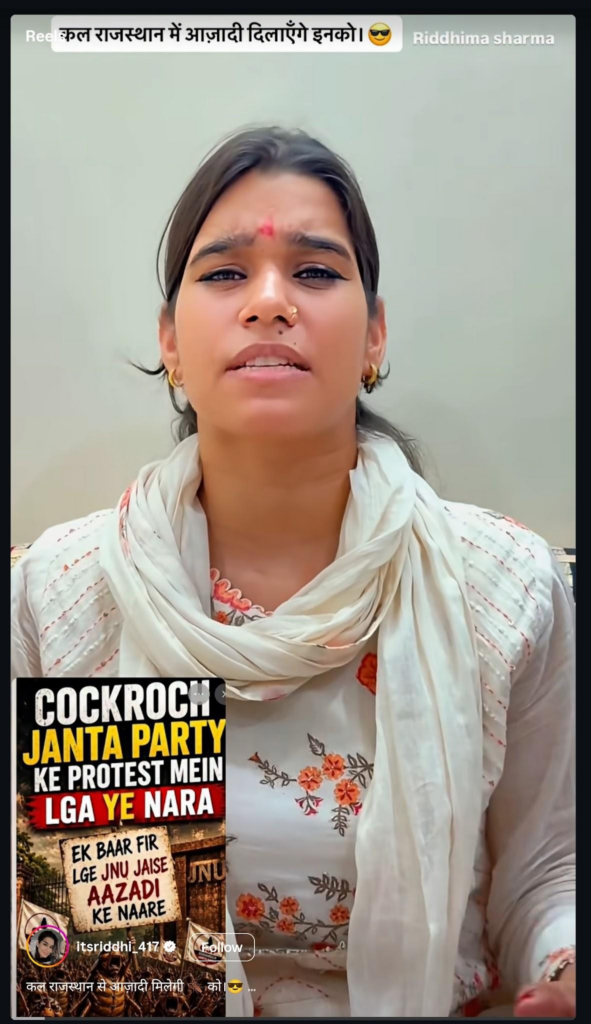
Example: During a protest in Jaipur, Sharma used her social media platform to urge local followers to “teach a lesson” to Abhijeet Dipke, founder of Citizens for Justice and Peace (CJP). Reports subsequently surfaced that Dipke had been physically attacked. While available evidence does not establish a direct causal connection between the online messaging and the assault, the incident illustrates how targeted digital campaigns, particularly those using emotionally charged, incitement-adjacent language directed at named individuals, can contribute to a climate of hostility in which real-world harm becomes more likely.
5. Conclusions
DFRAC’s investigation into Riddhima Sharma’s digital presence found that she has established a substantial and rapidly growing social media following through content focused on religion, nationalism, cultural identity, and socio-political commentary. The analysis identified recurring patterns of communal framing, religious identity mobilization, emotional amplification, selective contextualization, derogatory characterization of minority communities, and partisan political messaging. Rather than representing isolated incidents, these themes recur across multiple pieces of content, collectively constructing a narrative that frequently interprets political and social developments through a Hindu-Muslim binary
Note: As of the publication of this report, the Instagram account is no longer active.