Wars are not fought only on borders; in the modern era, social media has become a new battlefield where mobile phones, computers, and the internet have replaced bullets and gunpowder as the biggest weapons. In this war, lines of soldiers are not visible; instead, information, images, videos, and posts appearing on screens serve as weapons. The biggest challenge of this kind of information warfare is that ordinary social media users often do not even realise when they have become part of a well-planned propaganda campaign. The posts they share, repost, or quote-post thinking they are just ordinary information can often be part of a broader digital campaign designed to push a specific narrative. Such content is presented in a way that appears normal, credible, and factual at first glance, but digging deeper reveals a well-planned effort to establish a specific mindset and perception.
The strategy of information warfare is not limited to spreading fake news. Often, real events are presented using selective facts, incomplete contexts, emotional language, and constantly repeated narratives to strengthen a specific agenda. In the Indian context, states like Manipur, Kashmir, and Punjab have long been major hubs of information warfare, where even routine incidents are presented under a specific agenda. The uniform terminology, similar claims, identical framing, and constantly repeated propaganda narratives in this content indicate that these are not just organic reactions in the digital space, but organized efforts to project a massive impact.
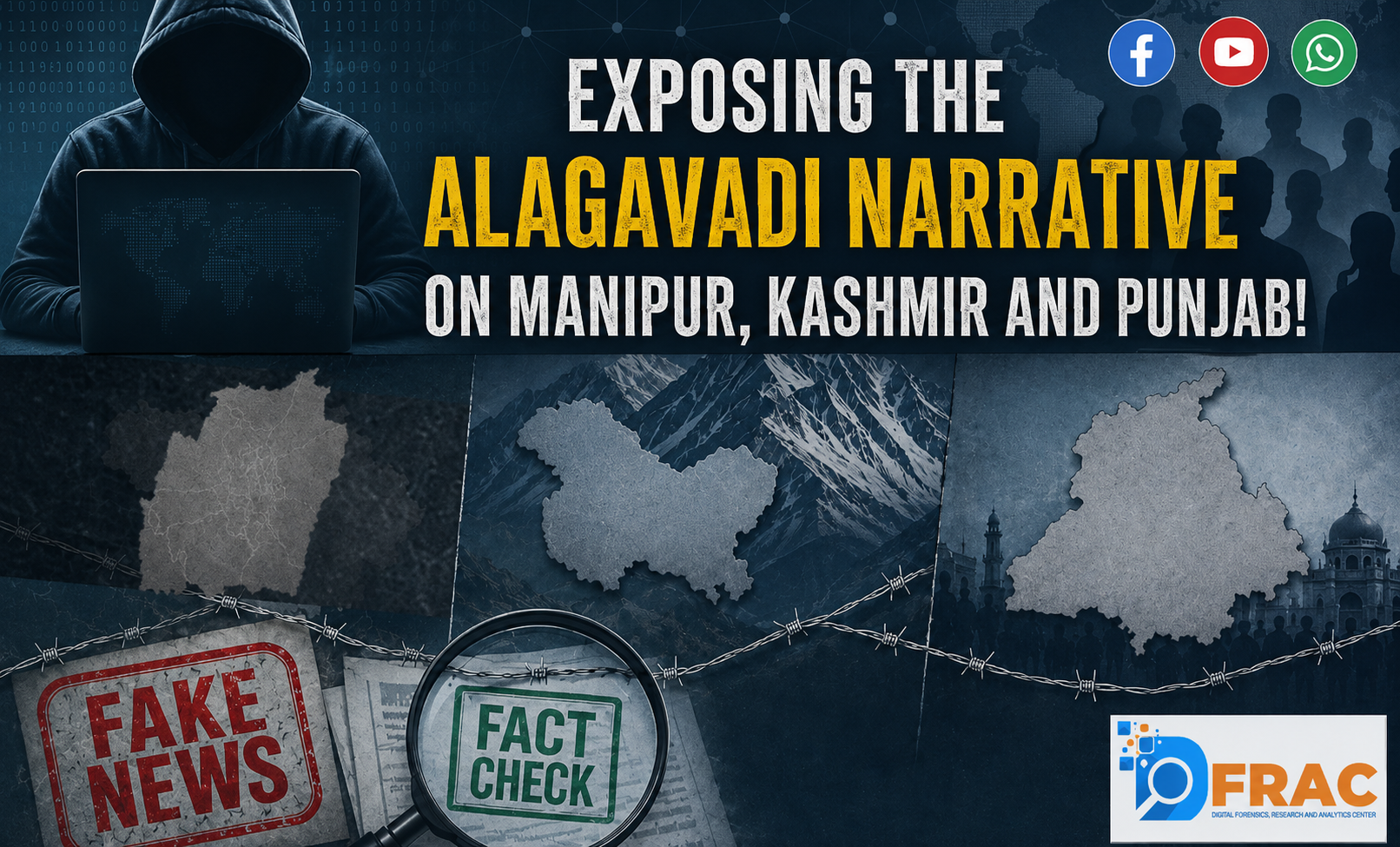
This special report by DFRAC presents an analysis of the activities of 11 such social media accounts. The report examines these accounts’ posting trends, shared content, key narratives, and digital activity patterns. Here are the key highlights of this report:
- Active users in digital propaganda
- Where are these accounts operated from?
- Indian Government action: Withheld and banned accounts
- Analysis of propaganda and narratives on Manipur
- Separatist narratives on Kashmir and Punjab
- Content analysis of propaganda users
- Fact-check of fake and misleading claims
1. Active users in digital propaganda
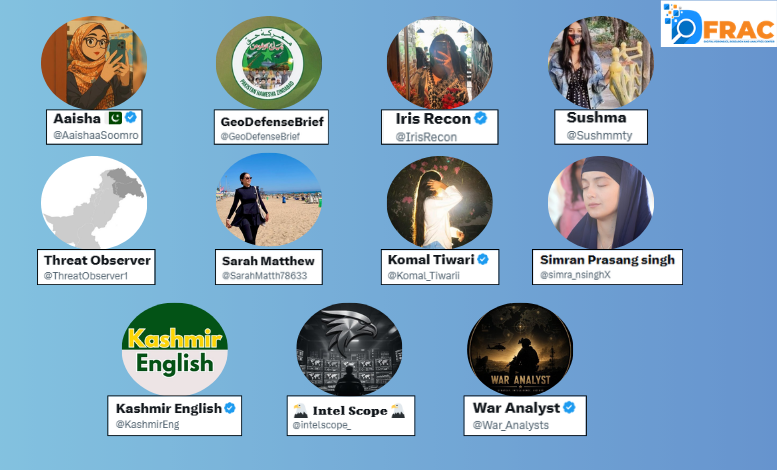
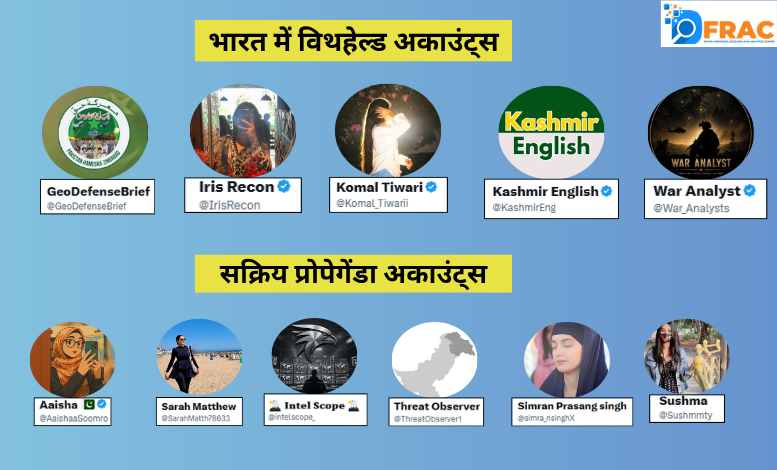
The 11 social media users involved in this digital propaganda network are active under various names and identities. These include accounts like AaishaaSoomro, GeoDefenseBrief, IrisRecon, ThreatObserver1, Sushmmty, SarahMatth78633, Komal_Tiwarii, simra_nsinghX, KashmirEng, intelscope_, and War_Analysts.
2 Where do these accounts operate from?
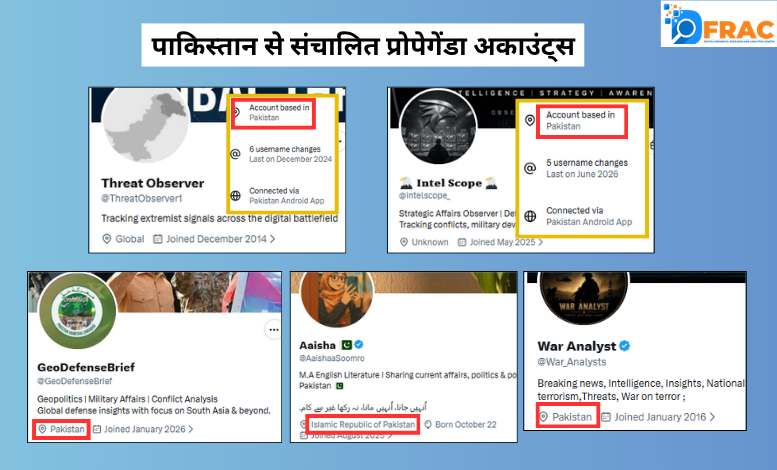
To understand any digital propaganda network, merely analyzing its content is not enough; it is also crucial to know what information the concerned accounts themselves share about their identity and location. Public information available on the social media platform X (formerly Twitter)—such as profile descriptions, About Sections, account locations, and connected devices—is vital for understanding a network. During our analysis, we examined the available profile information of these 11 accounts. The investigation revealed that while some accounts stated their location directly as Pakistan, several others mentioned India or other countries in their profiles, but their About Sections displayed indications linked to the South Asia region.
Propaganda operates from Pakistan:
We found that GeoDefenseBrief, AaishaaSoomro, ThreatObserver1, Intelscope, and War_Analysts are accounts whose public profile information indicates a connection to Pakistan. Among these, GeoDefenseBrief, AaishaaSoomro, and War_Analysts have directly mentioned Pakistan or the Islamic Republic of Pakistan in their profile locations. Meanwhile, the about sections of the ThreatObserver1 and Intelscope accounts display ‘Account based in Pakistan‘.
Propaganda handles showing signs of South Asian connection:
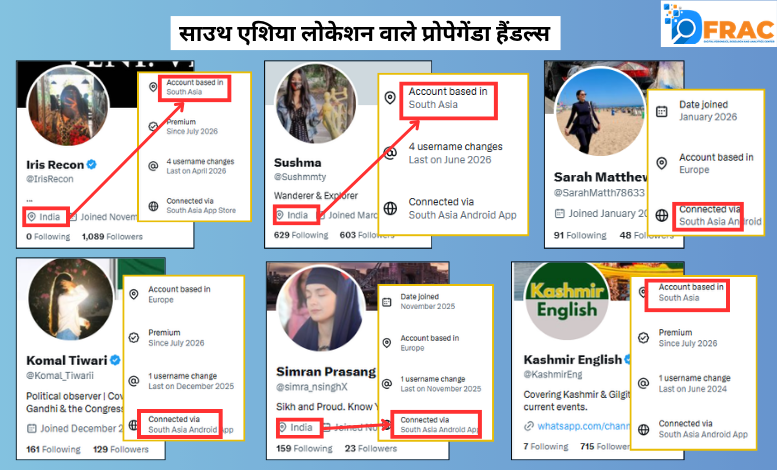
Iris Recon, Sushma, Sarah Mathew, Komal Tiwari, Simran Prasang Singh, and Kashmir English are accounts whose profiles mention India, Europe, or other locations. However, an analysis of the public information available in the “About Section” of these accounts reveals indicators such as “Account based in South Asia” or “Connected via South Asia Android App.“
For example, Iris Recon and Sushma have listed “India” in their profile locations, but their account details display South Asia-based information. Similarly, despite Komal Tiwari, Sarah Mathew, and Simran Prasang Singh mentioning Europe or India in their profiles, their “About Section” shows information indicating they are connected via the South Asia Android App. Meanwhile, “Account based in South Asia” is also displayed on the Kashmir English account.
3. Government of India’s Action: Accounts Withheld and Banned
The Government of India has been issuing necessary directives to social media platforms from time to time regarding matters related to national security, public order, and law and order. In this context, action was taken against several such accounts, which have been withheld in India. An analysis of these 11 accounts revealed that while some of these accounts are withheld in India, several other accounts are still active.
Accounts Withheld in India:
Geo Defense Brief, Iris Recon, Komal Tiwari, Kashmir English, and War Analyst are accounts that have been withheld in India. These accounts are unavailable in compliance with the legal demands of the Government of India.
Still Active Propaganda Accounts:
We found that Aisha, Sarah Matthew, Intel Scope, Threat Observer, Simran Prasang Singh, and Sushma are accounts that remain active on the X platform at the time of writing this report. These accounts maintain their activity on various issues related to India through regular posts, reposts, and quote posts.
4. Analysis of Propaganda and Narratives on Manipur
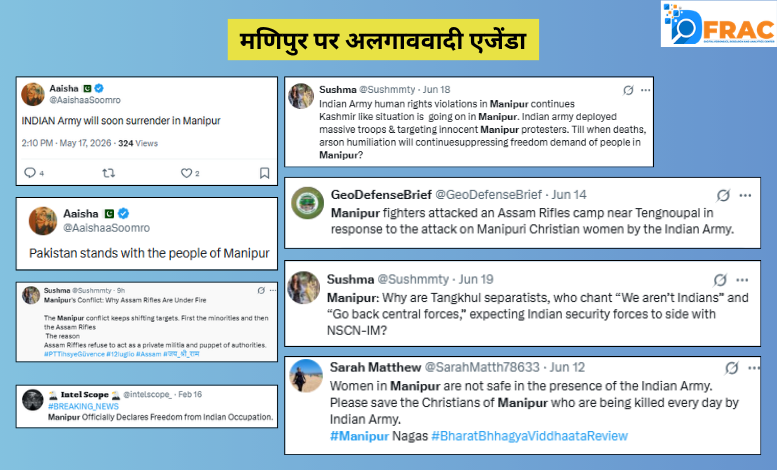
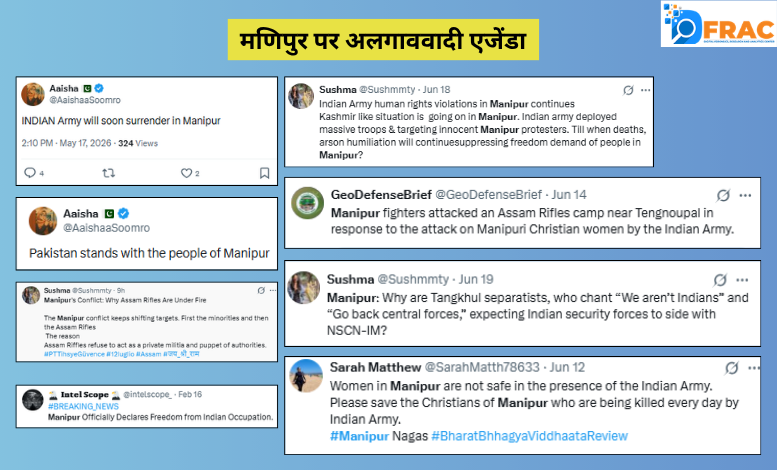
Analysis of content related to Manipur revealed that several social media accounts do not simply present the state’s incidents as law and order issues; rather, they consistently attempt to frame them under a specific narrative. These posts level serious allegations against the Indian security forces and government institutions, and incidents are presented in a way designed to create an atmosphere of distrust in India’s constitutional and administrative systems. The analysis of such narratives is as follows:
Narrative-1: Attempt to Portray the Indian Army Against Citizens
Several accounts prominently circulated allegations that the Indian Army is taking action against citizens, particularly women and the Christian community. By portraying the army’s role in a negative light, these posts make claims that appear aimed at breeding distrust towards the security forces and associating them with human rights violations.
Narrative-2: Portraying Manipur as an Indian-Occupied Territory
Some posts referred to Manipur using terms like “Indian Occupation.” This framing attempts to depict Manipur as an alleged occupied territory rather than an integral part of India. This type of narrative provides an ideological basis to separatist discourse.
Narrative 3: Framing as Religious Persecution
Many posts attempted to portray the situation in Manipur as organized action against the Christian community, rather than a regional conflict. The objective of this framing is to center religious identity on [narrative cuts off in original text].
5. Separatist Narratives on Kashmir and Punjab
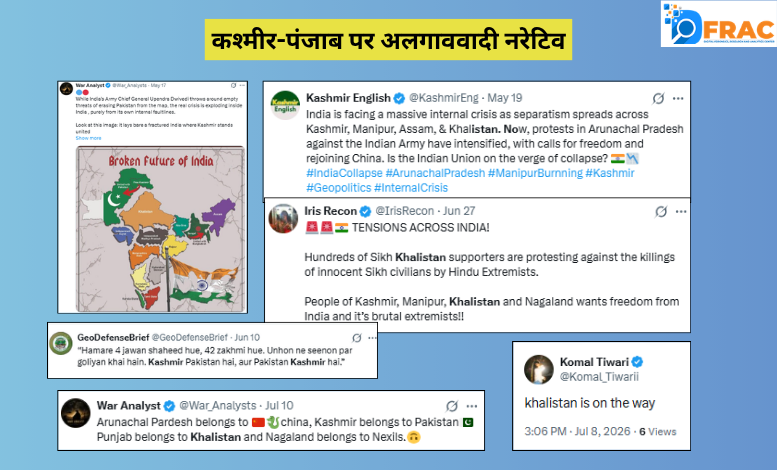
Content analysis of social media accounts reveals that narratives regarding Kashmir have been continuously propagated in an attempt to question India’s sovereignty and constitutional status. Some posts directly shared claims such as “Kashmir belongs to Pakistan.” Along with this, an attempt was made to present a picture of widespread instability in India by linking Kashmir with other sensitive regions like Manipur, Punjab, Assam, and Nagaland.
The analysis also highlighted that certain accounts portrayed India as a country grappling with internal crises, attempting to convey the message that separatist movements are emerging simultaneously across various states. In many posts, the visualization of India’s fragmentation was presented using maps, graphics, and symbolic imagery.
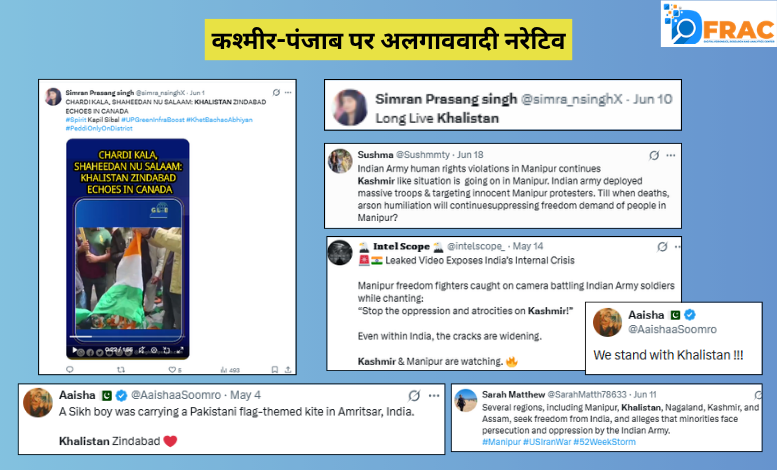
The study of content related to Punjab revealed that several accounts prominently propagated a pro-Khalistan narrative. Some posts shared messages like “Khalistan Zindabad”, “Long Live Khalistan”, and “We stand with Khalistan”. Furthermore, some posts used visuals and symbols that appeared to aim at encouraging pro-Khalistan sentiments and presenting separatist ideology as normal political expression.”
6. Propaganda Users’ Content Analysis:
Content analysis of these social media accounts reveals that the digital activities of most accounts are centered around sensitive issues like Manipur, Kashmir, and Punjab. These accounts regularly promote content through posts, reposts, and quote posts, which prominently highlight India’s internal security, social tensions, and political events.
| User | Platform | Content Activity | Analysis/ Network Impact |
| AaishaaSoomro | @AaishaaSoomro | Sharing posts, reposts, and quote posts related to sensitive issues in India, particularly those concerning Manipur, Kashmir, and Punjab. | An account that actively amplifies narratives around controversial issues related to India. Its content exhibits thematic similarities with that of other similar accounts. |
| GeoDefenseBrief | @GeoDefenseBrief | Sharing India-centric controversial content alongside posts related to geopolitics, defense, and national security. | Attempts to lend credibility to specific narratives while maintaining consistent activity around sensitive events. |
| Iris Recon | @IrisRecon | Regularly posts and reposts content related to defense, conflicts, and India-related developments. | An account that advances specific narratives by adopting the style of military and security analysis. |
| Threat Observer | @ThreatObserver1 | Posts related to conflicts, military activities, and India’s internal issues. | Attempts to make its content appear more credible by projecting an image of security and intelligence analysis. |
| Sushmmty | @Sushmmty | Regularly shares posts and quote posts related to Manipur, Kashmir, and other political issues. | An active account that amplifies emotional and political narratives. |
| Sarah Matth | @SarahMatth78633 | Posts, reposts, and reactions related to controversial issues concerning India. | Actively amplifies content from other similar accounts and plays an active role in the dissemination of specific narratives. |
| Komal Tiwarii | @Komal_Tiwarii | Shares posts related to political developments and sensitive issues concerning India. | An account that contributes to narrative-building through ideological framing. |
| simra_nsinghX | @simra_nsinghX | Posts and reposts related to Punjab and political developments. | A posting pattern primarily focused on Punjab. |
| KashmirEng | @KashmirEng | Kashmir-focused posts covering human rights, security, and political developments. | Attempts to build and promote narratives centered on the Kashmir issue. |
| intelscope_ | @intelscope_ | Shares posts related to defense, intelligence, and military developments. | An account that presents sensitive events through a specific framing by adopting the style of security analysis. |
| War_Analysts | @War_Analysts | Posts related to war, national security, and developments concerning India. | An account that disseminates controversial narratives under the guise of defense and security analysis. |
7. Fake and Misleading Information:
In an information war, the most effective weapons are not just fake news, but also half-baked facts, videos taken out of context, old photographs, and propaganda prepared with misleading claims. Here, we are providing a fact check for many such pieces of fake and misleading information.
Fake and Misleading News -1 :
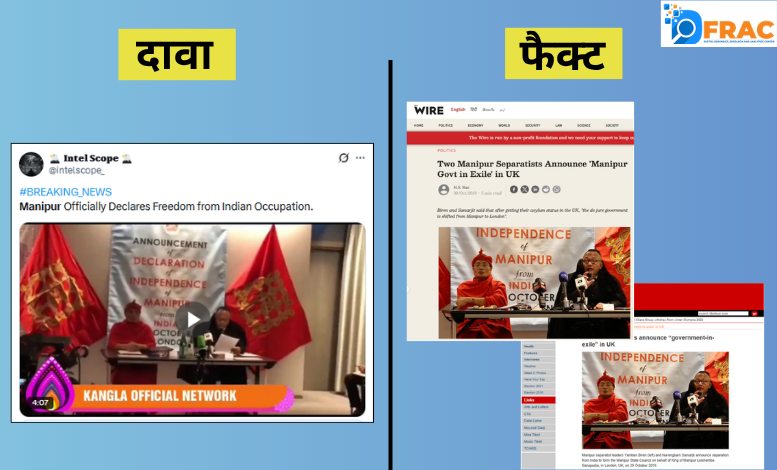
Regarding a post about Manipur, it is claimed that Manipuri leaders have officially declared independence from India following alleged human rights violations by the Indian Army. In our fact check, we found that the viral video is not linked to current events. This video is from the year 2019 and is unrelated to the recent violence.
Fake and Misleading News-2:
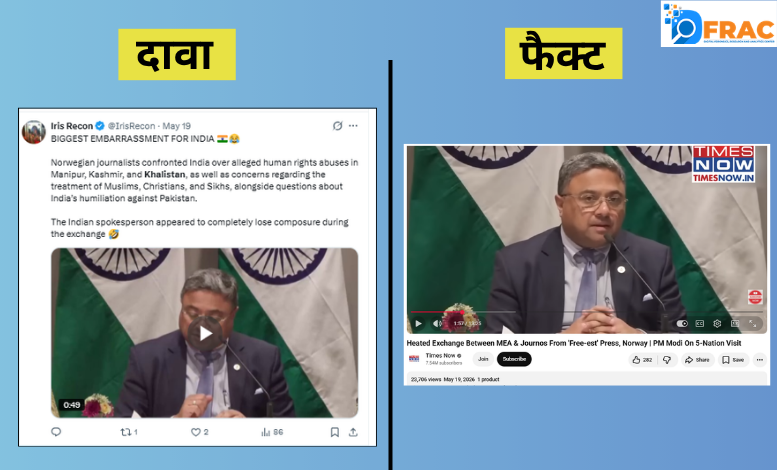
A post claimed that Indian diplomats were questioned about human rights regarding Manipur, Punjab, and Kashmir in Norway. The fact check found this claim to be misleading. In the original video, the Norwegian journalist did not make any mention of Manipur, Kashmir, or Punjab.
Fake and Misleading News-3:
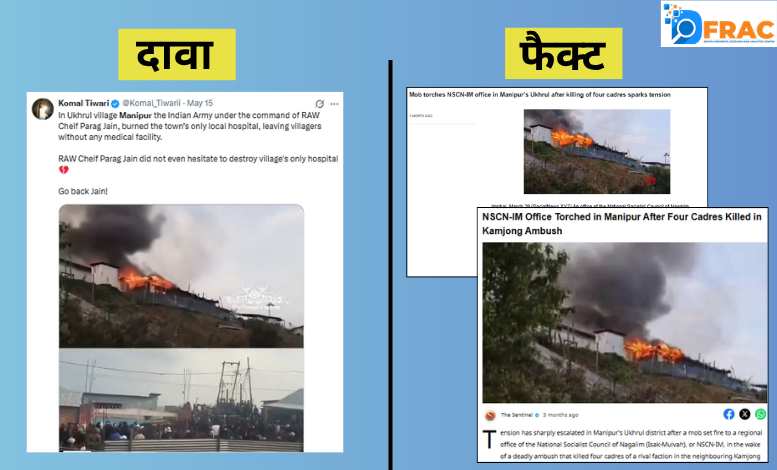
A post claimed that the Indian Army burnt down the only local hospital in Ukhrul, Manipur, and that army personnel are continuously burning houses. In a fact check, this claim was found to be misleading. In reality, the video being shared is old and is related to the NSCN-IM office that was set on fire in March 2026.
Fake and Misleading News-4:
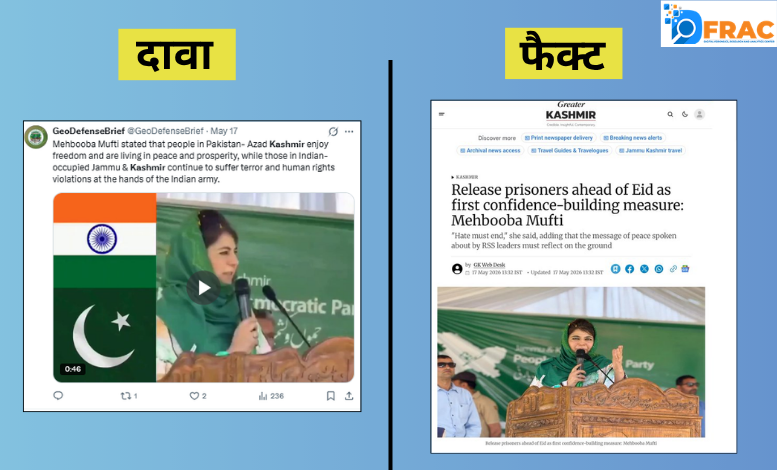
A statement by former Jammu and Kashmir Chief Minister Mehbooba Mufti was shared with the claim that she allegedly said Kashmir, Punjab, and Manipur should be liberated. In our investigation, we found this claim to be false and the viral video to be digitally altered.
Fake and Misleading News-5:
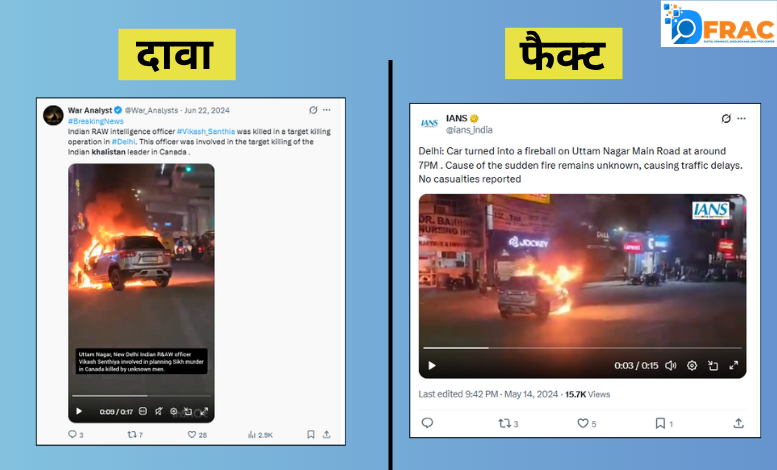
A video of a burning car was circulated with the claim that a RAW officer was targeted and killed in Delhi. A fact check found this claim to be misleading. In reality, the video shows a car fire incident in Delhi’s Uttam Nagar, and no casualties were reported in this incident.
Conclusion:
Analysis of the digital activities of these 11 social media accounts revealed that they are continuously active on sensitive issues in Manipur, Kashmir, and Punjab. An analysis of the accounts’ locations, posting patterns, content activities, and shared narratives clearly shows that these users have adopted Indian identities for propaganda purposes, even though they are operated from outside India.