The agitation over the NEET paper leak case continues at Jantar Mantar in Delhi, where protesters are demanding the resignation of Union Education Minister Dharmendra Pradhan. On July 20, protesters called for a march to Parliament, during which clashes broke out between the police and demonstrators. Numerous videos and images of the incident quickly went viral on social media, turning the issue into a widely discussed topic across digital platforms.
Such events often become opportunities for information warfare and misinformation campaigns, and the same pattern was observed in this case. Immediately after the clashes, social media was flooded with fake, misleading, and out-of-context content. False claims regarding the deaths of protesters were circulated, while other posts falsely alleged that a police officer had died during the protests. Many old and unrelated videos were also shared and falsely linked to the ongoing events in an attempt to create confusion.
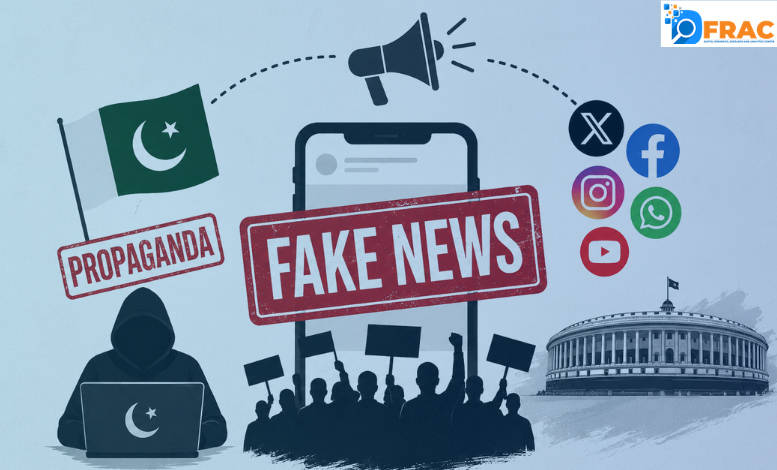
DFRAC’s analysis also revealed that several Pakistani social media handles played an active role in this disinformation campaign. These accounts not only spread unverified and misleading information but also attempted to portray India as a country facing anarchy, government oppression, military suppression, civil war, and the failure of democratic institutions. Rather than prioritizing factual information, these posts amplified inflammatory narratives to maximize their reach and influence. This pattern indicates that a domestic incident was exploited by foreign propaganda networks to advance their agenda and shape the digital narrative.
DFRAC’s report presents a detailed analysis of the fake and misleading claims spread by these Pakistani propaganda handles, their inflammatory narratives, and their coordinated digital activities. Among the prominent accounts identified are Zard Si Gana, Whistle Blower, Iris Recon, Pakistani Markhor, Intel Scope, and South Asia Rights Watch, all of which have consistently promoted propaganda related to Indian affairs.
Key Findings
- Fake statements falsely attributed to the Prime Minister and Union ministers were circulated on a large scale.
- AI-generated and digitally altered statements falsely attributed to senior Army and police officers were widely disseminated.
- Coordinated negative propaganda targeted the Indian Army.False narratives alleging clashes between the Indian Army and protesters were amplified.
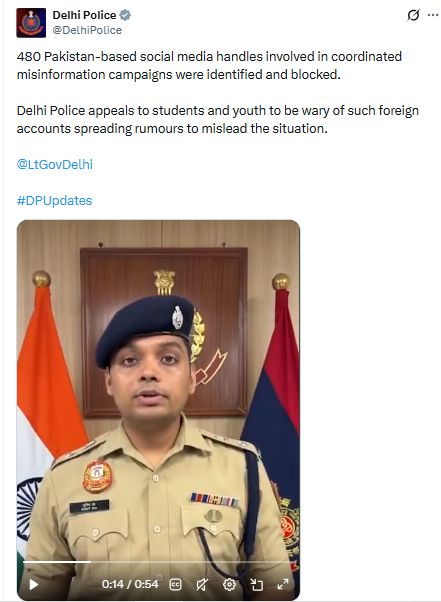
- Delhi Police took action against 480 Pakistan-based social media accounts
1. Fake Statements Attributed to the Prime Minister and Minister
DFRAC’s analysis revealed that Pakistani propaganda handles circulated multiple fake statements falsely attributed to Prime Minister Narendra Modi and senior Union government ministers in connection with the Delhi protests. Viral posts carried fabricated statements allegedly made by Prime Minister Narendra Modi, Defence Minister Rajnath Singh, Union Ministers Piyush Goyal and Kiren Rijiju, and Uttar Pradesh Chief Minister Yogi Adityanath. However, no evidence of any such statements exists in the public record.
For instance, one viral post falsely claimed that Prime Minister Modi had said, “If we leaked one paper, what problem do these students have? Does it make any difference?” DFRAC’s fact-check established that the Prime Minister had made no such statement.Similarly, another fabricated statement attributed to Union Defence Minister Rajnath Singh claimed, “If those students do not stop protesting, the entire power of the state will be used to end this protest, no matter the cost.” DFRAC found that this statement had been digitally fabricated.Pakistani propaganda accounts also circulated a fake statement attributed to Union Minister Piyush Goyal, claiming he had said, “We will hang two or three cockroaches so that the remaining cockroaches learn a lesson they will never forget. Just wait and watch.” Piyush Goyal’s team confirmed to DFRAC that he had made no such statement.Similarly, fake and digitally altered statements falsely attributed to Union Minister Kiren Rijiju and Uttar Pradesh Chief Minister Yogi Adityanath were also circulated in a highly provocative manner.
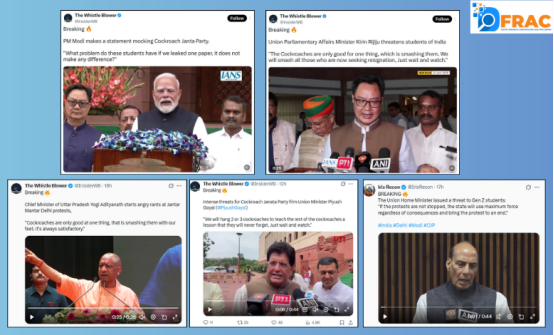
Fact check: 1,2,3,4
2.Flood of Fake Statements Attributed to Army and Police Officers
DFRAC’s analysis also found that during the protests at Delhi’s Jantar Mantar and the clashes between the police and demonstrators, numerous videos were circulated on social media. These included several videos falsely claiming that the police had used batons and tear gas against students.
Amid this highly sensitive environment, Pakistani propaganda handles appeared to execute a coordinated strategy to drag India’s security institutions into the controversy. These accounts circulated multiple AI-generated and digitally altered videos falsely attributed to senior officers of the Indian Army and the Delhi Police. The timing of these videos is particularly noteworthy. They were amplified precisely when discussions surrounding the Delhi protests and police action dominated social media, suggesting a deliberate attempt to intensify inflammatory narratives and exploit the prevailing public sentiment.
As part of this campaign, a video featuring senior Indian Army officer Lieutenant General Rajiv Puri was circulated, falsely portraying him as saying, “The government has ordered the Army to be deployed in Delhi and crush the protests brutally.” DFRAC’s fact-check found this claim to be entirely false. The investigation established that the video was AI-generated, with both the officer’s voice and the alleged statement being artificially created. No such official statement exists in the public record. The Indian Army’s Fact Check Unit also debunked the video and declared it fake.
Similarly, another video was circulated in the name of Delhi Police PRO Rajiv Ranjan, falsely depicting him as saying, “We support the protesters, but Home Minister Amit Shah has ordered us to carry out a lathi-charge.” DFRAC’s investigation revealed that the video had been digitally altered. The original footage was manipulated, and a fabricated audio track was inserted to create the misleading narrative.
The same pattern was observed in the case of Indian Air Force Chief Air Chief Marshal Amar Preet Singh. A video was shared on social media falsely showing him saying, “I am shocked and saddened by what is happening in Delhi and the way the current government is treating our students. Indian students are the backbone of our system. Gen Z is transforming the world at the global level.” DFRAC’s verification found this claim to be completely misleading. The audio and statement used in the video had been digitally altered, and the Air Chief Marshal has never made any such public remarks.
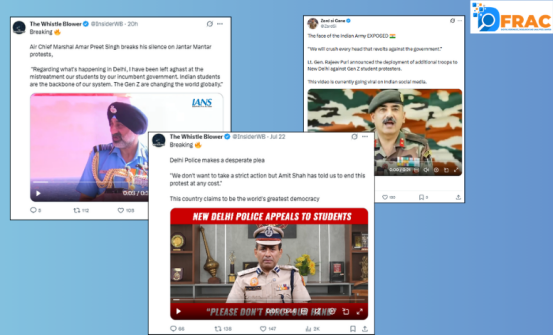
3.Negative Propaganda Targeting the Indian Army
DFRAC’s analysis clearly revealed that Pakistani propaganda handles carried out a coordinated disinformation campaign by linking the Delhi protests with the Indian Army. As part of this campaign, they promoted two contradictory yet equally misleading narratives about the Army.
The first narrative falsely claimed that the Indian Army had been deployed in Delhi to suppress the protests and was firing upon students and carrying out violent crackdowns against demonstrators. The second alleged that Indian Army personnel were dissatisfied with the government’s orders and had revolted in support of the protesting students. Although both claims were entirely baseless, they were disseminated extensively across social media platforms.
During the analysis, DFRAC found that several Pakistani handles repeatedly shared posts claiming that the Army had been called in to maintain law and order in Delhi and had opened fire on protesters. Some posts further alleged that Army personnel had brutally assaulted students and launched a forceful operation to crush the movement. These claims were accompanied by purported videos and images to make the false narratives appear credible and to instill fear, anger, and confusion among social media users.
However, DFRAC’s verification found the entire narrative to be false and misleading. Official information and an analysis of the sequence of events confirmed that the Indian Army was never deployed during the Delhi protests. Responsibility for maintaining law and order rested with the Delhi Police, the Central Armed Police Forces (CAPFs), and the Rapid Action Force (RAF). Therefore, all claims alleging that the Army opened fire on protesters, carried out baton charges, or participated in any action against demonstrators are entirely fabricated and without factual basis.
The second pattern of disinformation was equally deliberate. While one narrative portrayed the Army as an instrument of state repression, another attempted to depict Army personnel as rebelling against the government and joining the student movement. To reinforce this false claim, propaganda accounts circulated an unrelated video from Dantewada, Chhattisgarh, showing security personnel participating in a motorcycle ride. The video was reposted with a misleading caption claiming that Indian Army soldiers had arrived in Delhi to support the protesting students and had revolted against the government. This represents a clear case of recontextualization, where old and unrelated footage was repurposed to construct a false and misleading narrative.
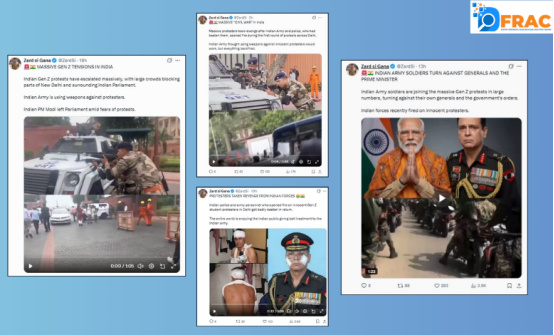
Fact check : 1,2,3,4
4.False Narrative of Protester Deaths and Clashes with the Indian Army
DFRAC’s analysis also revealed that during the Delhi protests, Pakistani propaganda networks did not limit themselves to circulating fake videos and digitally altered content. They also fabricated entirely false claims designed to inflame public emotions and portray the situation as far more violent and serious than it actually was. These claims were disseminated at a time when social media was already flooded with discussions surrounding the protests and police action, indicating a deliberate attempt not merely to spread misinformation but also to escalate tensions.
During the investigation, DFRAC found that a propaganda handle named South Asia Rights Watch claimed that 20 protesters had been killed in alleged firing and baton charges carried out by the Indian Army in Delhi. This claim was widely circulated on social media without any official confirmation, credible source, or factual evidence. However, DFRAC’s verification established that the claim was entirely false and misleading. The investigation identified an official statement issued by the Delhi Police, which explicitly confirmed that no protesters were killed during the demonstrations. Therefore, the claim that 20 people had died was completely fabricated.
Similarly, several other posts alleged that the Indian Army had carried out baton charges against protesters in Delhi, after which demonstrators retaliated by attacking Army personnel. Through such posts, propaganda networks attempted to create the impression that the Indian Army and civilians had come into direct confrontation in the national capital and that the situation had spiralled completely out of control.
DFRAC’s analysis found this claim to be equally baseless. As established earlier, the Indian Army was never deployed during the Delhi protests. Responsibility for maintaining law and order rested with the Delhi Police, the Central Armed Police Forces (CAPFs), and the Rapid Action Force (RAF). Consequently, there is no factual basis for claims that the Army conducted baton charges or that protesters attacked Army personnel. The entire narrative was built upon fictitious events.
These cases demonstrate that the propaganda network employed tactics such as Mass Casualty Disinformation and Escalation Narratives—strategies that deliberately exaggerate violence, fabricate casualties, and portray situations as significantly more chaotic and dangerous than they actually are in order to amplify fear, outrage, and social unrest.
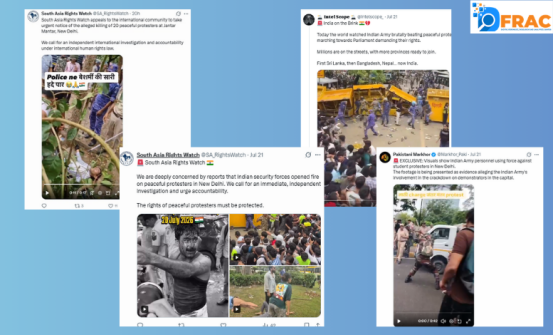
5. Delhi Police Took Action Against 480 Pakistan-Based Social Media Accounts
In view of the coordinated disinformation campaign surrounding the Delhi protests, the Delhi Police has been closely monitoring suspicious social media networks allegedly operating from Pakistan. Given the large-scale circulation of fake news, misleading claims, and inflammatory narratives aimed at disturbing public order, the police not only intensified its surveillance efforts but also urged citizens, particularly students and young people, to remain vigilant against such foreign propaganda networks.
In an official statement, the Delhi Police announced that it had identified 480 Pakistan-based social media accounts allegedly involved in a coordinated campaign to spread false and misleading information. The police further stated that all 480 accounts had been blocked to curb the dissemination of disinformation through these platforms.
Through its official communication, the Delhi Police appealed to students and young citizens to exercise caution when encountering content from foreign social media accounts spreading rumours and misleading claims related to India’s internal affairs. The police advised the public not to trust any viral post, video, or claim without proper verification and urged them to rely only on information issued by official and credible sources.
Conclusion:
DFRAC’s analysis demonstrates that Pakistani propaganda networks sought to exploit the Delhi protests by conducting a coordinated information warfare campaign through the dissemination of fake news, digitally altered videos, AI-generated content, and fabricated claims. The campaign appears to have been aimed at portraying the protests as more violent than they actually were, discrediting India’s security institutions, and exacerbating social tensions.