Mohd Fahad
The writer is Editor (National Desk) at First India
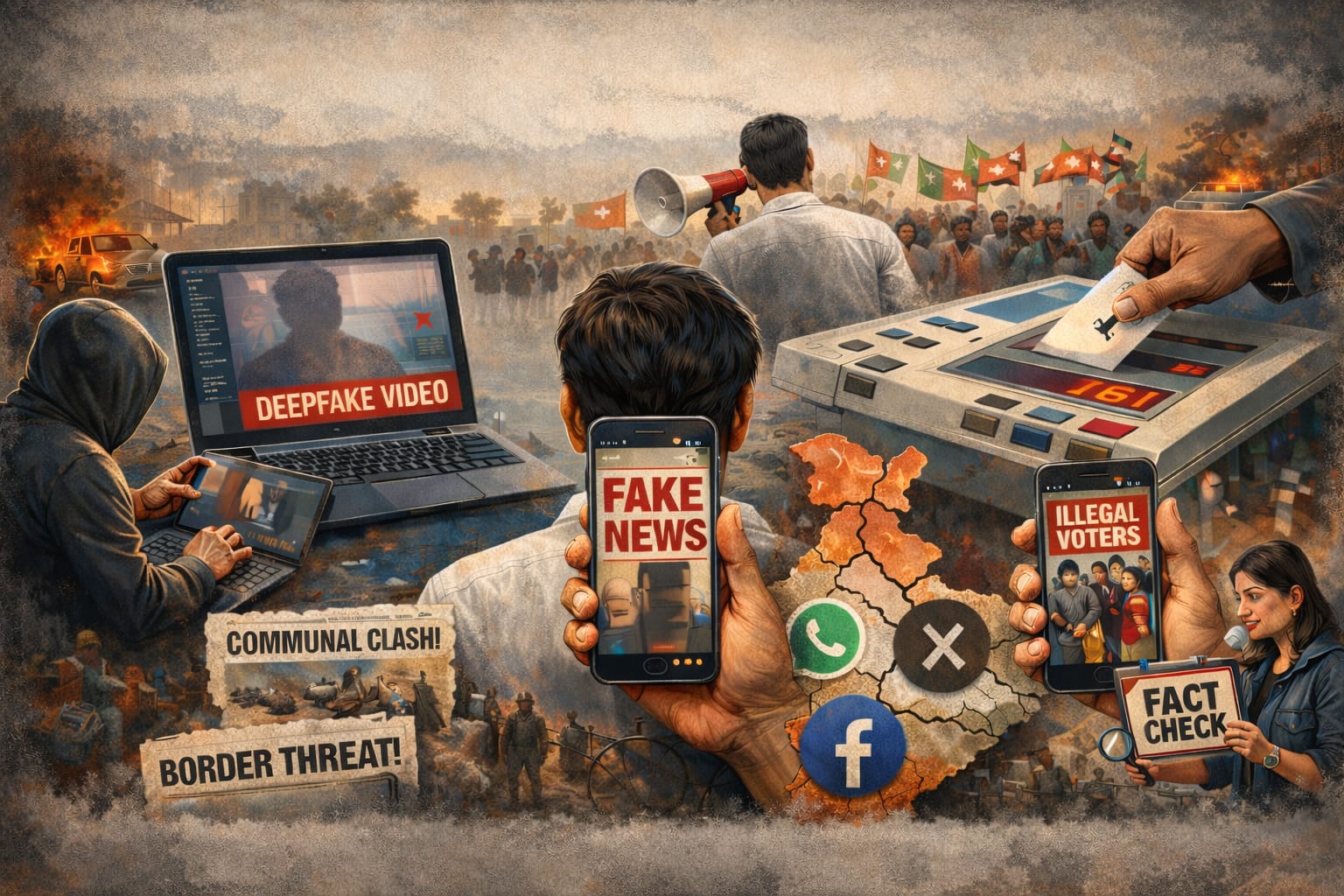
Elections in India have always been contested not just on the ground but also in the realm of narratives. However, in recent years—especially during Assembly elections in states like West Bengal, Assam, Kerala, Tamil Nadu, and Puducherry—the battlefield has decisively shifted to digital platforms. The proliferation of misinformation through WhatsApp and X has emerged as one of the most serious threats to democratic integrity. What was once rumor is now algorithmically amplified “information warfare,” often indistinguishable from truth for the average voter.
The rise of AI-driven misinformation
A defining feature of recent elections is the rise of AI-driven misinformation. Political campaigns are increasingly using artificial intelligence to create hyper-targeted content, sometimes crossing ethical boundaries. Edited videos, voice cloning, and repurposed archival footage are being circulated to falsely depict leaders making controversial statements or engaging in misconduct. This trend has alarmed the Election Commission of India, which has explicitly warned against deepfakes and pledged strict action, including FIRs and content takedowns.
West Bengal: Misinformation and political polarisation
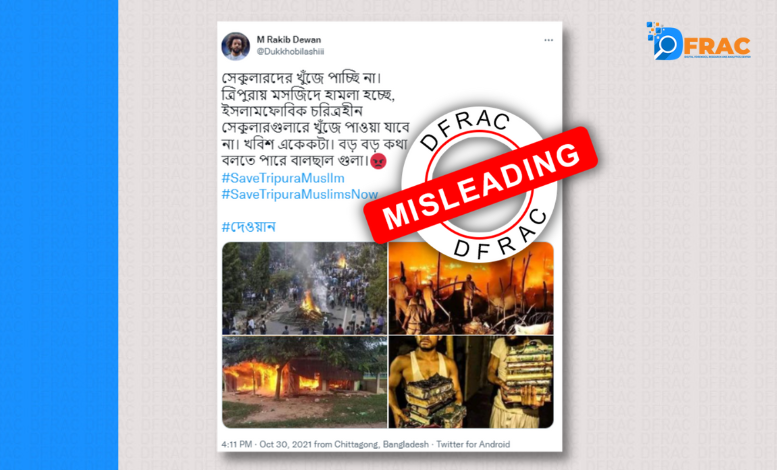
Take the case of West Bengal, where misinformation has historically played a volatile role. During election cycles, social media has been flooded with misleading images and videos of political violence, often stripped of context or entirely fabricated. In some instances, old or unrelated visuals were circulated as evidence of ongoing attacks, inflaming communal tensions. Political actors have also weaponized narratives around “infiltration” and border security, sometimes exaggerating or distorting facts to consolidate vote banks. The result is a deeply polarized electorate, where perception often outweighs reality.
Assam: Identity, migration, and viral claims
In Assam, misinformation has frequently revolved around identity and migration—issues that are already politically sensitive. Viral messages on WhatsApp have claimed the presence of “illegal voters” or large-scale voter fraud, often without evidence. Videos purportedly showing people with fake voter IDs or being “bussed in” from other states have circulated widely, creating suspicion and anxiety among voters. Such narratives not only undermine trust in the electoral process but also stigmatize communities.
Tamil Nadu: Deepfakes and cultural sensitivities
Tamil Nadu offers another telling example. Here, misinformation has taken more technologically sophisticated forms. There have been instances of speeches being edited or synthetically generated to make it appear as though political leaders endorsed controversial positions, including religious or cultural issues. In one widely discussed case, misleading claims about a prominent leader supporting practices like animal sacrifice were circulated before being debunked. Such content is particularly dangerous because it taps into cultural sensitivities and can rapidly influence public sentiment.
Kerala: Subtle narratives and language barriers
In Kerala, misinformation has often been more subtle but equally impactful. False or misleading political advertisements, unverified allegations, and manipulated narratives have prompted the Election Commission to mandate pre-certification of campaign ads. The state has also seen the spread of fake news in regional languages, making detection even harder. Language-specific misinformation ecosystems can be highly insular, allowing false narratives to circulate unchecked within communities.
Puducherry: Hyper-local misinformation
Even smaller electoral arenas like Puducherry are not immune. The integration of AI tools into campaign strategies has enabled the creation of hyper-local misinformation tailored to specific constituencies. Lesser-known candidates are particularly vulnerable, as fake videos or allegations can damage reputations without attracting widespread scrutiny or fact-checking efforts.
Strategic deployment of false narratives
What ties these examples together is not just the presence of misinformation, but its strategic deployment. This is not random noise—it is often coordinated, targeted, and designed to achieve specific political outcomes. Misinformation campaigns exploit existing social fault lines—religion, caste, language, and regional identity—to maximize impact. They are also amplified by the architecture of social media itself, where sensational content travels faster and farther than verified information.
Impact on democracy and voter behaviour
The consequences are profound. First, misinformation erodes trust—both in institutions and among citizens. When voters cannot distinguish between fact and fiction, their faith in the electoral process weakens. Second, it distorts voter behavior. Decisions that should be based on policies and performance are instead influenced by falsehoods and emotional manipulation. Third, it deepens polarization, turning elections into zero-sum battles defined by fear and misinformation rather than democratic debate.
Regulation and institutional challenges
The regulatory response has been mixed. The Election Commission of India has taken steps such as monitoring deepfakes, mandating ad certification, and warning against unethical practices. The Press Council of India has also emphasized the need to avoid unverified claims and illegal exit polls. However, enforcement remains a challenge. The sheer speed and scale at which misinformation spreads often outpace institutional responses.
Role of technology platforms
Technology platforms, too, face a dilemma. While companies like Meta Platforms and X have introduced measures such as fact-checking and content moderation, these efforts are often reactive rather than proactive. Encrypted platforms like WhatsApp present an additional challenge, as tracing the origin of misinformation is difficult without compromising user privacy.
Political accountability and ethical concerns
At the same time, political parties themselves have begun to acknowledge the scale of the problem. The emergence of dedicated fact-checking units within party structures reflects both the threat of misinformation and its normalization as a campaign tool. This raises an uncomfortable question: are political actors genuinely trying to combat misinformation, or simply manage it when it works against them?
The Humayun Kabir example
The controversy surrounding Humayun Kabir, like many such incidents, underscores how quickly unverified content can shape public perception. Whether true or manipulated, such content becomes part of the political discourse almost instantly, leaving little room for careful scrutiny.
Safeguarding democratic integrity
India’s elections are among the largest democratic exercises in the world. But their credibility depends not just on free and fair voting, but on an informed electorate. As misinformation becomes more sophisticated and pervasive, the challenge is no longer just about managing information—it is about safeguarding the very idea of democracy.If left unchecked, fake news will not just influence elections; it will redefine them.