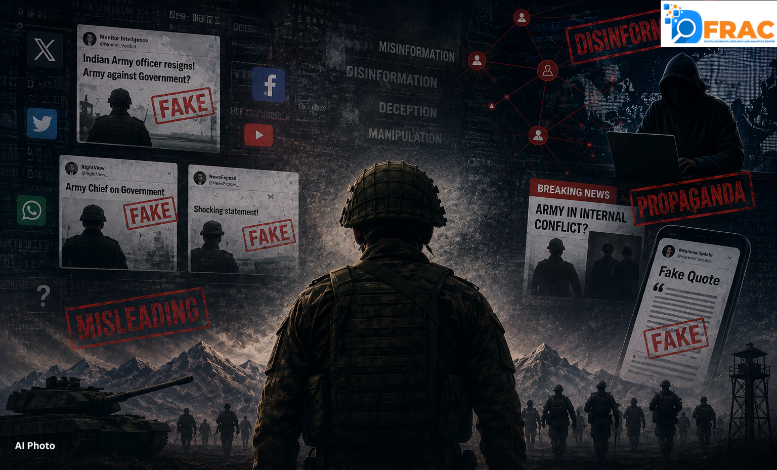
The rapid expansion of digital communication and the growing reach of social media platforms have transformed the information landscape in unprecedented ways. Within this evolving environment, information warfare, cognitive warfare, and influence operations have become significant elements of contemporary geopolitical competition and ideological conflicts. Various studies and international organizations have highlighted that disinformation, misinformation, and malicious information are not merely tools for spreading false facts; they are also designed to influence public discourse, collective perceptions, and institutional legitimacy. Such targeted information campaigns are often conducted through techniques such as decontextualized content, misleading visual material, false identification, selective presentation, and narrative engineering.
In the field of security and strategic studies, it is widely recognized that disinformation campaigns targeting institutions such as the armed forces are not limited to damaging their reputation. They also have the potential to undermine institutional trust, affect civil-military relations, and influence national security discourse. In this context, recent years have witnessed the emergence of various patterns of digital disinformation targeting the Indian Army and its officers. In many cases, videos and images from foreign or unrelated incidents have been falsely linked to Indian military personnel, while in others, statements made by military officers have been taken out of context, selectively quoted, distorted, or digitally altered. Additionally, narratives alleging conflicts between the military and civilians, disagreements between the military and the government, suppression of soldiers by their own institution, and tensions with neighboring countries have been systematically circulated across digital platforms. The role of social media accounts operating from neighboring Pakistan appears particularly questionable in spreading such narratives.
This report analyzes the major patterns and narrative structures of emerging digital disinformation targeting Indian Army officers. Alongside fact-checking specific viral claims and incidents, it also seeks to understand the broader information strategies, framing techniques, and influence mechanisms employed to affect the public image of the military and its officers, weaken institutional credibility, and shape public opinion. The major findings of this report are as follows:
1.False narratives portraying conflict between the Indian Army and civilians
2.Propaganda alleging contradictions between the Army and the Government
3.Misrepresentation and distortion of military officers’ statements
4.Attempts to tarnish officers’ reputations through fake and misleading information
5.Propaganda claiming that the Army suppresses its own soldiers
6.Disinformation aimed at escalating tensions with neighboring countries
1. False narratives portraying conflict between the Indian Army and civilians
The military is generally regarded as one of the most trusted institutions in any country. However, with the growing influence of social media, the spread of misleading claims, fabricated videos, and decontextualized content portraying alleged conflicts between the military and civilians has also increased. In numerous cases, old footage or unrelated incidents have been falsely presented as actions carried out by the Indian Army. Several foreign sources, cross-border networks, and social media accounts promoting anti-India narratives have been found actively involved in spreading such disinformation. These misleading narratives are often circulated under the guise of events occurring in regions such as Jammu and Kashmir, Punjab, and the Northeast. For example, during the ongoing situation in Manipur, several fake and misleading claims alleged that the Army had suppressed civilians. Users named “Manipur Post” and “Zard Si Gana” spread false reports claiming that 500 civilians, and later 200 civilians, had been killed in Army attacks. Another widely circulated fake claim alleged that local residents in Manipur had prevented the Indian Army from entering their areas.
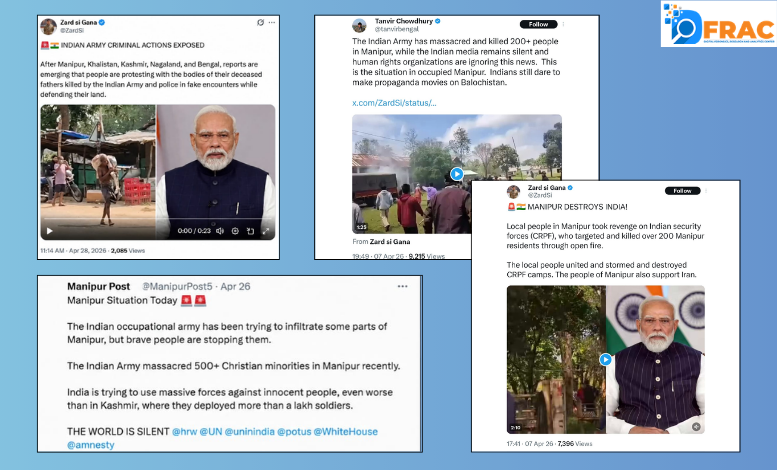
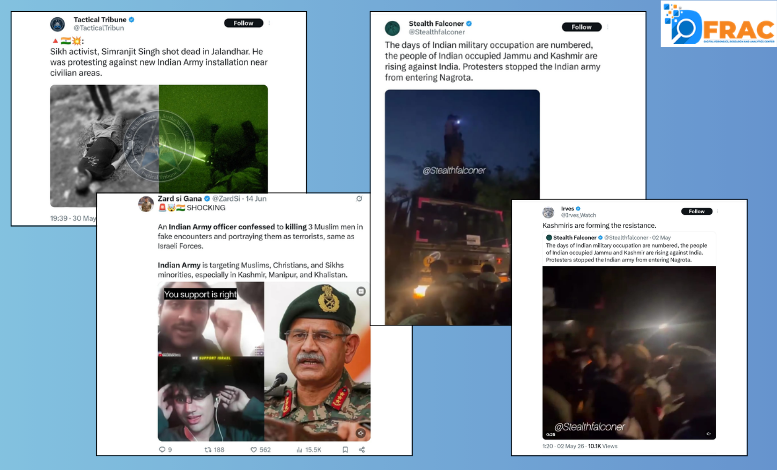
Similarly, false reports claiming that the Army used chemical weapons against civilians in Kashmir formed part of the same propaganda effort. Information is often framed in a manner that portrays the military as anti-minority, oppressive, brutal, and responsible for atrocities, directly assigning blame to the institution. For instance, the propaganda account “Tactical Tribune” blamed the Army for the killing of Sikh activist Simranjit Singh in Punjab, despite police having arrested Simranjit’s cousin, Sharandeep Singh, in connection with the murder. Likewise, a user named “Stealth Falconer” falsely portrayed a protest in Jammu over water shortages as a protest against the Army. Another user, “Zard Si Gana,” shared a video of military personnel baton-charging civilians in Bangladesh and falsely claimed it showed Muslims being persecuted during elections in West Bengal.
2. Propaganda alleging contradictions between the Army and the Government
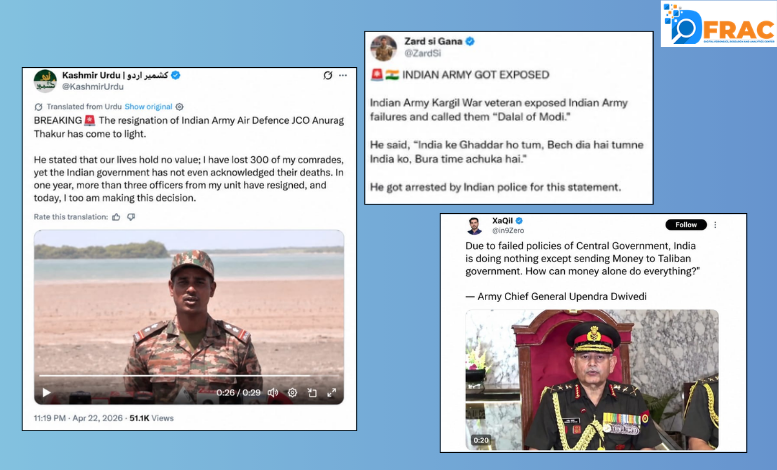
Several social media posts have circulated alleged statements attributed to senior Indian military officers, creating the impression that there are serious disagreements, dissatisfaction, and conflicts between the Army and the Government. However, fact-checking has repeatedly shown that these statements were fabricated or misleading and that the officers never made such remarks. Various groups remain active on social media, continuously sharing fake and digitally altered statements attributed to military officials. These claims often rely on fabricated quotations, decontextualized videos, misleading translations, and incomplete information to construct an artificial narrative of institutional conflict.
For example, a social media handle called “Kashmir Urdu” claimed that a military officer had resigned in protest against the government’s allegedly misrepresenting the number of soldiers killed during Operation Sindoor. The post included a video of a uniformed individual, falsely identifying him as an Indian Army officer and alleging that he had accused the government of concealing facts. Investigation revealed that the claim was misleading and that the video had no connection to any such resignation. Similarly, “Zard Si Gana” claimed that a Kargil War veteran had exposed failures within the Indian Army and referred to military officers as “agents of Modi.” Fact-checking found the claim to be baseless. Another post by a user named “XaQil” circulated a fabricated statement attributed to then Army Chief General Upendra Dwivedi, alleging that the central government was funding the Taliban. Verification showed that the Army Chief had never made such a statement and that the content had been digitally altered.
These examples illustrate how disinformation networks attempt to exploit the public credibility of military officers to generate political and institutional distrust. Through fabricated quotations, decontextualized videos, and invented claims, they seek to create the impression that there is internal dissatisfaction or opposition to the government within the military.
3. Distortion of Military Officers’ Statements
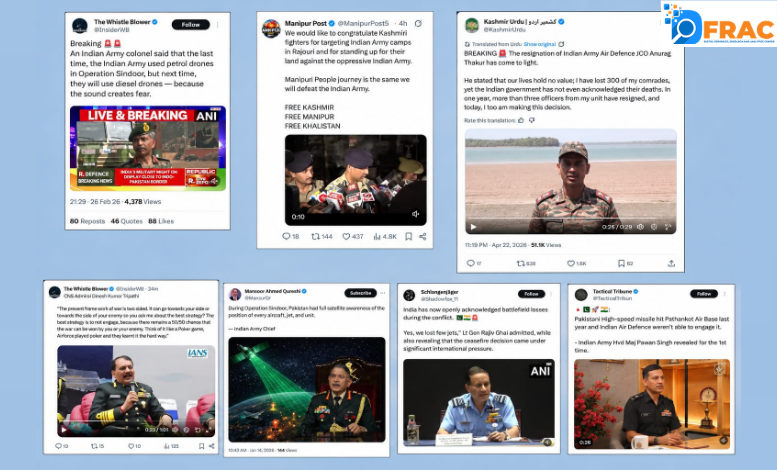
One of the primary methods of digital disinformation involves taking real or alleged statements by military officers out of context, presenting them selectively, or combining them with entirely fabricated claims. During our investigation, numerous examples emerged in which statements associated with the Indian Army, Indian Air Force, and military leadership were digitally altered or distorted to construct misleading narratives. Some social media accounts attributed fake statements to military officials, claiming that the Indian Army was confused about its military strategy, that serious disagreements existed regarding operations in border areas, or that military leadership opposed government policies. In some instances, genuine videos or press conference clips were selectively edited to completely change their original meaning and context. In others, statements were falsely attributed to officers without any official or credible source.
For example, a user named “Whistle Blower” claimed that an Army officer had stated that the Indian Army used petrol-powered drones during Operation Sindoor and would use diesel-powered drones in future operations to create fear through the drones’ sound. Fact-checking found the claim to be misleading. Likewise, “Tactical Tribune” claimed that an Indian military officer had acknowledged that a Pakistani missile successfully hit its target at Pathankot Air Base. Investigation showed that the officer had made no such statement and that the purported quote had been digitally altered. Several other misleading posts similarly attributed fabricated or decontextualized statements to the Army Chief and senior military officials.
4. Attempts to Tarnish Officers’ Reputations Through Fake and Misleading Information
Our analysis found several cases in which Indian military officers and their families were linked to controversies, criminal incidents, or social misconduct through misleading and unsubstantiated claims. Such propaganda relied on misrepresenting real events, altering identities, and associating unverified allegations with military personnel.
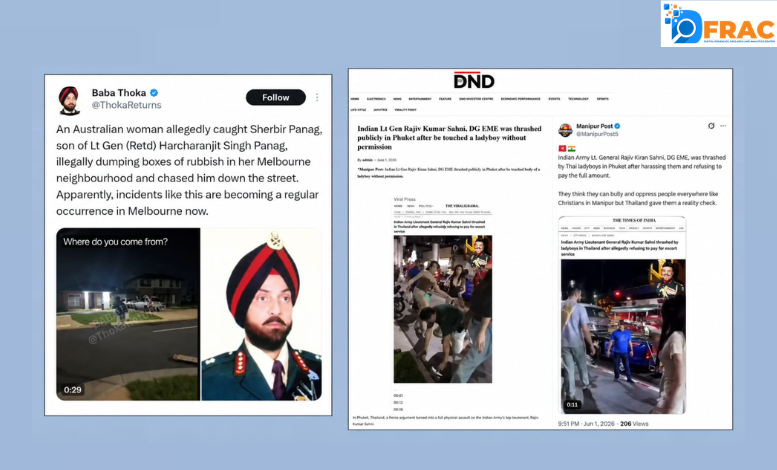
For example, a user named “Baba Toka” claimed that the son of a senior Indian military officer had been beaten by local residents in Melbourne, Australia, after allegedly dumping garbage outside neighbors’ homes. Fact-checking found no credible evidence supporting the allegation, and the attempt to link the incident to a military officer was misleading. In another case, “Manipur Post” shared a video of a physical altercation that occurred in Thailand and falsely claimed that one of the individuals involved was a senior Indian military officer. Some posts even described him as a Lieutenant General. Fact-checking confirmed that the incident had no connection to the Indian Army or any Indian military officer and had been deliberately misrepresented.
5. Propaganda Claiming the Army Suppresses Its Own Soldiers
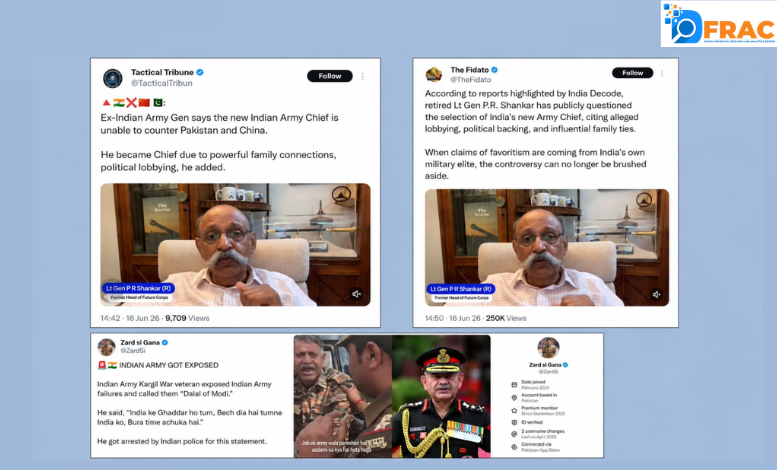
Our investigation also uncovered multiple cases in which statements by military and retired military officers were digitally altered or presented misleadingly to create narratives of internal dissatisfaction, discrimination, suppression, or conflict within the Indian Army. For example, a post by “Tactical Tribune” claimed that a retired military general had opposed the appointment of the new Army Chief and accused the Indian Army of political interference, nepotism, and lobbying. Social media posts presented his remarks as evidence of widespread dissatisfaction within the military leadership. Fact-checking revealed that retired Lieutenant General P.R. Shankar had actually been discussing the agreement between Iran and the United States and its geopolitical implications. Examination of the original video showed that he had made no comments regarding the Indian Army Chief or the Army’s capabilities. Furthermore, AI detection analysis indicated that the voice used in the viral clip had been artificially generated.
Similarly, “Zard Si Gana” claimed that a Kargil War veteran had been arrested for exposing failures within the Indian Army and criticizing the government. Investigation found this to be misleading. The viral video actually featured Congress leader Ramnath Sikarwar, who had been detained ahead of a planned protest targeting the Uttar Pradesh Legislative Assembly. These cases demonstrate how disinformation networks attempt to create narratives of division, dissatisfaction, and suppression within the military by exploiting the credibility and public recognition of retired officers.
6. Disinformation Aimed at Escalating Tensions with Neighboring Countries
Several fake, fabricated, misleading, and inflammatory statements attributed to Indian military officers have been circulated regarding neighboring countries. These statements are designed to challenge neighboring states, promote war rhetoric, and intensify regional tensions. Such campaigns exploit the credibility of military officials to disseminate provocative and diplomatically sensitive messages capable of influencing regional relationships.
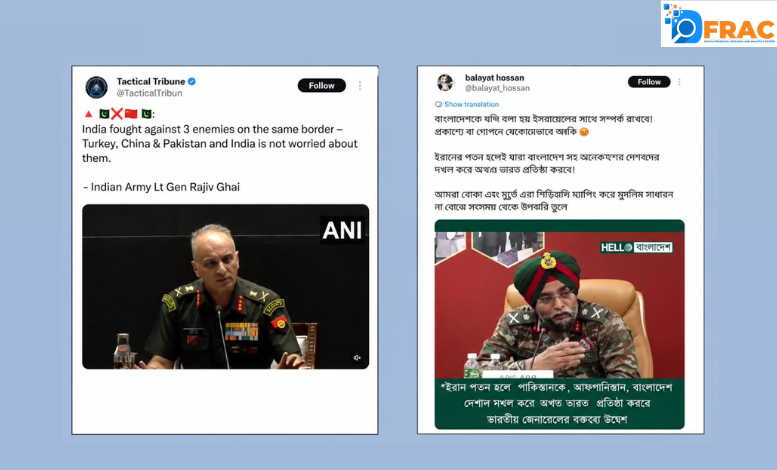
For instance, “Tactical Tribune” shared a video of Lieutenant General Rajiv Ghai and claimed that he had publicly stated that India could simultaneously fight Pakistan, China, and Türkiye and that he had no concerns regarding these countries. Fact-checking found that the statement attributed to him had been digitally altered. Similarly, a user named “Balayat Hussain” circulated a fabricated statement in Bengali alongside the photograph of a senior Indian military officer. The statement included provocative and controversial remarks concerning India-Bangladesh relations. Investigation revealed that the officer had never made such comments and that the content was misleading. These examples indicate that digital disinformation networks are not limited to influencing domestic political or institutional narratives; they also target issues related to international and regional relations.
Conclusion:
This analysis demonstrates the existence of a systematic pattern of digital disinformation targeting the Indian Army and its officers. Through fabricated quotations, decontextualized videos, misleading translations, false identification, and invented claims, disinformation actors attempt to construct narratives of conflict between the Army and civilians, institutional confrontation between the Army and the Government, distrust in military leadership, and heightened tensions with neighboring countries. These cases highlight that such information warfare strategies extend beyond merely spreading false information. They also seek to undermine the credibility of military institutions, erode public trust, and influence broader national discourse.