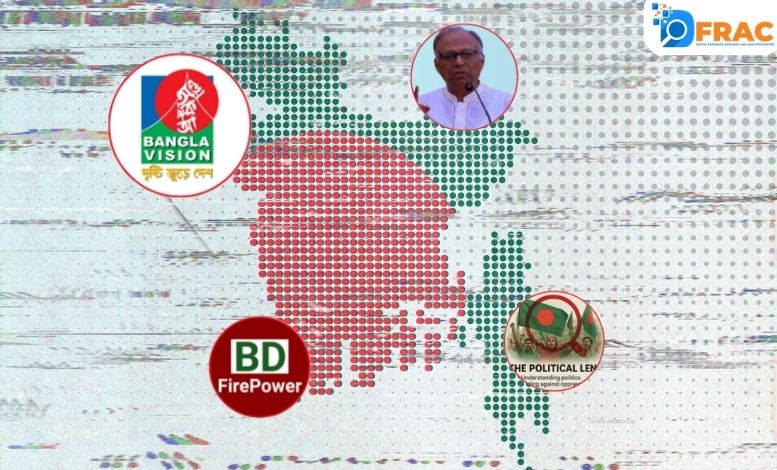
In recent years, a worrying trend has emerged rapidly across South Asia’s digital space: the spread of Bengali-language narratives and messages on social media that appear designed to influence regional equations and manipulate public perception. Many Bangladesh-based accounts present themselves as “media outlets” despite having no link to any recognized institution. They mimic news-format styles—breaking-news graphics, logos, visuals, live updates, and emotional language—misleading common users into believing they are legitimate media sources.
Using this disguise, these pages and channels strategically disseminate content related to sensitive issues, bilateral relations, and regional politics.
This report is based on a comprehensive analysis of such Bangladeshi social-media accounts that deliberately work to generate tension and hostility between India and Bangladesh. Many of these pages operate like a coordinated propaganda ecosystem. Their key tactic is to exaggerate Bangladesh’s military strength in unrealistic proportions while provoking fear, suspicion, and hostility toward India. India is frequently portrayed using phrases like “oppressor neighbor,” “rogue country,” and “bully power,” with the clear intention of inflaming public sentiment.
Meanwhile, Bangladesh’s military, weapons systems, and missile capabilities are portrayed as rising to the level of a major power—one that supposedly targets India.
These pages do not aim to provide factual defense analysis; rather, they attempt to construct an aggressive narrative that undermines bilateral cooperation, cultural ties, and diplomatic peace between the two nations. Collectively, these posts foster distrust among Indian and Bangladeshi audiences, normalize the idea of military confrontation, and weaken regional stability. This propaganda represents not just misinformation in the digital space, but a serious threat to peace and harmony between neighboring states.
Bangla Vision TV’s Propaganda and Its Ban in India
Bangla Vision TV is a major media network in Bangladesh with 9.2 million followers on Facebook and 8.9 million subscribers on YouTube. As a media institution, it has an obligation to remain neutral and provide verified news, fact-checking, balanced reporting, and ethical journalism. Instead, Bangla Vision TV ran content heavily aligned with an anti-India agenda. As a result, its YouTube channel has been banned in India for national-security reasons, though its Facebook and X (Twitter) accounts remain active.
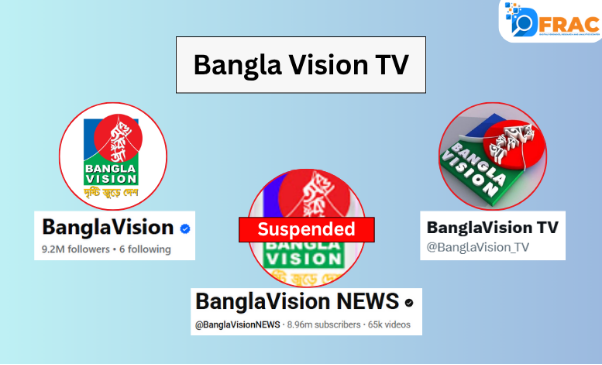
Bangla Vision TV’s Anti-India Agenda
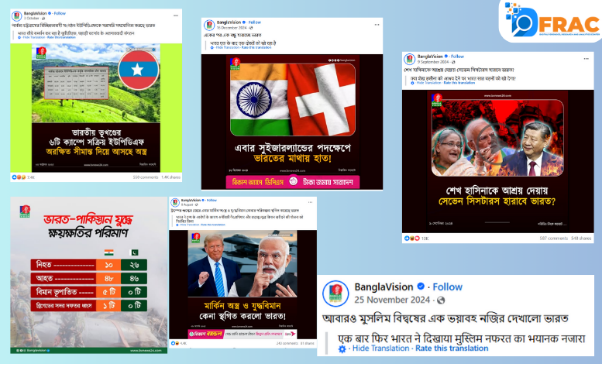
Its coverage related to India reveals a clear agenda. In one Facebook post, it accused India of supporting UPDF, a separatist group in Chittagong, and claimed that UPDF runs six camps inside Indian territory with weapons supplied from across the border. No source was provided—only an infographic was shared to push this propaganda.
During “Operation Sindoor,” Bangla Vision TV falsely claimed that India lost five fighter jets and one military base—figures entirely unverified and not released by any official Indian source. At the same time, it claimed Pakistan suffered no losses, showing a clear bias. Another graphic asked: “After giving asylum to Sheikh Hasina, will India lose the Seven Sisters?”—again without basis.
Who Is Mahmudur Rahman?
Mahmudur Rahman is a Bangladeshi journalist, owner and editor of the daily Amar Desh. Since 2008, he has been a strong critic of the Awami League government. Over 50 cases of defamation and sedition have been filed against him, and he has been arrested multiple times. He consistently pushes anti-India narratives.
Mahmudur Rahman’s Propaganda Themes
Rahman frequently launches attacks on India, often based on unverified, inflammatory claims—such as accusing ISKCON of being militants or linked to Indian intelligence. He often calls for resisting “Indian hegemony” and portrays Bangladesh as an “undeclared colony of Hindu nationalist India.” His speeches and writings repeat these claims without factual evidence.
His newspaper, Amar Desh, has faced multiple lawsuits for publishing false reports, including misinformation about government officials and unfounded allegations involving multinational companies like Chevron. Government agencies have filed serious cases against him, including sedition and fraud, leading to arrests and closures of his publications.
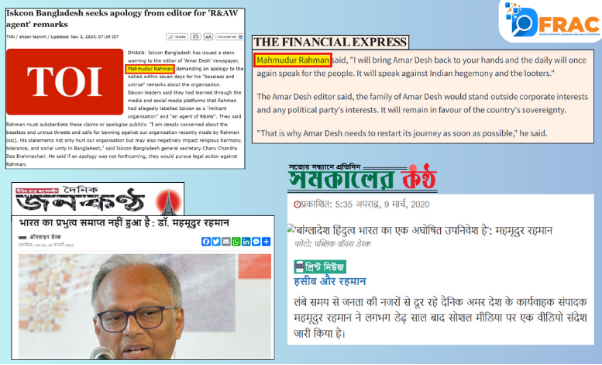
Mahmudur Rahman’s Major Statements Regarding India, Their Source, and Analysis:
| Statement / Claim | Source / Analysis |
|---|---|
| “Fight against Indian hegemony and fascism” | Fight against Indian hegemony. |
| “Indian dominance has not ended yet” | Indian dominance has not ended. দৈনিক জনকণ্ঠ || Daily Janakantha |
| “Conspiracy on July Revolution (a revolution / movement in Bangladesh)” | India will not easily accept the July Revolution, a conspiracy is ongoing Risingbd Online Bangla News Portal+1 |
| “Hindutva India tried to make Bangladesh a colony” | He said that Bangladesh was “not a declarative colony of Hindutva India” samakalerkontho.com |
| “The independence and power revolution happened to protect the country’s sovereign rule” | He said that “this revolution was against those who looted the freedom of 1971 and the sovereign rule, and against Indian dominance.” Daily Amardesh |
| “Called ISKCON R&AW agent and militant” | ISKCON Bangladesh accused that Mahmudur Rahman called them “R&AW agent” and “militant organization.” The Times of India |
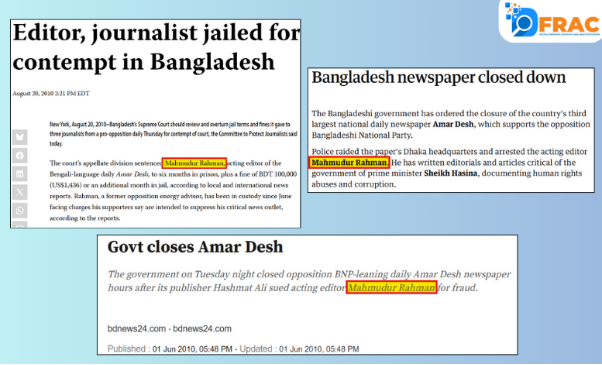
Due to fake news and controversies, Mahmudur Rahman was jailed
Mahmudur Rahman has a long-standing connection with controversies. He is often known for fake news, misleading information, factually incorrect and baseless statements. Because of these actions, many actions were taken against him; he was sent to jail, and restrictions were imposed on his newspaper. In October 2009, Amar Desh published a report claiming that the Bangladesh Telecommunication Regulatory Commission (BTRC) had appointed Indian employees and that this could be a threat to state security. BTRC denied this claim and, on October 28, filed a defamation case against the newspaper and clarified that the appointment of Indian citizens was not by the commission but by the United Nations.
Similarly, in January 2010, the then Energy Minister Tawfiq-e-Elahi Chowdhury filed a defamation case against Amar Desh regarding a December 2009 news report. The report accused him and Prime Minister Sheikh Hasina’s son Sajeeb Wazed Joy Hasina of taking bribes from Chevron to get contracts in Bangladesh. Three days after the report was published, the reporter was attacked by unknown people. After this report, Awami League leaders had already filed 24 defamation cases against the newspaper against the Energy Minister.
Over time, various government agencies filed a total of four serious cases against Mahmudur Rahman—these included two police cases regarding the closure of the press office controversy, a sedition charge for publishing material of the banned group Hizb-ut-Tahrir, and a fraud case based on a statement of his publisher. After these accusations, Rahman was sent to eight days of custody.
Mahmudur Rahman and ‘The Political Lens’:
A Facebook page called The Political Lens has over 660,000 followers. The page consistently posts an anti-India agenda and misleading content. Initially, it was created under Mahmudur Rahman’s name on 11 December 2012 and later renamed “The Political Lens” on 21 October 2025. Investigation shows it is operated by two people, one in Bangladesh and the other in the USA.
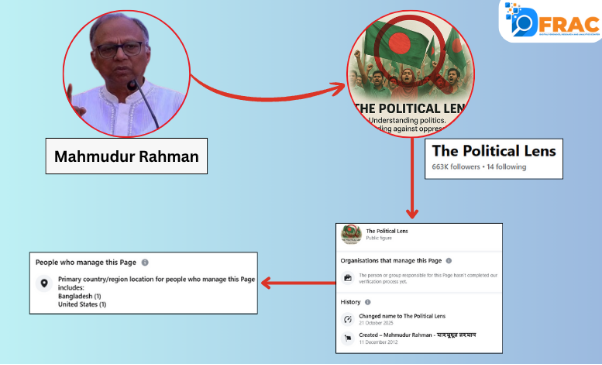
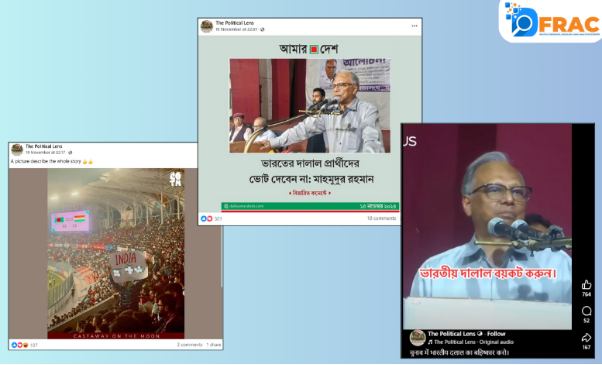
Controversial Posts from ‘The Political Lens’:
- Displaying the word “India” on posters in stadium crowds in a derogatory way.
- Highlighting speeches with harsh comments about Indian political interference.
- Repeatedly sharing videos and graphics to establish a one-sided narrative portraying India as interfering in Bangladesh.
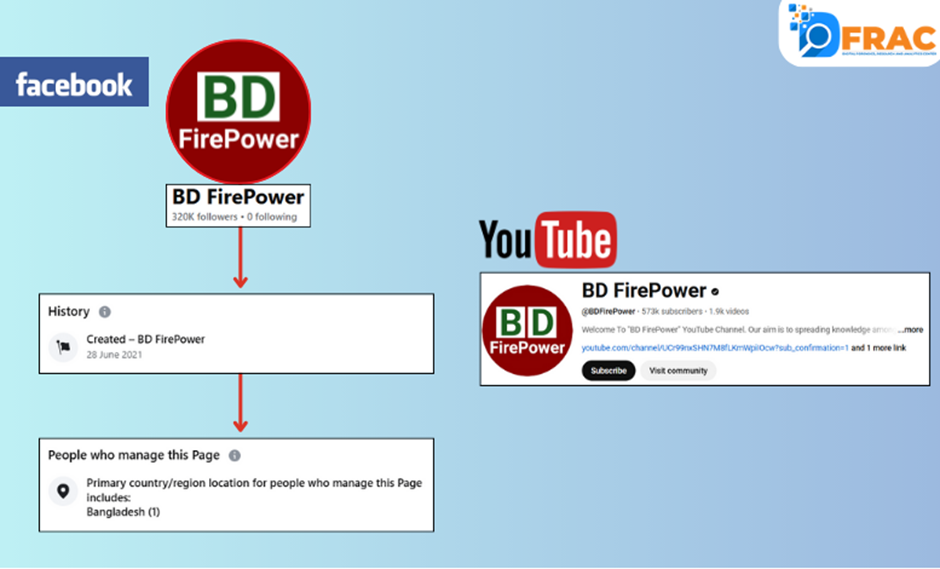
BD Fire Power: Promoting Military Confrontation:
On Facebook and YouTube, a user named BD Fire Power is active. This user has more than 300,000 followers on Facebook and more than 573,000 subscribers on YouTube. Taken together, this forms an online group of more than one million. On Facebook, this page was created on 28 June 2021 and is operated by a user from Bangladesh. On YouTube, it was created on 23 March 2017.
This user presents itself as a news and media website, which provides military, economic, and diplomatic news. However, its activities are such that they promote military confrontation, and for this, it delivers content that tries to escalate deadlock. Its posts and captions are such that Bangladesh’s military strength is shown as increasing, and this increasing military strength is presented as a threat to India.
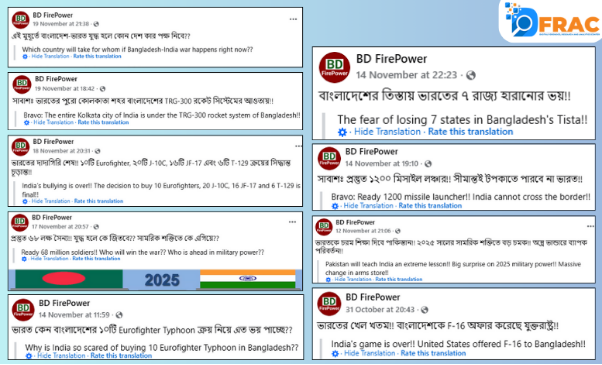
Misleading posts about military clashes between India and Bangladesh:
This deliberately spreads military-centred propaganda and intentionally increases the illusion of military superiority and the possibility of conflict with India. Its posts continuously exaggerate potential war, missile attacks, air power, and geopolitical clashes between India and Bangladesh. For example, claims like “Kolkata city is within TRG-300 range,” “India cannot cross the border,” “1200 missile launchers ready,” “68 million soldiers ready,” and “In 2025 Pakistan will teach India a lesson”—such claims appear to be made with the purpose of creating military excitement and aggression.
The posts often use exaggerated figures, unverified military capabilities, and provocative language, which can create misunderstanding and tension among the audience. In many posts, India’s strategic concerns are presented with words like “fear,” “attempt to intimidate,” or “bullying ends,” which clearly create a one-sided and inflammatory narrative. At the same time, by citing support from Western countries or Pakistan, Bangladesh’s power is shown as excessively amplified.
The Game of Anti-India Narrative:
To promote anti-India narratives, many accounts have been created on X and Facebook, whose usernames themselves are based on anti-India sentiment. Two of these accounts are prominently visible: first — ভারতের দালাল মুক্ত বাংলাদেশ চাই (We want to free Bangladesh from Indian agents) and second — Kick India out of Bangladesh. These two users are involved in the game of promoting anti-India propaganda and narratives.
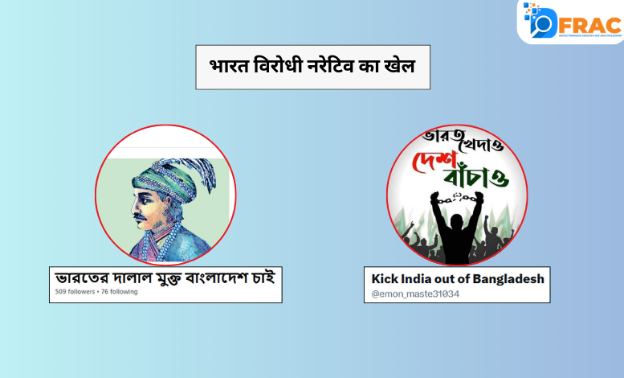
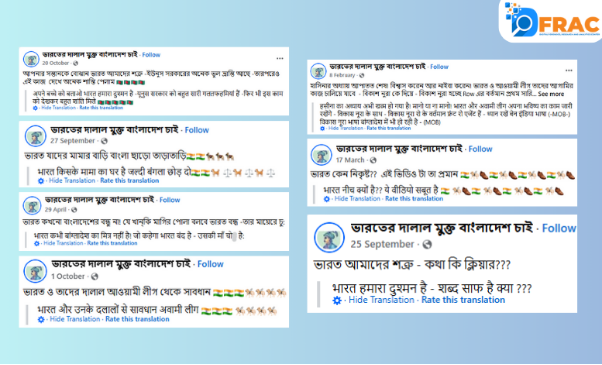
These two users continuously use provocative, emotional, and misleading posts to promote anti-India narratives. The content pattern is clearly designed to create the perception of “India = Enemy.” Posts address India with insulting words, exaggerate border issues, and try to present every political or social event as an Indian conspiracy. Many posts deliberately use provocative emojis, offensive language, and sentences that stir nationalist feelings.
The purpose of such content is to move away from factual reality and create distrust, anger, and hatred among the public, so that an emotional atmosphere against India can be established. Especially, linking Awami League, border disputes, or economic issues to India shows that the page’s agenda is political polarization and strengthening anti-India sentiment on social media.
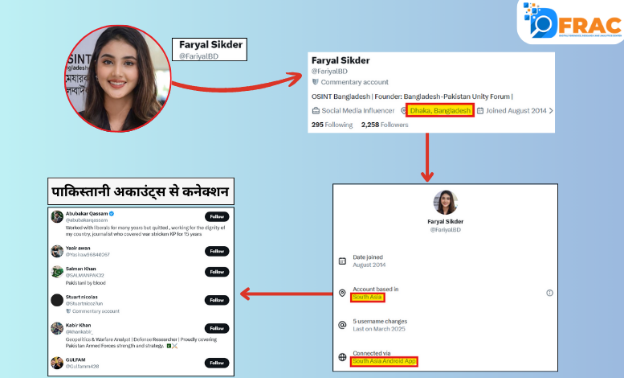
A Pakistani propaganda account posing as Bangladeshi for anti-India agenda:
An account named Faryal Sikder presents itself as a Bangladeshi user. It has listed its location as Dhaka, Bangladesh. This account was created in August 2014. According to available data on the X platform, it has changed its username 5 times so far. This account actively works to promote anti-India narratives and agendas. However, there is a question about its Bangladeshi identity because the account closely carries out Pakistani propaganda. According to data available on X, its location is unclear and shows ‘South Asia’ as location. However, its activities indicate links to Pakistan, as it conducts propaganda for Pakistan and also follows accounts operated from Pakistan.
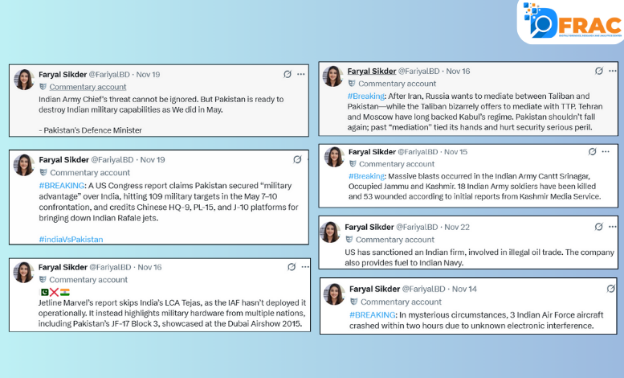
Propaganda in support of Pakistan:
The post pattern of Faryal Sikder appears tilted in one direction — presenting Pakistan’s military capability, diplomacy, and strategy positively, while presenting news related to India negatively, exaggeratedly, or unverified. For example, information about the Indian army such as “major attacks,” “heavy casualties,” “mysterious accidents,” and “electronic interference” has been shared without reliable sources. Many posts attempt to show, using names of American or international institutions, that Pakistan has gained military advantage or India’s major defense projects are failing.
Additionally, the account often presents events related to India as “breaking news,” creating fear, insecurity, and instability. Meanwhile, military success, diplomatic strength, and regional support related to Pakistan are exaggerated. This pattern indicates that the account’s purpose is not to share neutral information but to promote a specific geopolitical narrative, portraying India as continuously weak, unstable, and in crisis.
Anti-India campaign of ‘Anti-India Public’:
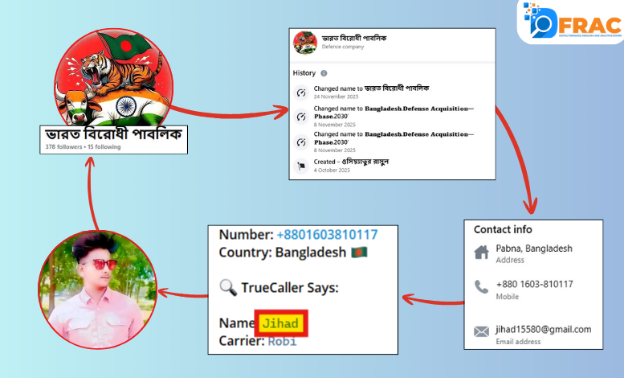
On Facebook, a user named ‘Anti-India Public (ভারত বিরোধী পাবলিক)’ is active. As the name itself indicates, the content shared by this user is against India. Our investigation found that this page was created on October 5, 2025, under the name ‘Allah ke Rasool’. Later, its name was changed to 𝐁𝐚𝐧𝐠𝐥𝐚𝐝𝐞𝐬𝐡.𝐃𝐞𝐟𝐞𝐧𝐬𝐞 𝐀𝐜𝐪𝐮𝐢𝐬𝐢𝐭𝐢𝐨𝐧—𝐏𝐡𝐚𝐬𝐞.2030. Later, it was changed to ‘Anti-India Public (ভারত বিরোধী পাবলিক)’.
During the investigation of this page, we found its location listed as Pabna, Bangladesh, and a phone number +880 1603-810117 and email: [email protected]. Searching this mobile number on Truecaller revealed it is registered under the name “Jihad.” When our team searched this number on WhatsApp, we found the profile photo shows a person’s picture.
Posts spreading confusion and fear about India’s military base:
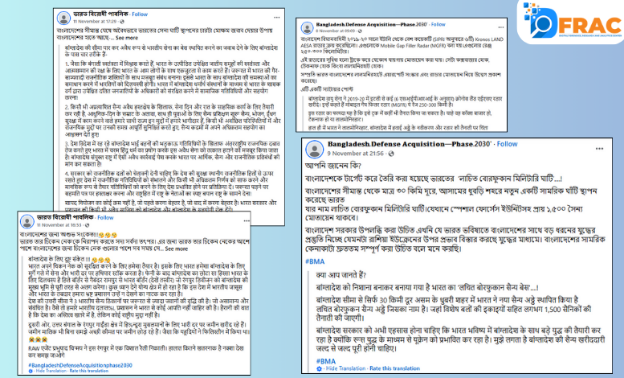
The account Bangladesh Defense Acquisition–Phase 2030 in this collage exaggerates Bangladesh’s military capability while trying to create an anti-India environment. Posts repeatedly give the narrative that India is “afraid” of Bangladesh’s growing defense capacity, while Bangladesh is rapidly becoming self-reliant in weapons, missiles, and military production. Many posts portray India as “enemy,” “threatening country,” or “oppressive neighbor,” fueling bilateral distrust. At the same time, Bangladesh’s army and industry are presented globally as “invincible,” “rapidly developing,” and “defense exporters.” Overall, this page uses nationalist propaganda and exaggeration rather than factual military information to increase doubt and hostility toward India among the public, potentially creating unwanted tensions between regional partners.
Fake news and fact-checking:
These users spread fake and misleading information using false claims, fabricated military figures, and incorrect translations, to increase distrust and tension in India-Bangladesh relations. We provide fact checks of some fake and misleading information here.
Fake/Misleading News-1:
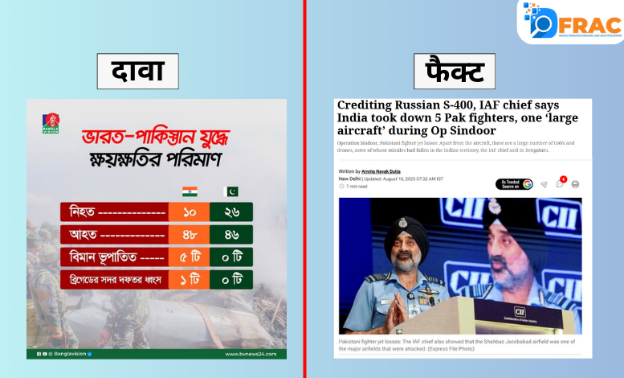
Bangla Vision TV posted an infographic in May during Operation Sindur giving figures of military losses of India and Pakistan. It claimed that India lost 5 fighter jets, while Pakistan lost none. It also claimed one Indian military base was destroyed, while no Pakistani base was damaged.
Fact-checking found these numbers to be fake, as no official record exists of 1 military base being destroyed or 5 Indian jets being lost.
Fake/Misleading News-2:
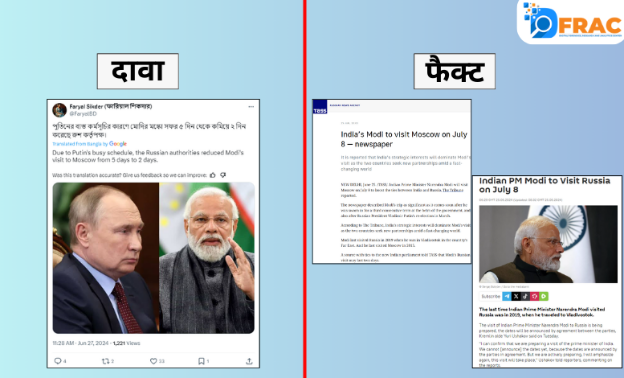
In June 2024, it was claimed regarding Prime Minister Narendra Modi’s potential Russia visit that, due to Russian President Vladimir Putin’s busy schedule, PM Modi’s 5-day visit was reduced to 2 days.
Fact-checking found this claim misleading, as the official dates of PM Modi’s visit had not yet been announced at that time.
Fake/Misleading News-3:
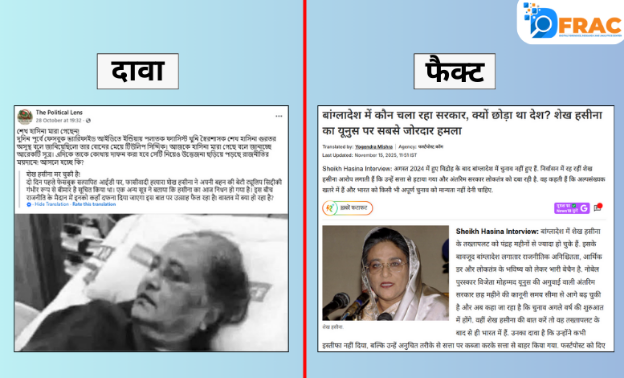
The Political Lens posted on October 28 claiming the death of Sheikh Hasina in India, sharing a photo. The claim of Sheikh Hasina’s death is fake, as she gave interviews to media on November 15, proving the October 28 claim was false.
Fake/Misleading News-4:
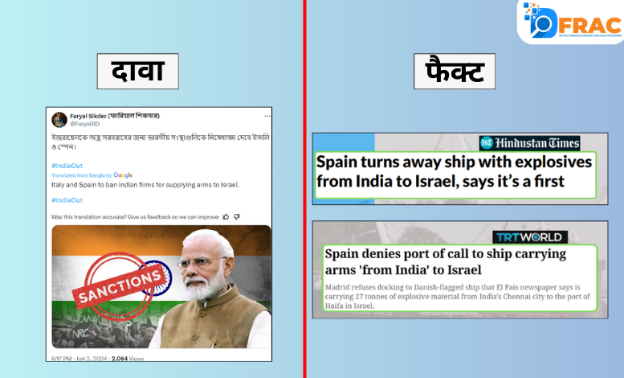
Faryal Sikder claimed in June 2024 that Italy and Spain would impose sanctions on Indian companies supplying weapons to Israel. DFRAC team investigation found this fake, as Italy and Spain did not announce any sanctions on Indian companies.
Conclusion:
Joint study of these propaganda accounts active on Bangladeshi social media shows that they are not merely personal opinions but appear to be part of a planned digital campaign. Their goal is to increase distrust, fear, and hostility between the two countries—especially by normalizing the idea of military conflict. Portraying India repeatedly as a “repressive,” “interfering,” or “enemy” nation and exaggerating Bangladesh’s military strength produces a psychological impact that can influence public perception. The content of these pages clearly indicates that inciting emotions beyond reality is their primary strategy. This propaganda not only spreads misinformation but also poses a threat to stability, cooperation, and peaceful regional relations in South Asia.