Introduction
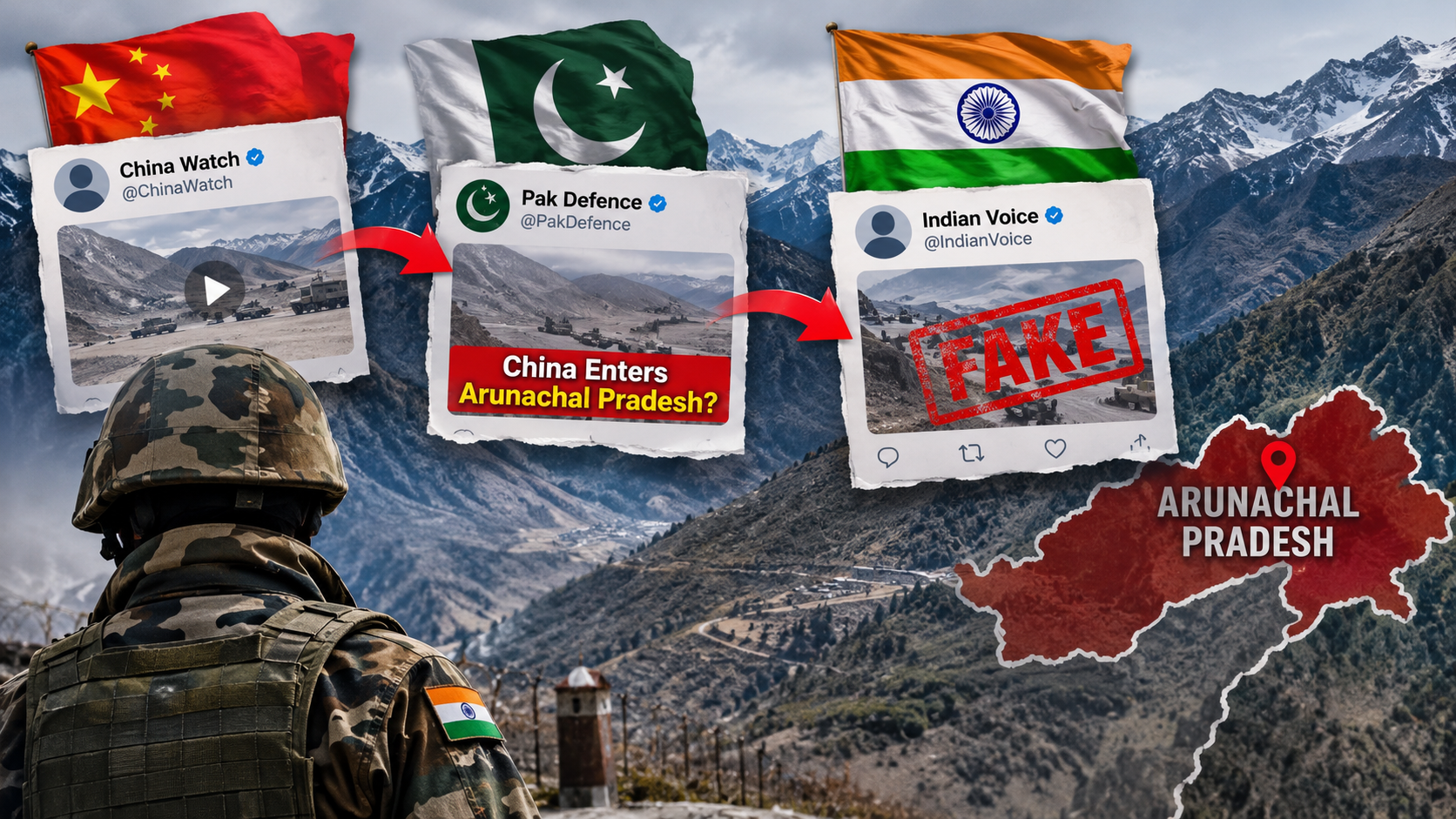
In late October 2026, outgoing Indo-Tibetan Border Police (ITBP) Director General Shatrujeet Singh Kapoor warned that traditional methods were no longer sufficient to counter China’s heavily modernised military and confirmed ongoing face-offs along the Arunachal Pradesh border. Against this backdrop, Pakistan-based social media accounts have been circulating claims that China’s People’s Liberation Army (PLA) has crossed into Indian territory in Arunachal Pradesh.
Several of these accounts appear to be working in coordination, sharing AI-manipulated videos and images, false information and misleading claims to portray a Chinese incursion as an established fact. Their content appears aimed at creating fear and uncertainty among Indian audiences by exploiting sensitivities surrounding India’s border with China.
This report examines the claims, visuals and posting patterns circulated by these accounts to trace how misleading content is being used to amplify fears of a Chinese incursion and push a narrative against India’s security interests.
Indian-Impersonating accounts promoting Chinese narrative:
The number of Pakistan-based social media accounts impersonating Indian users appears to be growing. These accounts show a keen interest in India’s domestic issues and challenges, sometimes even posting positive content about the Indian government to make their profiles appear more Indian. This helps them gain some credibility among Indian audiences, while they remain active in amplifying narratives emerging from Pakistan. Their recent posts on the China-Arunachal Pradesh issue, including AI-manipulated videos, images and false claims of Chinese incursions, reflect their efforts to exploit sensitive security concerns and create fear among Indians. Some of these accounts are:
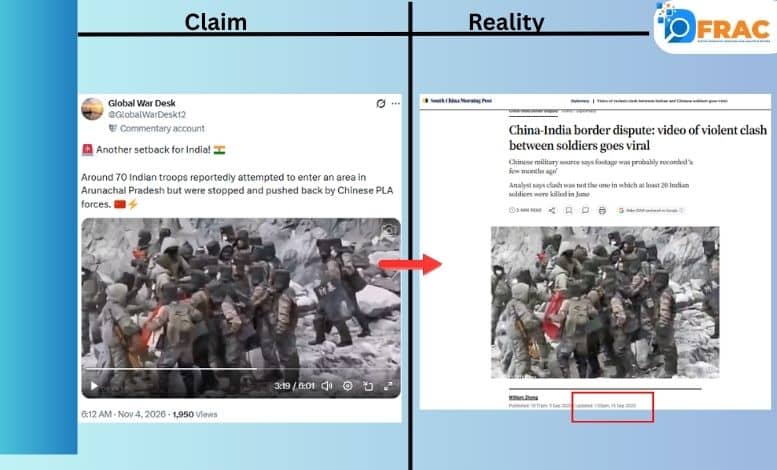
- @GlobalWarDesk12:
An unverified claim was posted by this account that around 70 personnel from the Indian Armed Forces allegedly entered an area in Arunachal Pradesh and were subsequently pushed back by the People’s Liberation Army (PLA). In our investigation, we found that the video is as old as six years, dating back to the Galwan Valley clash between India and China near the Line of Actual Control (LAC). The Galwan Valley clash was a deadly hand-to-hand confrontation between the Indian Army and China’s People’s Liberation Army (PLA) on June 15, 2020, along the Line of Actual Control (LAC) in eastern Ladakh. It marked the first fatal clash between the two militaries along the LAC in 45 years and severely strained India–China relations.
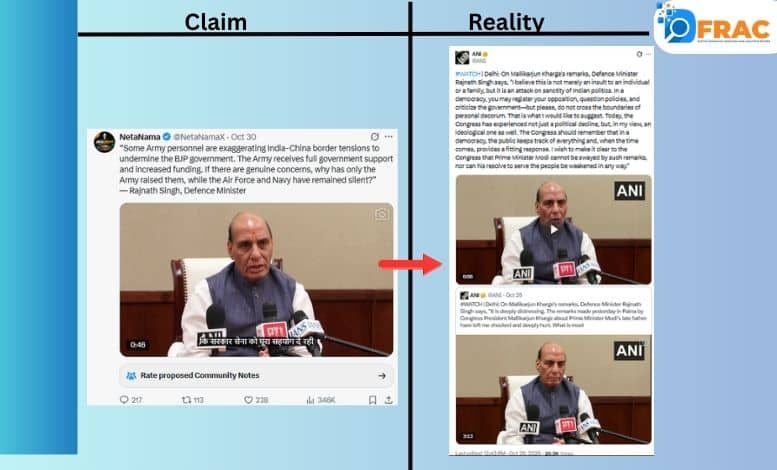
2. @NetaNamaX
Another Indian impersonating account, which regularly posts anti-India narratives but sometimes posts in favour of the Indian side. One of our fact-checks has debunked a claim, along with a video, posted by this account. The video featured Indian Defence Minister Rajnath Singh, making claims that the Indian Armed Forces were rebelling because of the Chinese intrusion. We revealed that the video is digitally manipulated and Rajnath Singh did not make any of the alleged remarks in the original footage.
3. @cutegirlindia21
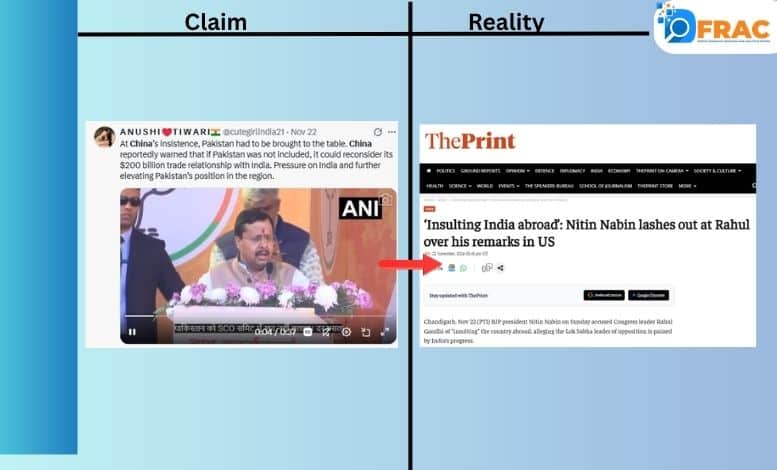
A digitally altered video of Nitin Nabin was posted by an Indian impersonating account based in Pakistan. In this video, he can be seen making controversial statements about China’s occupation of Indian territory, Pakistan’s invitation to the SCO Summit and the Tejas Mark 1A aircraft. While it was a digitally altered video, in the original footage Nitin Nabin praised India’s rise to the world’s fourth-largest economy under Prime Minister Narendra Modi and cited World Bank data on poverty reduction. He also criticised RahulGandhi and the Congress party, alleging that they undermined India’s progress abroad.
Pakistan-based accounts:
Unlike Indian-impersonating accounts that selectively present themselves as Indian users, these Pakistan-based accounts openly promote anti-India narratives. They frequently use racial slurs against Indians, target Indian institutions and amplify content in support of Pakistan’s current ruling establishment. They also serve as an important source of misinformation, with claims and visuals originating from these accounts subsequently picked up and circulated by Indian-impersonating profiles, creating the appearance of wider discussion among Indian users.
PooWorld_Order:
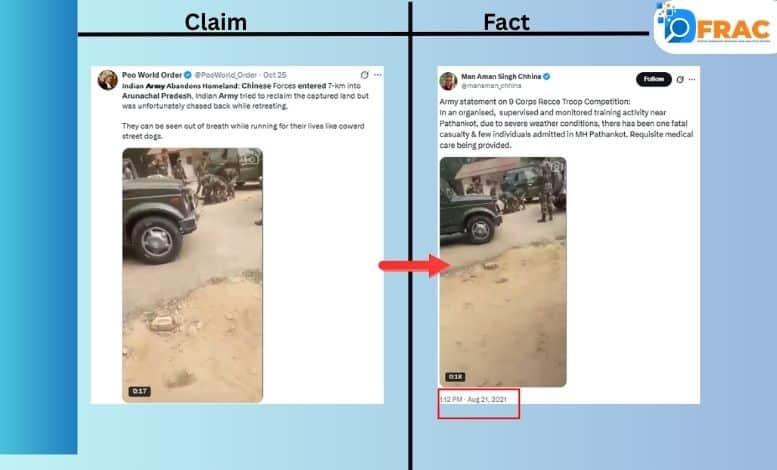
A video from August 2021 was shared with the claim that the Chinese Army has entered a village in Arunachal Pradesh. Originally, the video depicts soldiers collapsing due to severe weather conditions, while it was claimed that the Indian soldiers allegedly retreated from the homeland after facing the Chinese Army.
China-based accounts:
Chinese social media accounts have been actively sharing old videos from the Galwan Valley clash, along with unrelated visuals, to push misleading narratives about Arunachal Pradesh. These posts are subsequently amplified by Pakistan-based accounts and picked up by Indian-impersonating profiles, creating a chain of circulation across different networks. This pattern raises concerns about how old and unrelated footage is being used to portray false developments along the Arunachal Pradesh border and create confusion among Indian audiences.
@wngmngling70608:
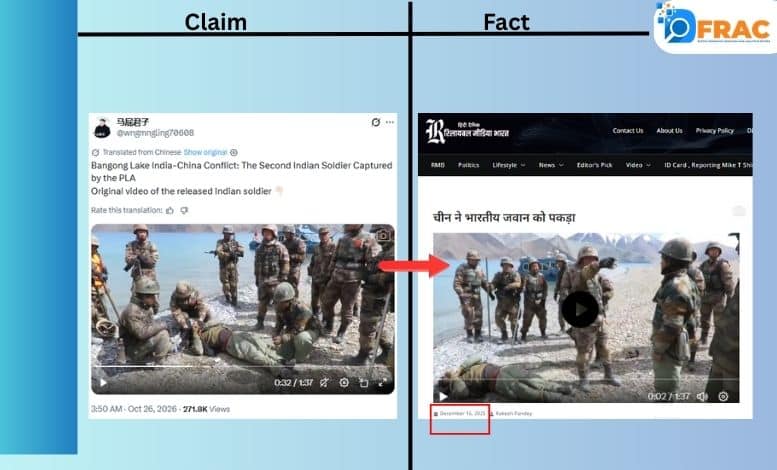
A video from 2025 was shared with the claim that an Indian soldier was captured by a Chinese soldier. The post did not state that the incident was old. Some of the social media posts and reports also provided that the Indian soldier was receiving medical checks from the PLA, but it is not verified.
Conclusion:
The findings of this report highlight how misleading narratives about the Arunachal Pradesh border are being circulated across Chinese, Pakistan-based and Indian-impersonating social media accounts. Old videos from the Galwan clash, unrelated visuals and AI-manipulated content are being used to portray false Chinese incursions and create fear among Indian audiences. The circulation pattern, in which content shared by Chinese accounts is amplified by Pakistan-based profiles and subsequently picked up by Indian-impersonating accounts, warrants closer scrutiny.
At a time when border tensions and military developments require careful reporting, the circulation of unverified claims and manipulated visuals can create unnecessary confusion. Tracing the origins of these posts and exposing their actual context is essential to understanding how misinformation is being used to influence public perception of India’s security situation.