

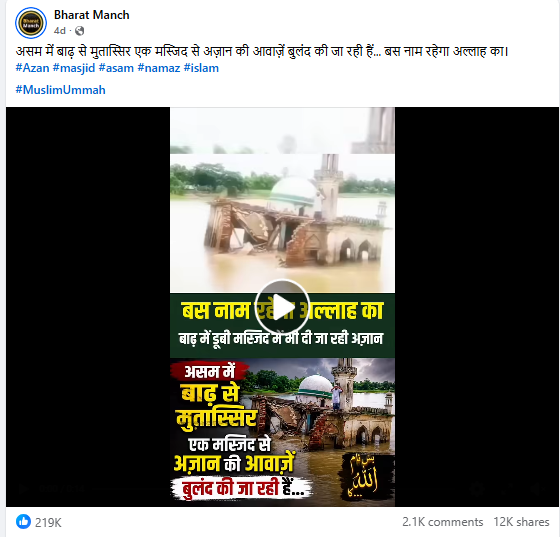
Assam has witnessed widespread devastation due to severe floods. Millions of people have been affected across the state. According to media reports, more than 80 people have lost their lives, while millions have been displaced. Several genuine videos of the floods in Assam have been circulating on social media. Amid this, another video has gone viral claiming to show a man giving the Azaan from the roof of a partially submerged and damaged mosque during the floods. The footage appears as though it was captured using a drone.
A Facebook user named Bharat Manch shared the video with the caption: “The call to Azaan is being raised from a mosque affected by the floods in Assam… Only the name of Allah shall remain.” The post has received more than 200,000 likes and has been shared over 12,000 times.
The same video has also been widely shared on X (formerly Twitter). A user named Azam Khan parody posted it with the caption: “Alhamdulillah..! We are Muslims… The sound of Azaan is echoing from a damaged mosque amid the floods.” This post has also gone viral, garnering more than 9,700 likes.

Our team also found that several Instagram users have shared the same video, which can be seen here and here.
Fact check:
DFRAC’s investigation found that the viral video is not a real video from the Assam floods. Instead, it is AI-generated. AI expert Kumar Aniket, after analysing the footage, also confirmed that it was created using artificial intelligence.
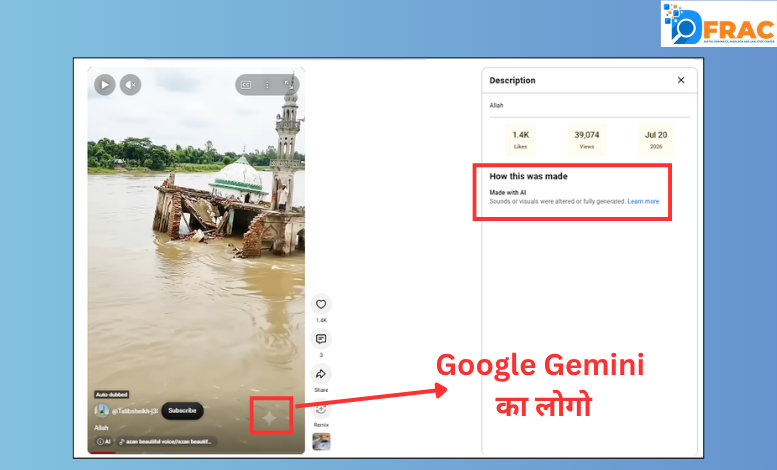
As part of the investigation, DFRAC first extracted keyframes from the video and conducted a reverse image search using Google Lens. We found the same video uploaded on a YouTube channel named Talib Sheikh on July 20, 2026. The post simply contained the word “Allah” without providing any context or description.
Upon closely examining the video, we noticed the Google Gemini logo at the bottom of the frame. This logo typically appears on videos generated using Google Gemini. Furthermore, the video description explicitly states that it was created using AI and that the visuals and/or audio were either modified or entirely generated.
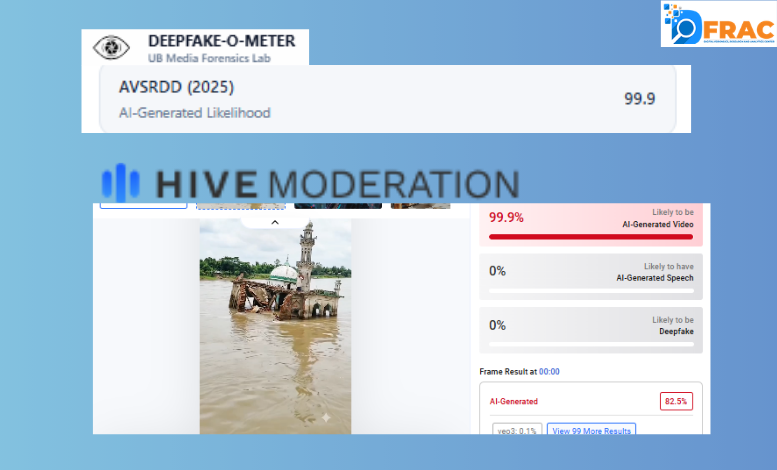
To further verify the authenticity of the footage, DFRAC analysed the video using AI detection tools Hive Moderation and Deepfake-O-Meter. Hive Moderation indicated a 99.9% probability that the video was AI-generated. Similarly, Deepfake-O-Meter also concluded with a 99.9% likelihood that the video was created using artificial intelligence.
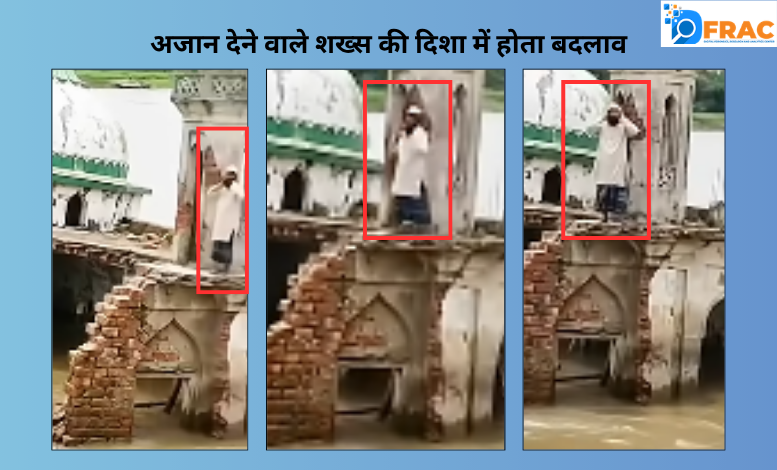
For additional verification, DFRAC consulted AI expert Kumar Aniket, who identified several indicators suggesting the video was AI-generated:
First, the direction in which the man is facing changes from frame to frame. During the Azaan, however, the person remains consistently oriented toward the west (in the Indian context, towards the Qibla), and the direction does not change.
Second, the mosque is shown standing in the middle of a river, despite the riverbanks being clearly visible in the video. Moreover, there are no surrounding buildings or residential structures nearby, making the scene unrealistic.
Third, the movement of the water, lighting conditions, and reflections do not exhibit the physical consistency expected in genuine footage.
Fourth, the video displays several common AI-generation artifacts, including temporal inconsistencies, unstable textures, and rendering distortions across consecutive frames.
Conclusion:
DFRAC’s fact-check confirms that the viral video showing a man giving the Azaan from a flood-submerged mosque is not authentic and has no connection to the Assam floods. Our investigation found that the footage was generated using artificial intelligence (AI). Therefore, the viral claim is misleading.
| Claim Review | Video of a man reciting the Azaan from a damaged mosque submerged in floodwaters in Assam |
| Claimed By | Social Media User |
| Fact Check | Misleading |
Sources:
- Technical analysis by IT expert Kumar Aniket shared with DFRAC.
- AI Detector tool Hive Moderation analysis of the viral Video.
- Deepfake-o-Meter tool analysis of the viral Video.
- YouTube video uploaded on 20th July 2026.