
(Dr. Shujaat Ali Quadri)
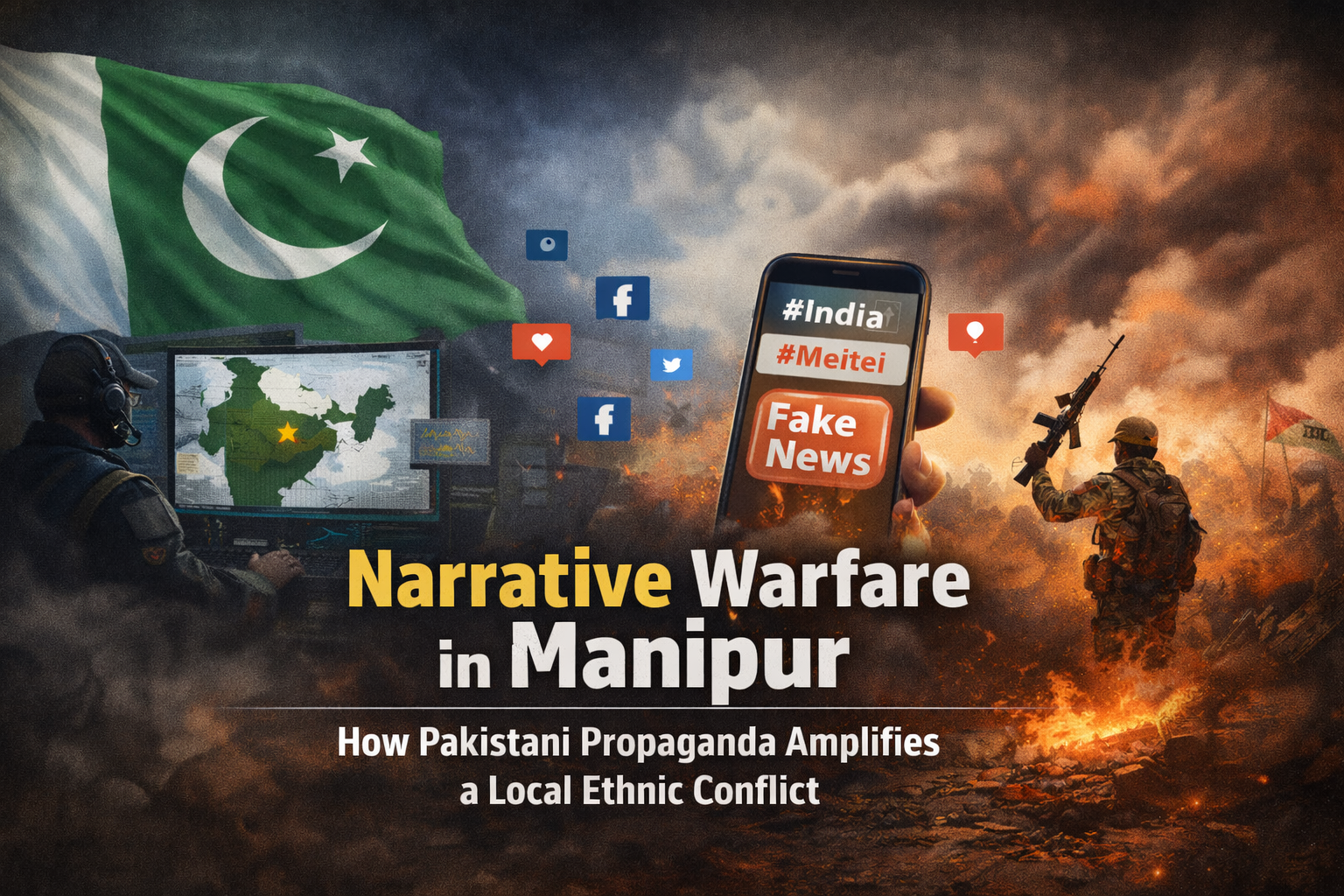
The information environment surrounding the Manipur crisis has been aggressively weaponized. What began as a deeply rooted ethnic conflict has evolved into a high-velocity digital battleground shaped by competing narratives and coordinated amplification. A surge of newly created social media accounts, a relatively small but highly amplified cluster of foreign-based handles, and opportunistic engagement by global audiences and partisan actors within India have collectively produced a sophisticated propaganda ecosystem.
Among these amplifiers are accounts based in, or linked to, Pakistan and Pakistani-language networks. Others operate from diasporic or automated networks. The cumulative effect is predictable: rapid narrative construction, emotional contagion, misattribution of events, and the internationalization of what is fundamentally a localized ethnic conflict. These dynamics raise political stakes, harden identities, and complicate conflict mitigation. This article examines the mechanisms behind this information warfare, outlines what public data reveal, clarifies attribution limits, and proposes practical detection and policy responses.
What the Public Data Reveal
The outbreak of violence in Manipur triggered an immediate explosion of online activity. Independent reporting documented more than 100 newly created social media handles in the early days of the unrest, many explicitly framing events for external audiences rather than local communities. This rapid account creation suggests narrative pre-positioning rather than organic community discourse.
International monitors and conflict analysts have documented significant displacement, prolonged violence, and institutional breakdown in the state. While structural local drivers such as inter-communal tensions and policing failures remain central, analysts also caution that foreign and transnational information operations have amplified the crisis beyond its local capacity to absorb or manage.
Regional investigations have identified Pakistan-based and Pakistan-linked accounts on X (formerly Twitter) and Facebook that amplified anti-Meitei and anti-Indian government narratives. Patterns of coordinated inauthentic behavior including synchronized posting, shared media assets, and repeated hashtag usage indicate structured amplification rather than spontaneous commentary.
Moreover, broader international reporting demonstrates how emotionally manipulative social media content has, in other contexts, contributed to escalating India–Pakistan tensions. This underscores the plausible strategic incentive for actors seeking to exploit polarizing narratives emerging from Manipur. Localized disinformation, when amplified strategically, carries regional consequences.
Mechanisms of Amplification
1. Rapid Account Creation and Narrative Seeding:
In the immediate aftermath of violent incidents, dozens of new accounts often emerge simultaneously. These accounts disseminate graphic imagery, short video clips, and emotionally charged captions designed for virality. The objective is not merely information sharing but narrative framing shaping how events are perceived before verified reporting can stabilize the discourse.
2. Cross-Platform Replication:
Content rarely remains confined to a single platform. A short video or image is reposted across X, Facebook, Telegram, and Instagram, often with slightly modified captions to test engagement levels. Influencers and partisan commentators then amplify the most viral versions, multiplying reach exponentially.
3. Third-Party Credentialing:
Some foreign-based handles present themselves as journalists, human rights observers, or concerned diaspora voices. This performative legitimacy lowers skepticism among global audiences, enabling rapid embedding of their content into mainstream conversations.
4. Hashtag Engineering and Trend Manipulation:
Coordinated hashtag campaigns and synchronized retweet bursts can artificially elevate specific narratives into trending lists. Once algorithmically boosted, these narratives gain organic spillover, reaching users far beyond their initial networks.
5. Blending Truth with Falsehood:
Effective propaganda rarely relies entirely on fabrication. Instead, authentic footage is paired with misleading captions or decontextualized claims. This hybrid approach enhances plausibility while maximizing emotional response.
6. Geopolitical Narrative Bundling:
Pakistan-linked networks often frame developments in Manipur within broader geopolitical narratives, linking them to Kashmir, Assam, or alleged systemic repression. This reframing nationalizes and internationalizes the conflict, attracting audiences far removed from the local context.
Attribution: What We Can and Cannot Conclude
It is possible to document the presence of Pakistan-based accounts among key amplifiers and to identify patterns consistent with coordinated behavior. Independent analyses have mapped clusters of accounts exhibiting synchronized activity and shared messaging.
However, the presence of accounts operating from Pakistan does not automatically establish direct state orchestration. State actors, non-state actors, commercial entities, and diaspora networks can all operate within the same jurisdiction. Definitive attribution requires access to platform-level forensic data, IP traces, device identifiers, and financial links, most of which are not publicly available. Responsible analysis must therefore distinguish between observable coordination and confirmed state control.
The Manipur crisis illustrates how local ethnic violence can become a theatre for transnational information warfare. Pakistan-based accounts represent one identifiable vector within a broader ecosystem of digital amplification. Yet the deeper challenge lies not merely in foreign actors but in systemic vulnerabilities, algorithmic acceleration, verification gaps, and fragile information trust.
The solution extends beyond takedowns and attribution debates. It requires investment in resilient, multilingual local journalism, transparent verification mechanisms, digital literacy initiatives, and platform accountability. Only by strengthening the integrity of the information ecosystem can trust be restored more quickly than the next viral falsehood spreads.