
After gaining independence from British colonial rule in August 1947, India faced the monumental task of integrating over 560 plus princely states, semi-autonomous entities that had been under British suzerainty but not direct control. These princely states were given the option to accede to either India or Pakistan, or, in theory, to remain independent. Under the leadership of Sardar Vallabhbhai Patel and V.P. Menon, the Indian government initiated a largely diplomatic and legal process to unify these territories. While most states joined the Indian Union voluntarily through the Instrument of Accession, a few complex or contested cases required more assertive measures. This fact check examines the nature of that integration and addresses the claim that India became a colonizing power shortly after independence.
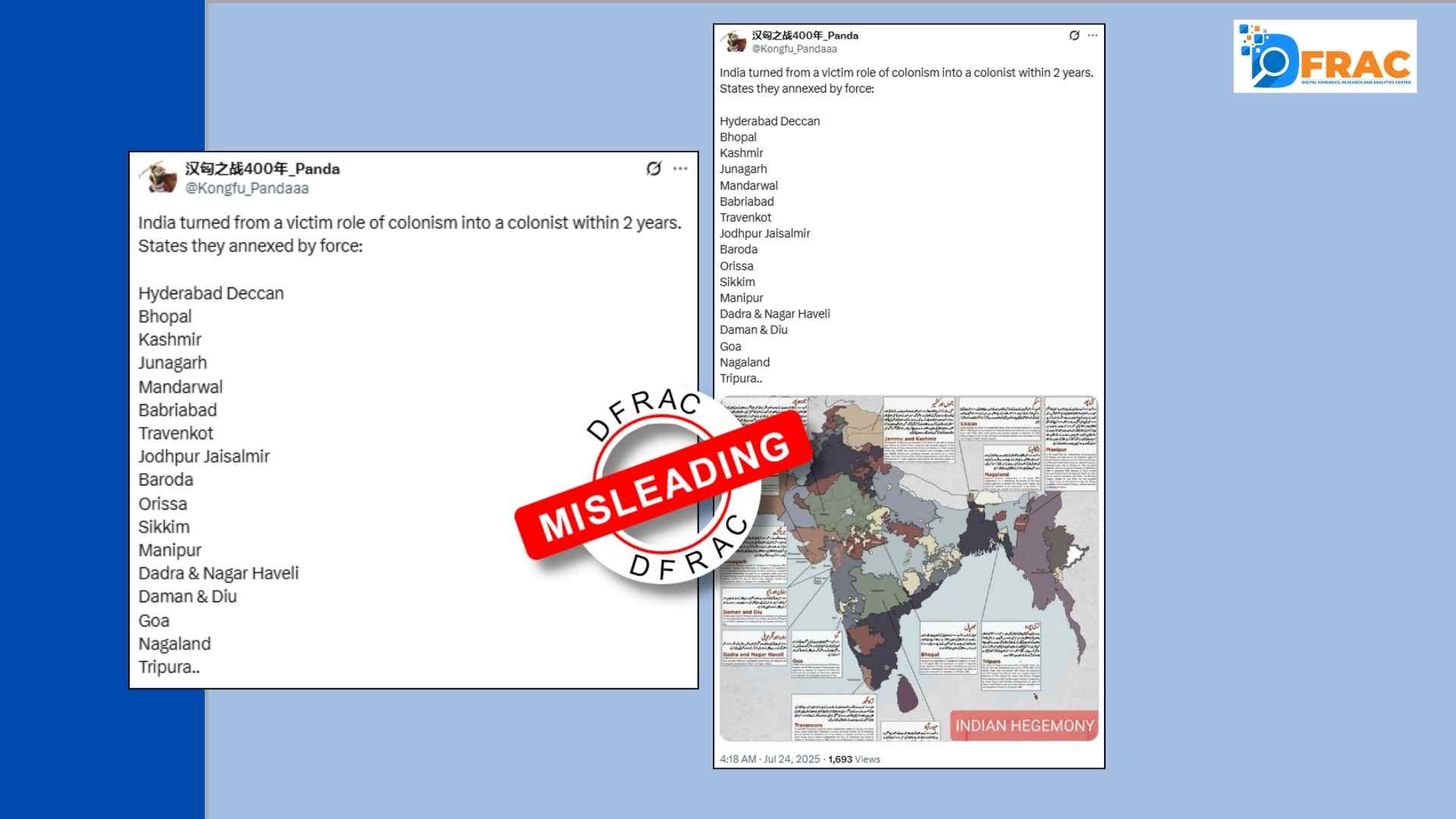
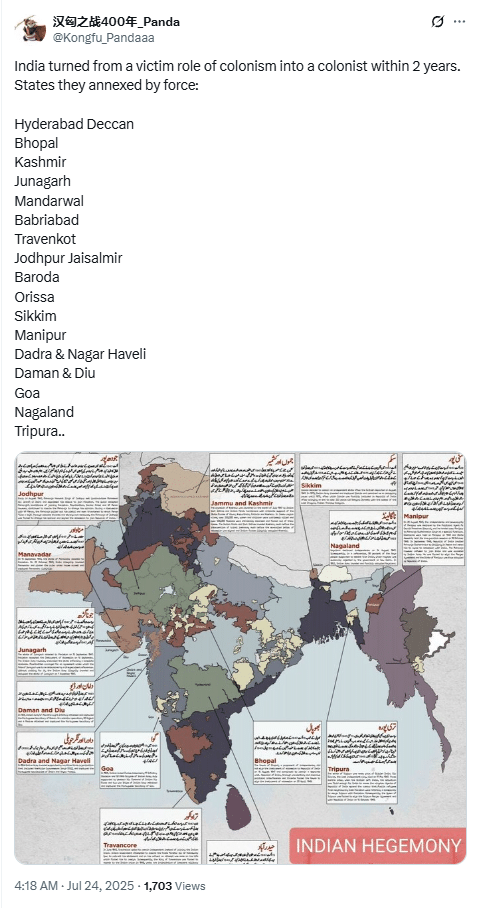
An account named @Kongfu_Pandaaa has shared the claim stating, “India turned from a victim role of colonialism into a colonist within 2 years. States they annexed by force: Hyderabad Deccan, Bhopal, Kashmir, Junagarh, Mandarwal, Babriabad, Travenkot, Jodhpur, Jaisalmir, Baroda, Orissa, Sikkim, Manipur, Dadra & Nagar Haveli, Daman & Diu, Goa, Nagaland, Tripura..”
Fact Check
Upon investigation, the claim was found to be false. At the time of Indian independence in 1947, there were over 560+ princely states under British suzerainty, not direct rule. These states were given the choice to:
-Join India
-Join Pakistan
-Or remain independent (though in practice this was discouraged by both countries)
India did integrate multiple princely states between 1947–1950, but the overwhelming majority joined voluntarily through diplomatic negotiations and legal instruments.
All Other Princely States: All other princely states, including Bhopal, Travancore, Jodhpur, Jaisalmer, Baroda, Manipur, Tripura, etc., joined India by signing the Instrument of Accession, after negotiation or mild political persuasion. Some, like Bhopal and Travancore, initially hesitated but later acceded voluntarily without military action.
Some names in the claimed list do not correspond to known historical princely states in India:
Mangrol & Babriabad: These were tributary states of Junagadh. They declared independence from Junagadh and acceded to India voluntarily before the main Junagadh crisis.
Mandarwal / Mandrail: Not a princely state. It was an administrative unit or town within Karauli State, a legitimate princely state in northeast Rajasthan, ruled by the Jadaun Rajputs.
Orissa: While the coastal region was part of British India, the interior had 26 princely states, which merged voluntarily with India post-1947 and were later integrated into Orissa province.
Special Cases (Post-1947 Integration)
Sikkim: Became an Indian protectorate in 1950; joined India formally after a referendum in 1975.
Goa, Daman & Diu: 1961, Under Portuguese rule, Military action against Portuguese occupation after Portugal refused peaceful transfer.
Dadra & Nagar Haveli: 1954, Liberated by Indian nationalists from the Portuguese; later integrated.

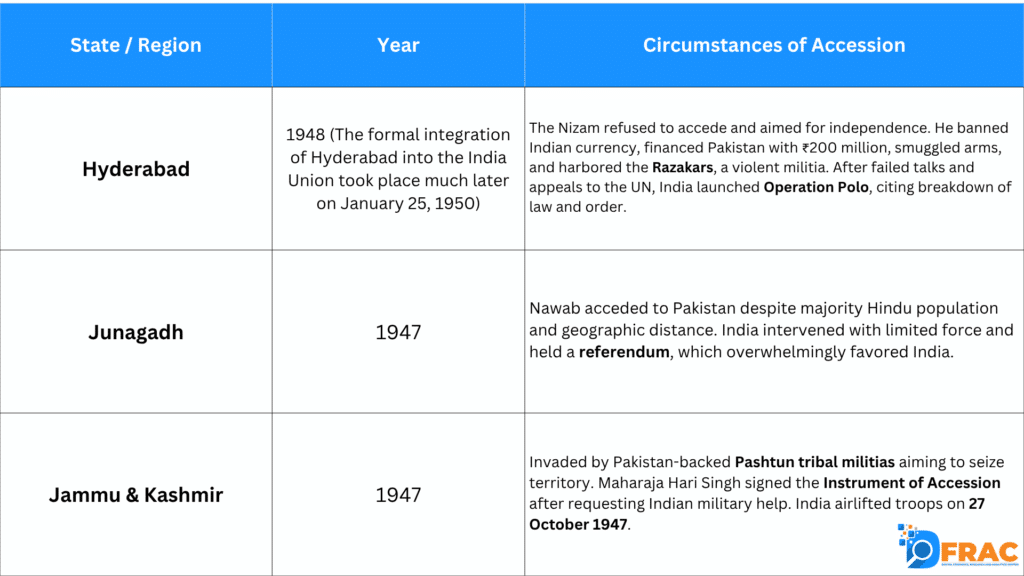
Only three significant cases involved military force or conflict, and even those had specific internal or external triggers, not colonial motives. Below, we provide a table for the cases of military action for the accession of Hyderabad, Junagarh, and Jammu & Kashmir.
Conclusion
The claim stands as FALSE.
India’s actions were geographically confined to adjacent regions, many of which shared historical, linguistic, and cultural ties with pre-colonial Indian kingdoms. These were not colonies; they were integrated as equal constitutional units under Indian federalism. There was no overseas conquest, no settler colonialism, and no economic exploitation resembling European colonialism. These regions later became equal parts of the Indian Union, not colonies.