With the rapid expansion of digital media and social media platforms, the impact of information warfare and organized disinformation campaigns continues to grow. Particularly in a sensitive and strategic region like Northeast India, digital networks that influence online narrative-building, political polarization, and regional discontent have become a matter of serious concern. During this investigation, a detailed analysis was conducted on a digital media platform named Voice of North East India (VONEI) and its associated alleged columnist network, which revealed several suspicious technical, social media, and content-related patterns.
A study of the platform revealed that VONEI presents itself as a media organization that is “independent,” “credible,” and “the real voice of the Northeast.” However, an analysis of its published articles, social media activities, alleged columnist profiles, and digital network structure exposed several serious contradictions. In a large number of articles published on the platform, topics such as security crises, human rights violations, political failures, militarization, and regional discontent were consistently presented through a uniform ideological framing. The use of emotional language, selective facts, and narratives that foster distrust toward institutions was observed in several articles and posts, reinforcing the suspicion that this may not merely be independent journalism but part of an organized narrative-building ecosystem.
The impact of such disinformation networks can be particularly severe in a sensitive region like the Northeast, where issues related to identity, regional pride, ethnic tensions, and political sensitivities are already fragile. In such a scenario, misleading information, communal framing, and separatist narratives can become tools for increasing social distrust, creating suspicion toward institutions, and strengthening online polarization.
Fake Media Institution and Columnists
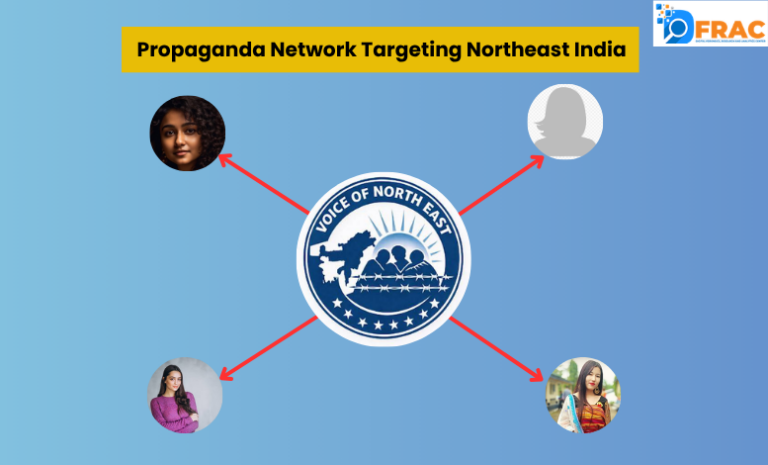
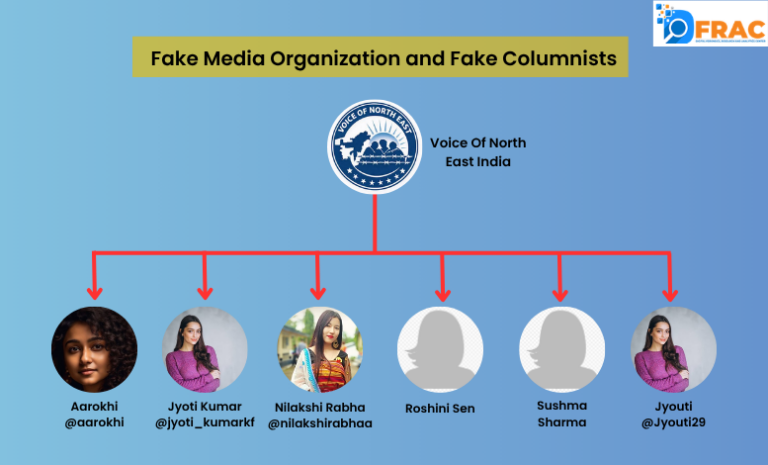
Our investigation reveals the structure of an organized digital ecosystem surrounding the Northeast, at the center of which appears to be a platform called Voice of North East India (VONEI). This platform presents itself as a media institution focused on news, opinions, and socio-political issues related to the Northeast. However, an analysis of its digital content and published columns revealed several suspicious patterns. During the study, it was found that many articles, posts, and alleged analyses published on the platform’s website and its associated social media handles appear to operate in a uniform ideological direction, displaying signs of separatist framing, political polarization, and the provocative presentation of sensitive regional issues.
This network includes several alleged “columnists” whose identities appear suspicious. Content published under their names is presented as legitimate public opinion or independent analysis. These columnists include Aarokhi Deshmukh Aarokhi (@aarokhi), Jyoti Kumar (@jyoti_kumarkf), Nilakshi Rabha (@nilakshirabhaa), Roshini Sen, Sushma Sharma, and Jyouti (@Jyouti29) Aarokhi (@aarokhi), Jyoti Kumar (@jyoti_kumarkf), Nilakshi Rabha (@nilakshirabhaa), Roshini Sen, Sushma Sharma, and Jyouti (@Jyouti29).In the content published through these columnist profiles, claims were repeatedly made without adequate fact verification, selective events were presented out of context, and sensitive issues were amplified in an emotional and misleading manner. In some cases, the same narrative was repeatedly disseminated through different profiles and social media accounts, suggesting a coordinated digital campaign.
What is Voice of North East India?
The website VONEI – Voice of North East India presents itself as a modern and independent digital news platform, claiming to bring forward the real voice of Northeast India. In its introduction, the platform promotes itself through claims of unbiased journalism, fact-checking, reliable reporting, and freedom from political or corporate influence. On the surface, this introduction resembles that of a typical independent media organization. However, an analysis of the content, columns, and social media activities published on the platform reveals several contradictory patterns. Most notably, despite claims of independent reporting and authentic storytelling, many articles and posts display one-sided narratives, emotional language, and the selective use of facts.
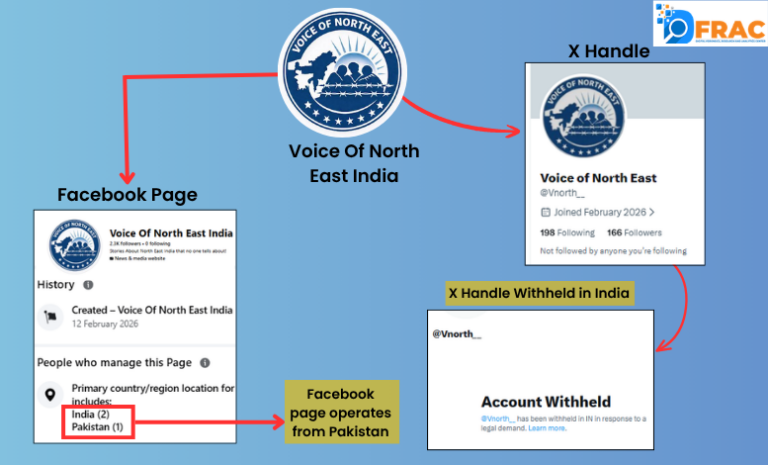
During the investigation, an analysis of the social media network associated with VONEI revealed several critical and suspicious findings. According to the prepared graphical map, VONEI’s Facebook page appears to be operated not only from India but also from Pakistan. The Page Transparency information on Facebook indicates that page administrators are located in both India and Pakistan. For any regional Indian media platform, this fact is highly significant and sensitive, particularly when the platform actively publishes content concerning political and social issues in a strategically important region such as the Northeast. Additionally, VONEI’s X (formerly Twitter) account has been withheld in India. Generally, an account being withheld in India indicates that action has been taken against the account or its content following a legal complaint, government order, or platform policy enforcement.
Website Domain and Web Address
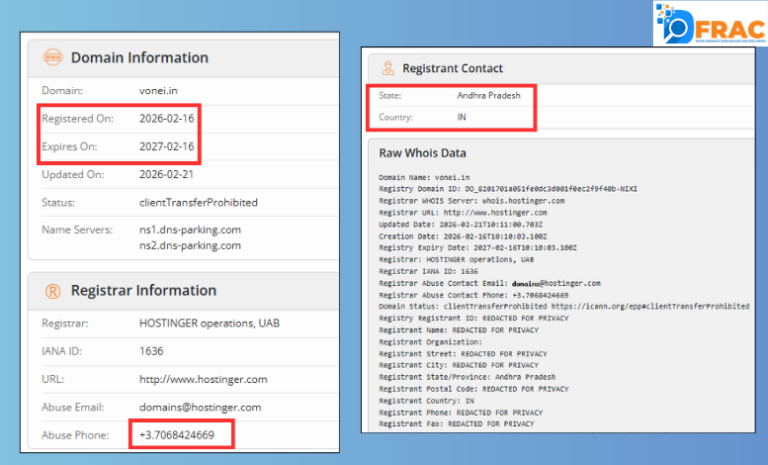
Domain intelligence and WHOIS data analysis revealed several key technical indicators linked to the Voice of North East India (VONEI) website. According to available records, the domain was registered in February 2026 and is valid until 2027. The WHOIS record lists HOSTINGER Operations, UAB as the registrar, while technical details identify Andhra Pradesh, India, as the registrant location. Additionally, a contact number beginning with the country code +370 is listed in the records. This country code belongs to Lithuania, making the technical infrastructure of this network more intriguing and worthy of further investigation.
Posted a Controversial Map of India
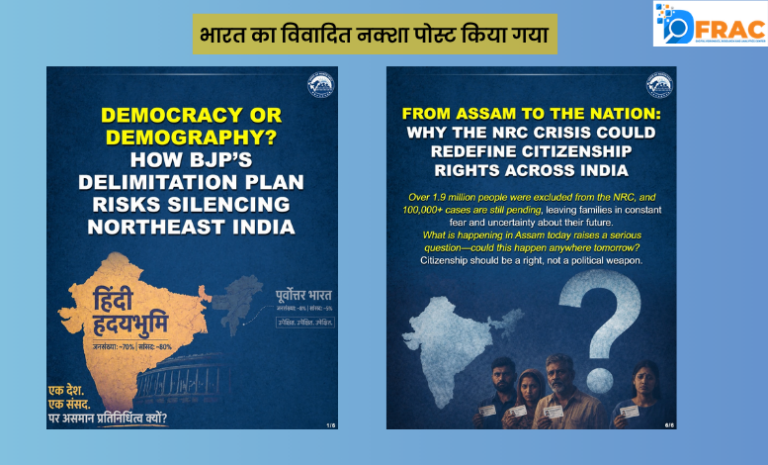
During our investigation of VONEI’s Facebook page, we found that a controversial map of India was posted in multiple uploads. In two Facebook posts, Jammu & Kashmir and Ladakh were omitted from the map of India. This does not appear to be a mere error but rather content published under a specific agenda.
How Was the Fake Columnist Exposed?
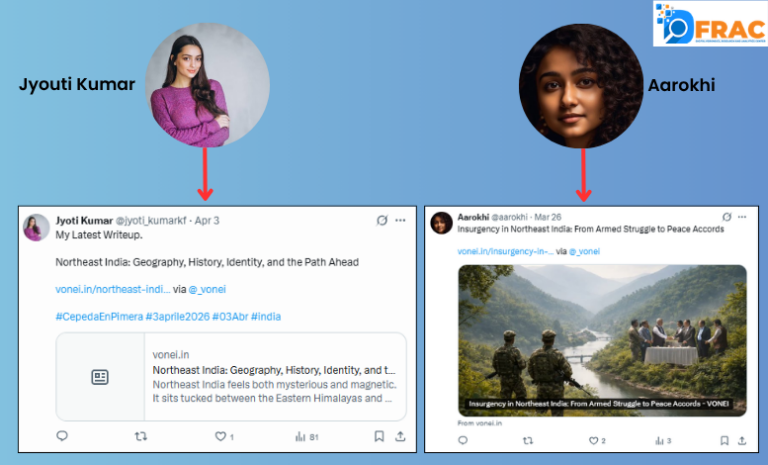
While investigating the individuals writing columns for VONEI, our team identified two X (formerly Twitter) handles, namely Jyoti Kumar and Arokhi, that had shared articles from the VONEI website. Jyoti Kumar claimed in a post to be the author of a particular article, while Arokhi shared an article published under the name Arokhi Deshmukh.
Geographical Location of the Alleged Propaganda Columnists
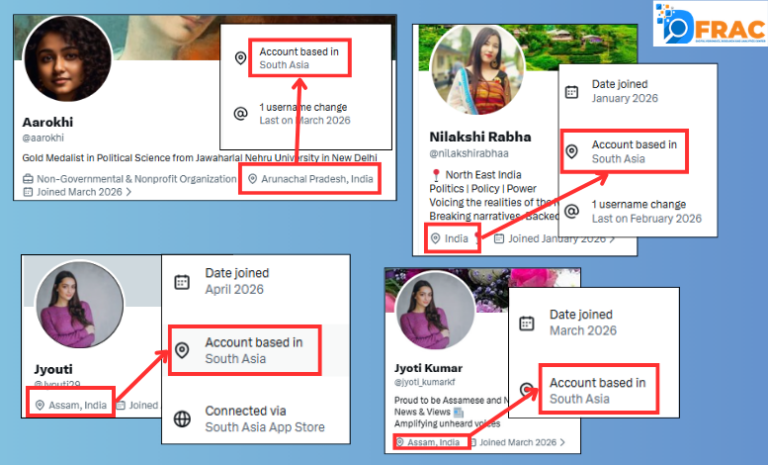
During the investigation, an analysis of the alleged columnist profiles associated with the VONEI network revealed several unusual and suspicious digital patterns. The profiles identified in the graphical analysis include Aarokhi (@aarokhi), Nilakshi Rabha (@nilakshirabhaa), Jyouti, and Jyoti Kumar (@jyoti_kumarkf). All these profiles portray themselves as being connected to different regions of India, particularly Arunachal Pradesh, Assam, and the broader Northeast region. Information such as “Arunachal Pradesh, India” and “Assam” appears in their profile biographies and location fields, indicating an attempt to establish themselves as local and authentic Northeast-based voices.
However, a recurring pattern was observed in the public account information available on X, where several profiles display the location indicator “Account based in South Asia.” While this designation alone may simply indicate a broad regional identity, the appearance of the same indicator across multiple allegedly local profiles raises questions regarding the actual location and operational structure of the network. This concern becomes more significant when these accounts are consistently observed promoting similar narratives on sensitive political and social issues.
The analysis also revealed that some accounts show indicators such as recent username changes and a limited digital history. For example, the Nilakshi Rabha profile shows a record of username changes, matching a pattern often used in coordinated digital operations. Additionally, the creation and activity timelines of some profiles appear within almost the same period, further strengthening the suspicion that these accounts could be part of an organized network structure. The most significant fact that emerged is that Nilakshi Rabha’s X account appears in a ‘withheld’ status in India. Generally, an account being withheld in India indicates that action has been taken against that account or its content due to a legal complaint, government request, or platform policies.
How Many Articles Were Published Under Each Name?
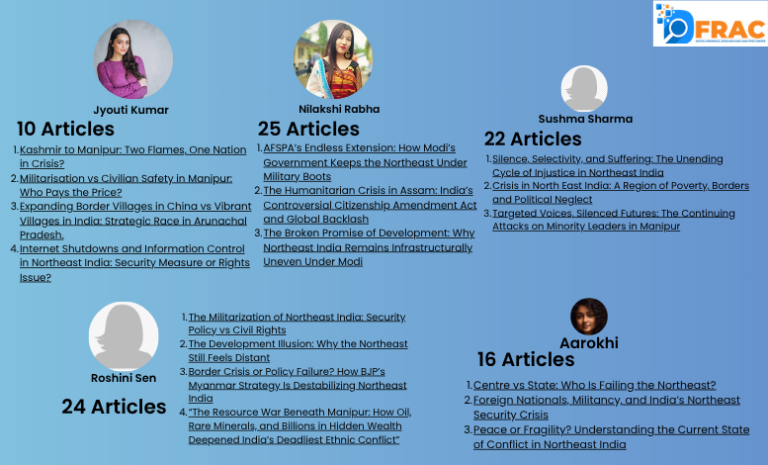
A content analysis of the alleged columnist network associated with VONEI revealed that a substantial number of articles on the platform were consistently published under a limited set of profiles. The highest number of articles (25) was published under the name Nilakshi Rabha, followed by Roshini Sen (24), Sushma Sharma (22), Aarokhi (16), and Jyouti Kumar (10). This pattern suggests that content creation and narrative dissemination on the platform are concentrated among a small number of selected profiles. The most significant aspect of the analysis was the thematic framing of these articles. Topics such as security crises, human rights violations, political failures, militarisation, ethnic conflict, separatist dissent, and distrust toward government policies appeared prominently and consistently throughout the published content.
The investigation also revealed that the language and structure of these articles appear more opinion-driven and narrative-centric than standard news reporting. In many cases, factual events were presented through emotional and conflict-oriented framing, creating a consistent portrayal of Northeast India as a perpetually troubled, neglected, and unstable region. Furthermore, despite being attributed to different columnist profiles, the articles displayed remarkable similarities in themes, writing style, and narrative direction. This strengthens the suspicion that the platform may not simply represent a collection of independent writers but rather a coordinated editorial ecosystem in which multiple identities are used to create the impression of broad-based support for the same narrative. Of particular significance is the fact that the social media accounts associated with these columnist profiles also exhibited suspicious digital patterns, including South Asia-based account indicators and, in some cases, withheld status. These observations further reinforce suspicions of coordination between the platform’s content network and its broader social media ecosystem.
Website Content Analysis
An analysis of the articles and published content available on the platform clearly indicates that the website extends beyond conventional news reporting. Instead, it consistently amplifies a particular political, security, and regional narrative. The majority of the published articles frame Northeast India primarily through themes of conflict, militarization, political failure, human rights crises, and institutional oppression.
One of the most prominent patterns identified in the content analysis is the victimhood narrative, in which Northeast India is repeatedly portrayed as a neglected and insecure region subjected to state repression. For example, articles such as Blood on the Frontier, Peace Accords or Political Deals?, The Architecture of Impunity, and Elections Under Fire predominantly present Indian security institutions, the central government, and democratic processes through a negative lens. The analysis further revealed the repeated use of a “Delhi vs. Northeast” framing. In several articles, the central government was portrayed as an external and oppressive force, while the identity, culture, and politics of the Northeast were presented as victimized entities. This pattern is particularly visible in articles such as From Margins to Majority and Peace or Fragility?, where political developments were framed as examples of central control and suppression of local identity rather than as ordinary democratic processes.
| User/Columnist | Platform/ Profile | Content | Analysis |
| Nilakshi Rabha | VONEI / X – @nilakshirabhaa | 25+ Published Articles Active on Political and defence issues | Prominence given to militarization, human rights, and anti-establishment narratives; account withheld in India, deepening suspicions regarding network activities. |
| Roshini Sen | VONEI / Social Media Profiles | 24+ Articles; Focused on Regional Discontent and Political Issues | Narratives portraying the North-East as a neglected and unstable region are amplified; emotional framing is dominant. |
| Sushma Sharma | VONEI / Website Columns | 22+ Articles; Content Based on Institutional and Political Criticism | Erosion of trust in security institutions and government policies—a strong indication of an opinion-driven narrative. |
| Aarokhi | VONEI / X – @aarokhi | 16+ Articles; Active on Social and Political Issues | The constant highlighting of conflict, repression, and identity-based issues appears to be part of the network’s coordinated narrative ecosystem. |
| Jyouti Kumar | VONEI / X – @jyoti_kumarkf | 10+ Articles; Limited but Regular Activity | Content related to regional discontent and political polarization was shared; narrative patterns similar to those of other profiles are evident. |
| Voice of North East India (VONEI) | Website / Facebook / X | Organized Digital Content Network; Regular Articles and Social Media Amplification | The crisis, militarization, and anti-Centre framing regarding the North-East are being continuously amplified; India-Pakistan location signals within Facebook operations—along with a network of withheld X accounts—render the activity suspicious. |
The Nexus’ Connection with Another Pakistani Propaganda Platform
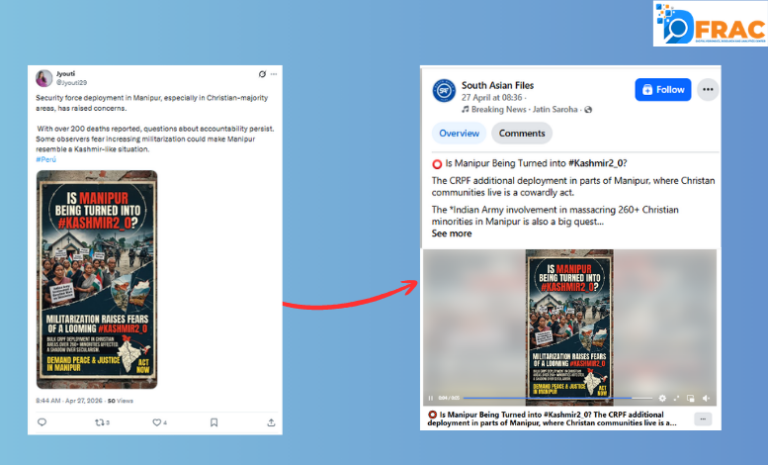
During the investigation, we found that the Jyoti Kumar handle shared a postcard comparing Manipur to Kashmir while criticising the deployment of security forces. The post attempted to construct a narrative suggesting that military deployment in both Kashmir and Manipur compromises minority security and violates human rights. Further investigation revealed that the exact same postcard had also been shared by a Facebook page named South Asian Files. The post stated: “Is Manipur being turned into ‘Kashmir 2.0’? The additional deployment of CRPF personnel in parts of Manipur where the Christian community resides is a cowardly move. The involvement of the Indian Army in the massacre of over 260 Christian minorities in Manipur also raises serious questions about secularism in India. This heavy deployment is turning Manipur into another Kashmir—an emerging ‘Kashmir 2.0’.”
South Asian Files Operates from Pakistan
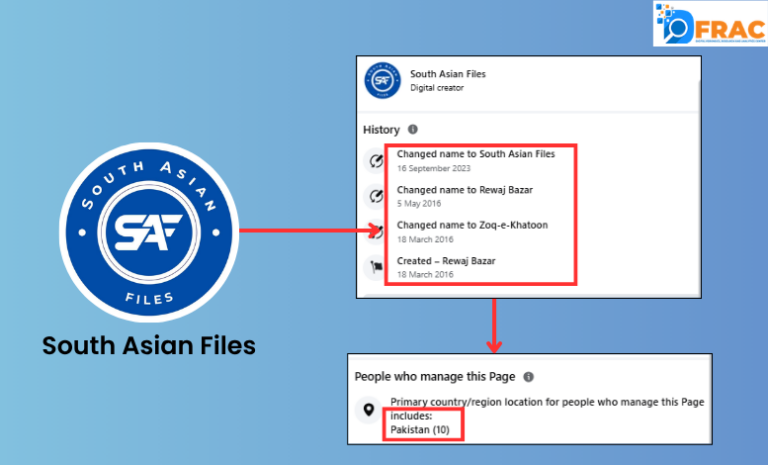
We conducted an in-depth investigation into the Facebook page South Asian Files. The investigation revealed that the page is operated from Pakistan by ten administrators. It also showed that the page has undergone multiple name changes over time. When the page was created on 18 March 2016, it was named Rewaj Bazar, an online e-commerce platform for small and medium-sized fashion retailers in Pakistan. It was later renamed Zoq-e-Khatoon, then reverted to Rewaj Bazar, and was ultimately renamed South Asian Files on 16 September 2023, under which name it continues to operate. Our analysis suggests that the account is currently being used to disseminate anti-India propaganda narratives.
Conclusion
This investigation and digital analysis indicate that Voice of North East India (VONEI) does not appear to function merely as a conventional news platform. Rather, it appears to serve as a vehicle for promoting a structured narrative around sensitive issues related to Northeast India. Several coordinated patterns emerged across the platform’s content, alleged columnist network, social media activities, and technical infrastructure. Themes such as militarisation, political dissent, distrust toward institutions, and regional crises were repeatedly amplified across multiple channels. Taken together, these findings point toward a potential digital influence ecosystem that warrants deeper investigation and continued monitoring.