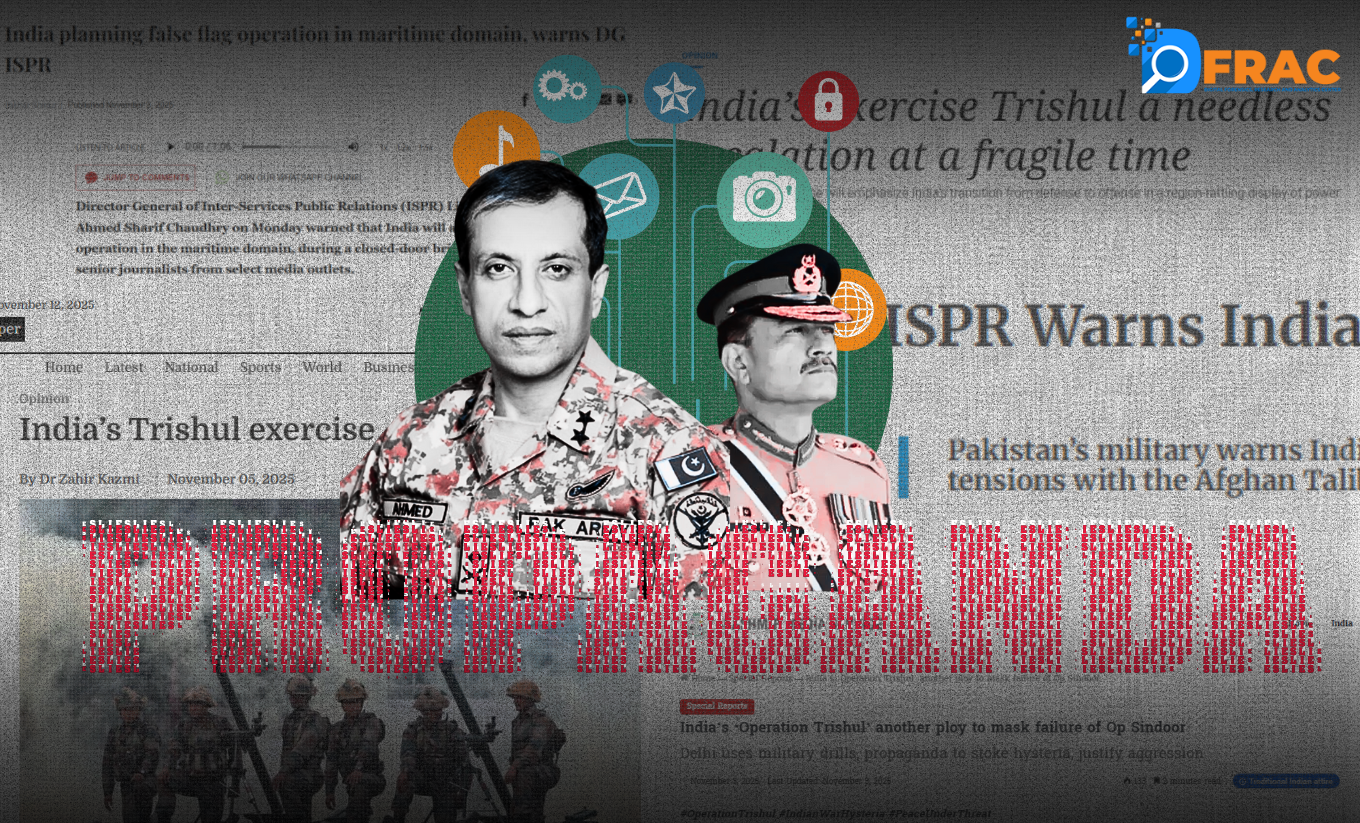
When Pakistan’s propaganda machine activates, it doesn’t happen in isolation. It’s not a few random trolls on Twitter or a handful of suspicious accounts pushing a narrative. What we uncovered in our investigation of the campaign against India’s Operation Trishul is something far more systematic. This well-oiled assembly line runs from military briefing rooms through newsrooms and into the digital trenches of social media. This is the story of how that machine works, and how we traced its operations.
The Spark: An ISPR Briefing Room in Rawalpindi
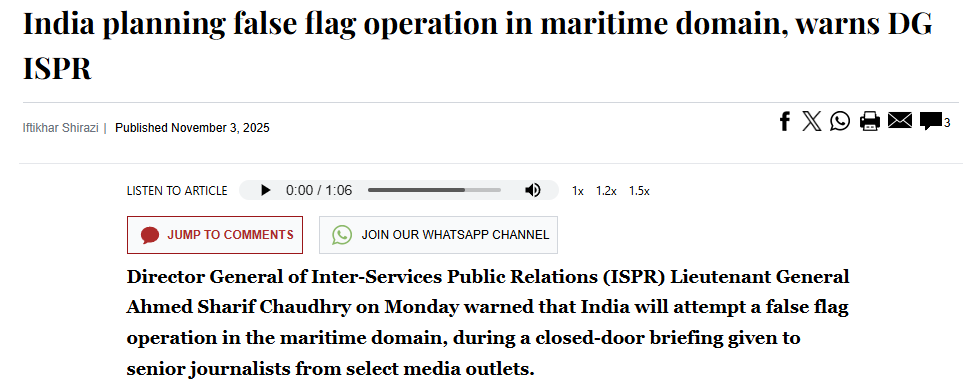
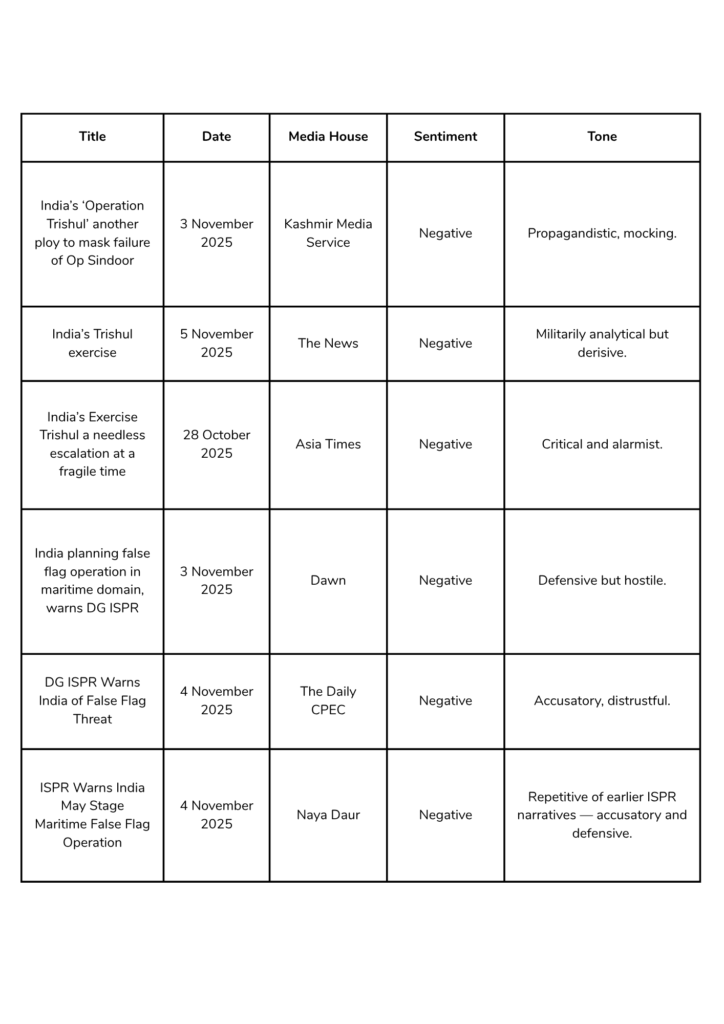
It began on November 4th, 2025, in a closed-door briefing room where Lieutenant General Ahmed Sharif Chaudhry, Pakistan’s Director General of Inter-Services Public Relations, sat down with a carefully selected group of journalists. The ISPR chief delivered a warning that would reverberate through Pakistan’s entire media ecosystem: “India will attempt a false flag operation in the maritime domain.”
That single sentence became the seed for everything that followed. It wasn’t a press conference open to all media. It wasn’t a public statement. It was a controlled environment with handpicked journalists who could be trusted to carry the message exactly as intended. And they did.
General Chaudhry added another line that day, one that carried an unmistakable threat: “Let India do whatever it wants, on land, in the sea, or in the air. India must know that this time, the response will be far more severe.”
The Echo Chamber: When News Becomes Narrative
Within hours of that briefing, Pakistan’s media landscape began moving in perfect synchronization. The Dawn published the ISPR statement. Their coverage included General Chaudhry’s warning verbatim, lending the imprimatur of serious journalism to what was essentially a military press release. But The Dawn was just the beginning. Daily CPEC, a social media account that has transformed itself into a news outlet, picked up the story and ran identical talking points. The article offered no additional reporting, no independent verification, just amplification of the official line.
Naya Daur TV, a digital news platform, went harder on the “false flag” angle, making it the centrepiece of their coverage. Their framing suggested not just a warning but an imminent threat that viewers needed to understand and fear.
Then came Kashmir Media Service, an outlet our investigation identified as having a documented history of publishing fabricated news. KMS didn’t just report the ISPR statement; they editorialized it into: “India has launched yet another propaganda campaign under the name ‘Operation Trishul’ to divert attention from its humiliating failure in the recently exposed ‘Operation Sindoor.'”
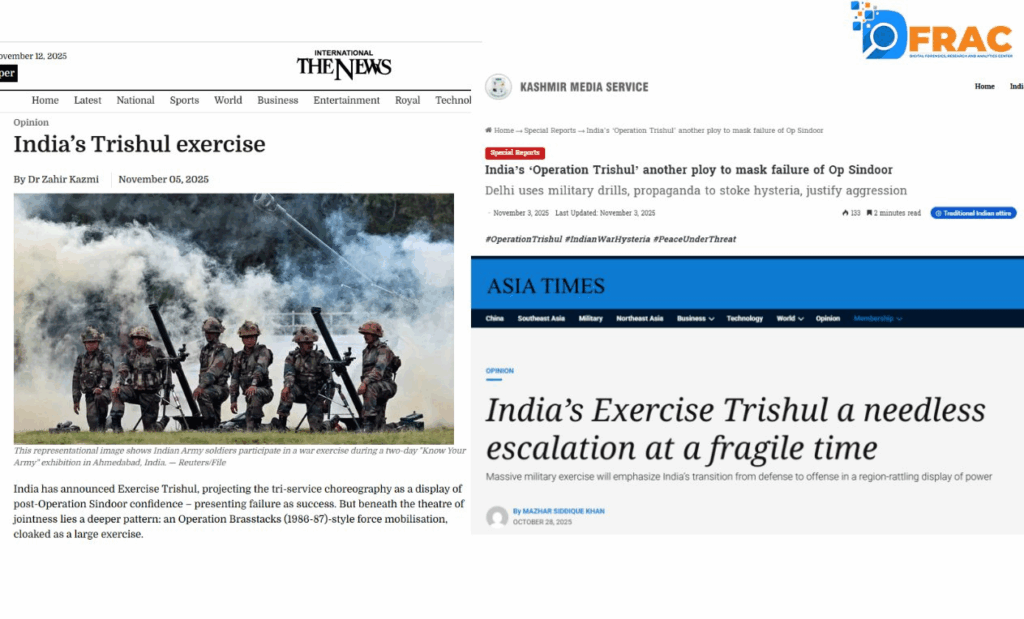
KMS went further, claiming that what began as a “routine Indian tri-service drill” had been “deceitfully repackaged by the Indian media into a full-blown Operation, a drama of deception meant to manipulate public perception and manufacture tension along Pakistan’s western borders.” Every sentence reinforced the central narrative: India was lying, India was manipulating, India was manufacturing a crisis.
Asian Times published a piece with a deceptively measured tone, describing Operation Trishul as “a needless escalation at a fragile time.” The framing was subtle but effective.
The News, another major Pakistani publication, took a historical approach, drawing parallels to Operation Brasstacks from 1986-87, when India-Pakistan tensions reached dangerous heights. Their article suggested that beneath “the theatre of jointness lies a deeper pattern: an Operation Brasstacks-style force mobilisation, cloaked as a large exercise.”
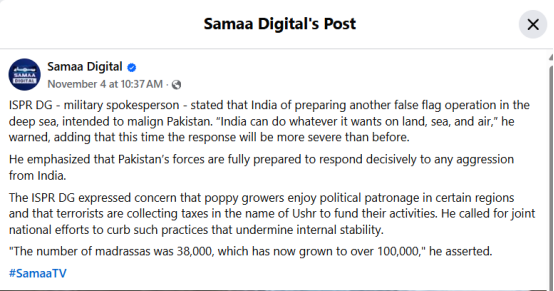
Here’s what struck us during our analysis of this media coverage: the uniformity. Different mastheads, different bylines, different publication styles, but the messaging was remarkably consistent. Every outlet portrayed Operation Trishul negatively. Every piece used similar language, “provocative,” “propagandistic,” “needless escalation,” “false flag,” “coercive agenda,” “political theatre,” “war hysteria.”
The ISPR briefing had provided the narrative framework, and every outlet had colored within those lines.
Sentiment Analysis
When we conducted a systematic analysis of the language used across these publications, the pattern became even more apparent. These weren’t neutral reports about a military exercise. These were pieces deliberately crafted to evoke specific emotional responses and shape perception.
Kashmir Media Service, The News, and Asian Times all framed Operation Trishul as aggressive posturing driven by distrustful motives. The word “provocative” appeared repeatedly. So did “propagandistic.” The consistent negative sentiment across supposedly diverse media sources revealed what we were really looking at: a coordinated information operation where state-provided narratives were being laundered through media outlets to create the appearance of independent verification and consensus.
From Newsrooms to Social Media Warfare
Within hours of the ISPR briefing becoming public knowledge, social media accounts began flooding timelines with AI-generated deepfake videos of India’s senior military leadership.
This wasn’t crude photo manipulation or poorly edited clips. These were sophisticated deepfakes that took genuine interview footage of real military officials and digitally altered them to make these individuals appear to say things they had never said.
The first deepfake targeted Colonel Sofia Qureshi. The manipulated video showed her supposedly appearing on “live Indian TV” and making explosive statements: “These Trishul exercises are nothing but a political gimmick aimed at manipulating the Bihar elections. I’m sick of being used as a prop for Muslim support. I can’t stand the saffronization of the Indian Army.” The fake video was designed to exploit communal sensitivities, suggesting that even Muslim officers felt alienated by Hindu nationalism’s alleged influence on the military.
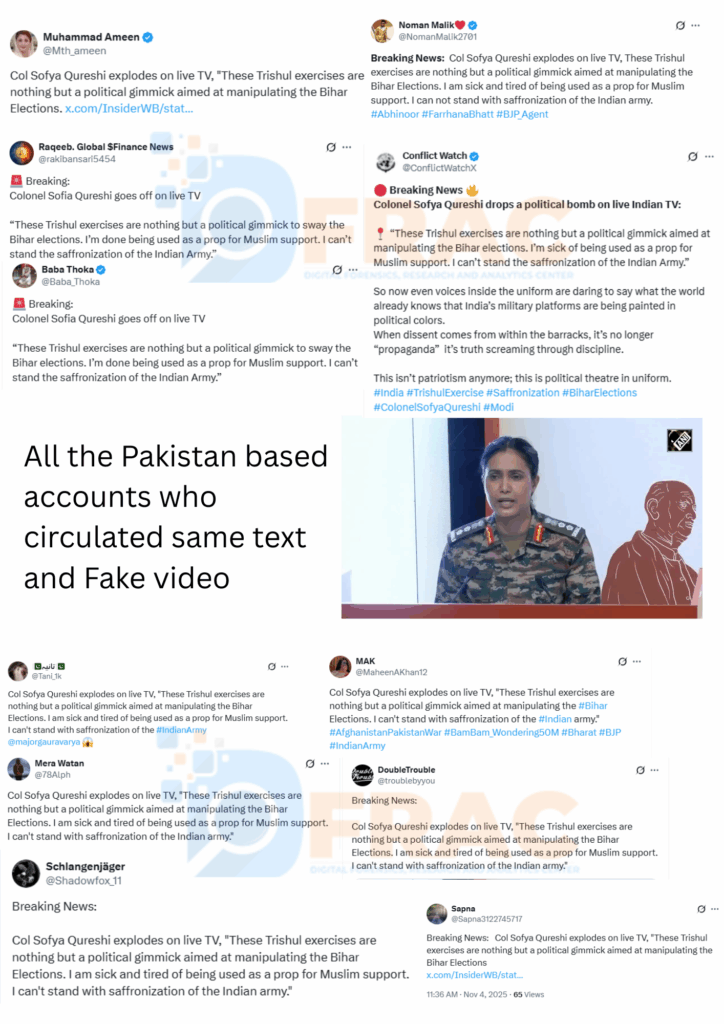
The caption accompanying the fake video drove the point home: “So now even voices inside the uniform are daring to say what the world already knows that India’s military platforms are being painted in political colours. When dissent comes from within the barracks, it’s no longer ‘propaganda’, it’s truth screaming through discipline.”
The second deepfake targeted someone even more prominent: Army Chief General Upendra Dwivedi, India’s highest-ranking military officer. The manipulated video portrayed him supposedly stating: “These so-called Trishul exercises are nothing but political theatre before the Bihar elections.”
The third deepfake targeted the Air Chief Marshal. The fake video showed him supposedly declaring: “I stand with Rahul Gandhi on the issue of casteism within the Indian Army. Trishul exercises are being used to prop up the centre government for Bihar.”
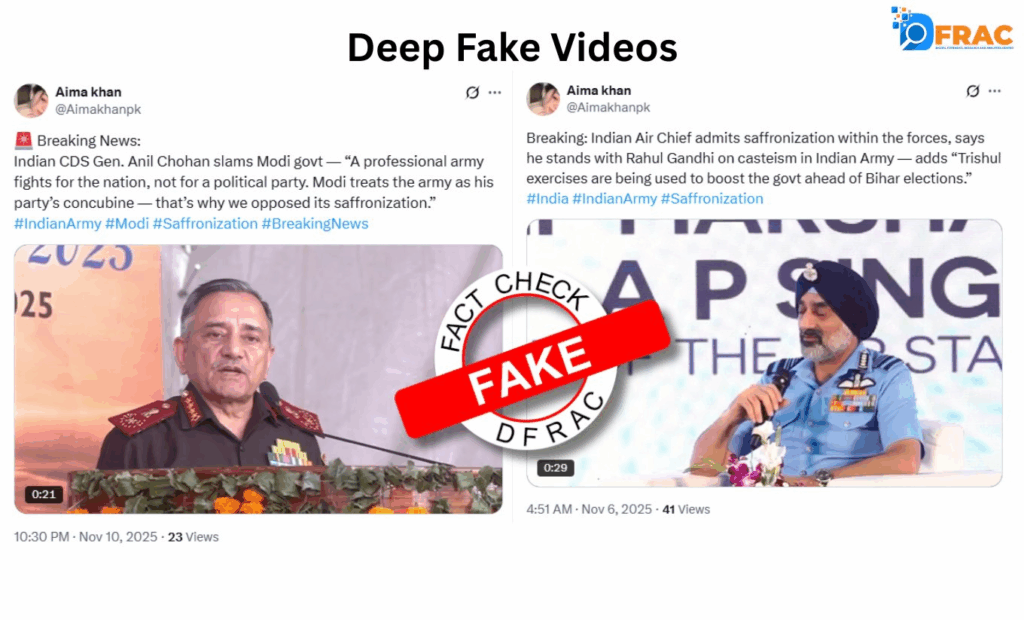
When we analyzed these three deepfakes together, a clear pattern emerged. Every single fabricated statement injected partisan politics into military operations. Every video referenced Bihar elections, suggesting that military exercises were being timed and shaped for electoral advantage. Every deepfake portrayed senior military leadership as opposing government policy and feeling manipulated by political considerations.
Graphics Built for Virality
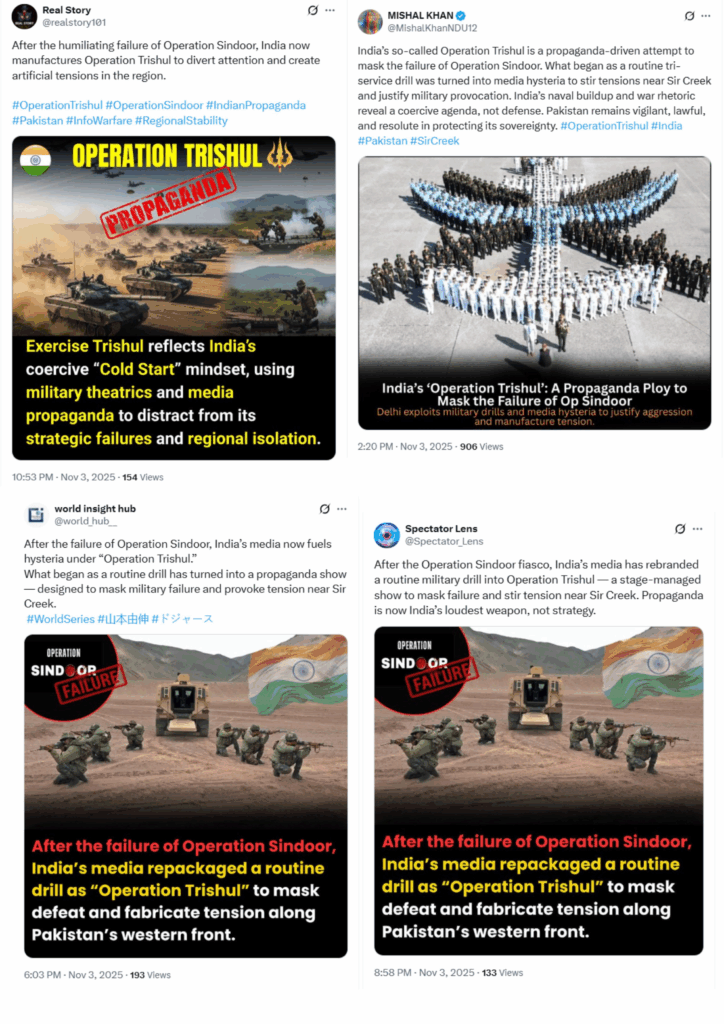
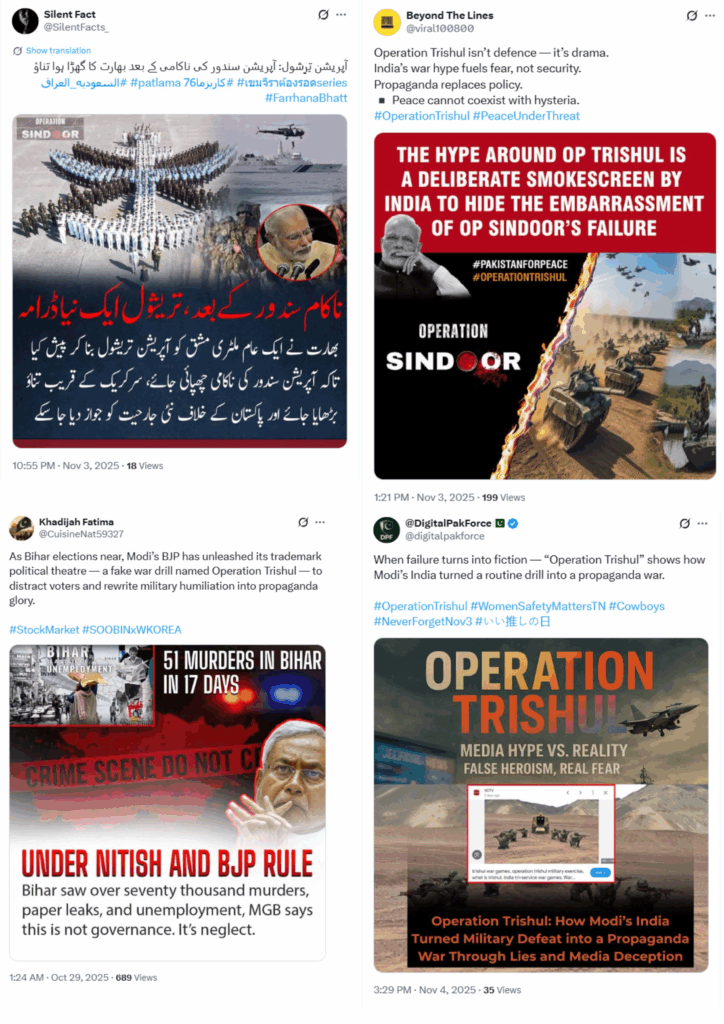
Alongside the deepfakes, another component of the campaign flooded social media: professionally designed graphic images. We identified six distinct graphics, each optimised for maximum shareability across WhatsApp, Facebook, and Twitter.
The graphics hammered consistent themes. “Trishul is propaganda to hide Sindoor’s failure.” “It’s war hysteria for the Bihar elections.” “Modi’s political theatre disguised as defence.” Every image highlighted the narrative that Operation Trishul wasn’t a legitimate military exercise but a political stunt designed to manipulate domestic audiences and distract from previous failures.
It packed multiple narrative elements into a single shareable image. The graphics served a specific function in the broader campaign. While the ISPR statement provided official legitimacy and the media coverage created the appearance of news, these graphics translated the narrative into social media currency, content that could be shared rapidly without requiring readers to click through or read lengthy articles.
Hashtag Warfare: Concentrating the Message
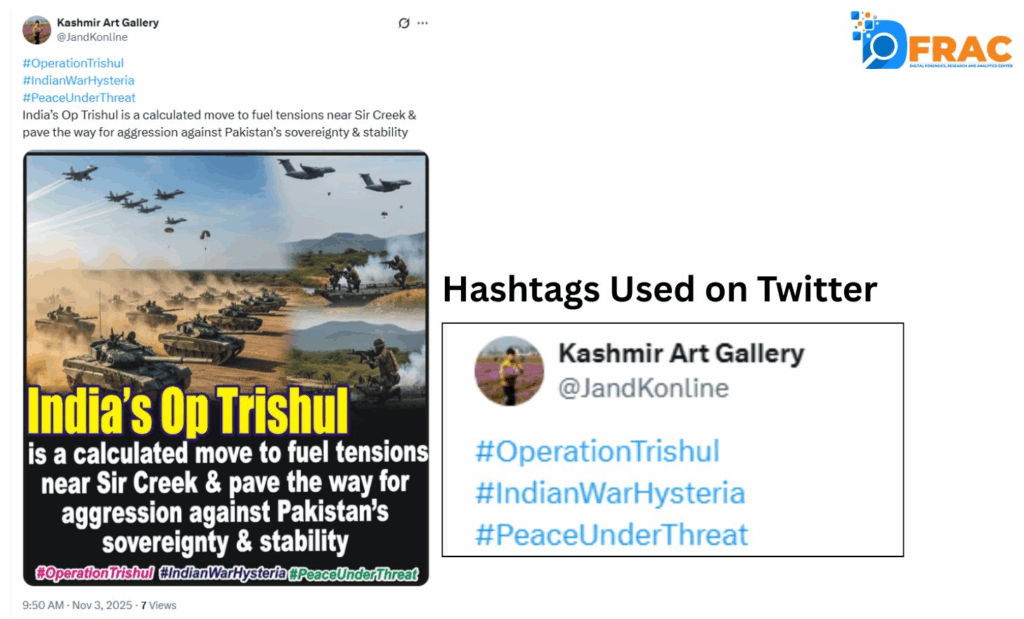
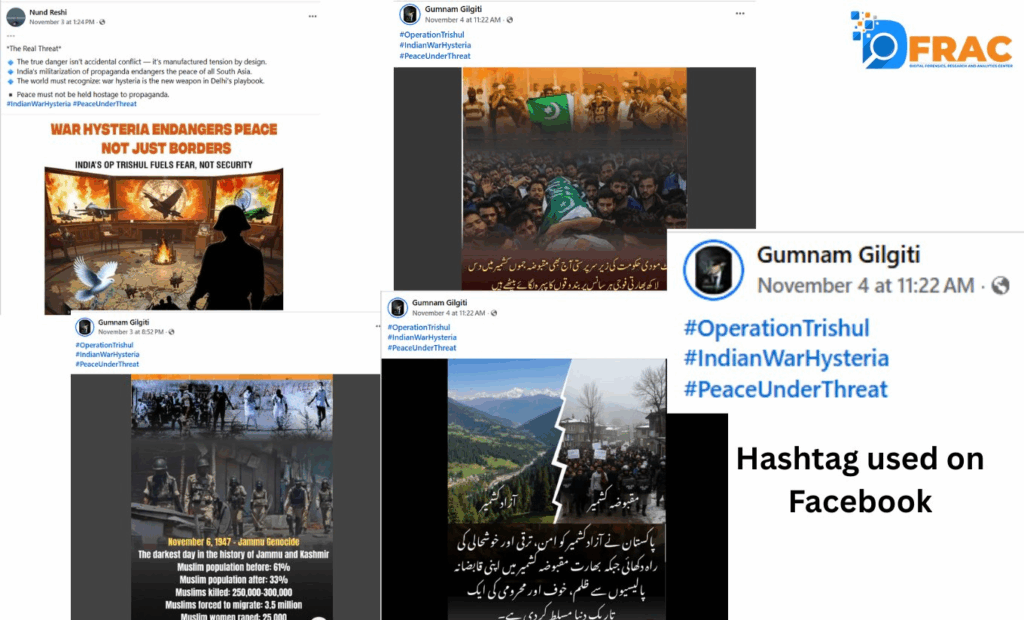
#PeaceUnderThreat and #IndianWarHysteria: These hashtags served multiple purposes. They concentrated disparate content under common identifiers, making it easy for users to find and engage with the campaign. Every Pakistan-origin account pushing the anti-Trishul narrative attached these hashtags to their posts. The graphics carried these tags. The deepfakes were shared with these tags. The hashtags became the organizing principle for the entire social media component of the campaign.
But here’s where the investigation uncovered something crucial: these weren’t new hashtags created specifically for Operation Trishul. #PeaceUnderThreat and #IndianWarHysteria were the exact same hashtags used during the previous Operation Sindoor campaign.
Bot Account
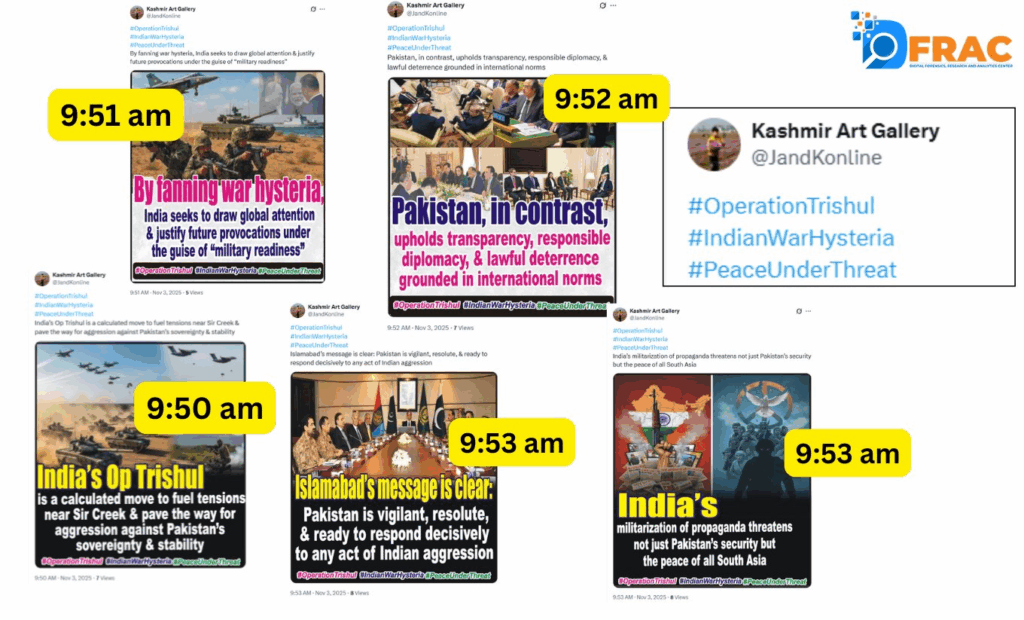
The most concrete evidence of coordination came from analyzing posting patterns on social media. During our investigation, we identified a specific account that exhibited behaviour inconsistent with human activity.
On November 3rd, 2025, this account posted five separate messages about Operation Trishul. The posts appeared at exactly 9:50 AM, 9:51 AM, 9:52 AM, 9:53 AM, and 9:53 AM. Five posts in approximately three minutes, with mechanical regularity.
The Assembly Line
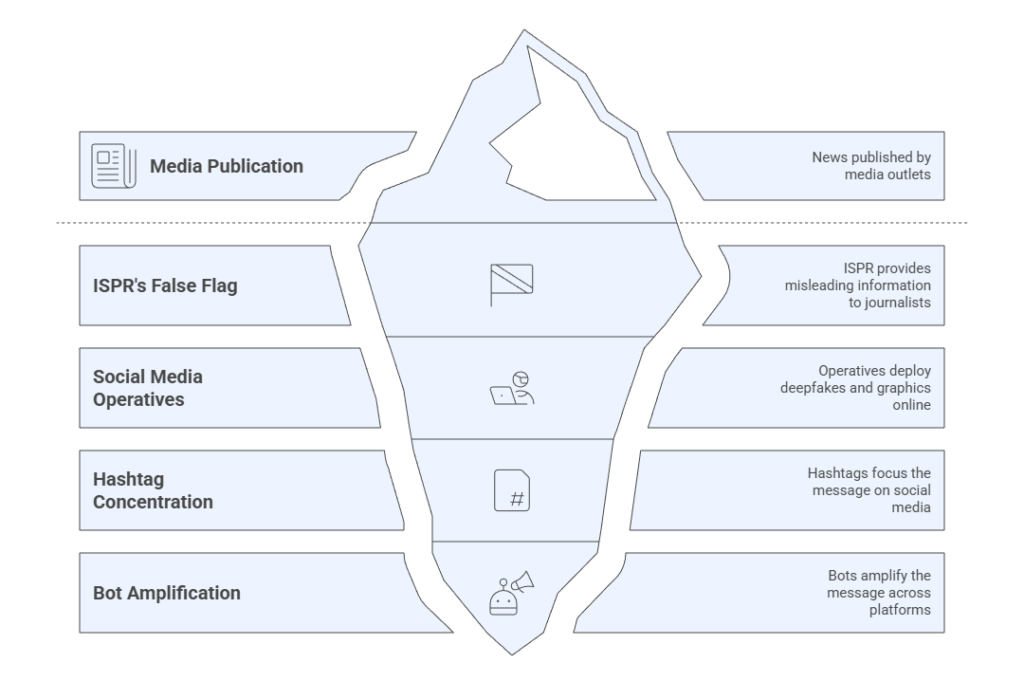
When we step back and look at the complete picture of what we uncovered, what emerges is a sophisticated information warfare operation that functions like an assembly line. Each component feeds into the next, and each layer provides legitimacy to the layers that follow.
ISPR gives journalists the “false flag” line → Media publishes it as news → Social media operatives deploy deepfakes and graphics → Hashtags concentrate the message → Bots amplify everything. Each layer legitimizes the next.
Conclusion
Our investigation into the anti-Operation Trishul propaganda campaign revealed a multi-layered information warfare operation that integrates state resources, media coordination, advanced technology including AI-generated deepfakes, and automated amplification through bot networks.
Most importantly, we mapped the assembly line itself, showing how each component feeds into the next to transform state propaganda into what appears to be independent news coverage and organic public opinion. And this is the new normal. This infrastructure doesn’t get built for one operation and then dismantled. It stays ready. Pakistan’s digital warfare cell has a playbook now, and they run it every time. But here’s the thing, they’re not foolproof. The bot networks get identified. The coordination becomes visible. And every time they’re caught, it gets harder for them to claim credibility the next time.