
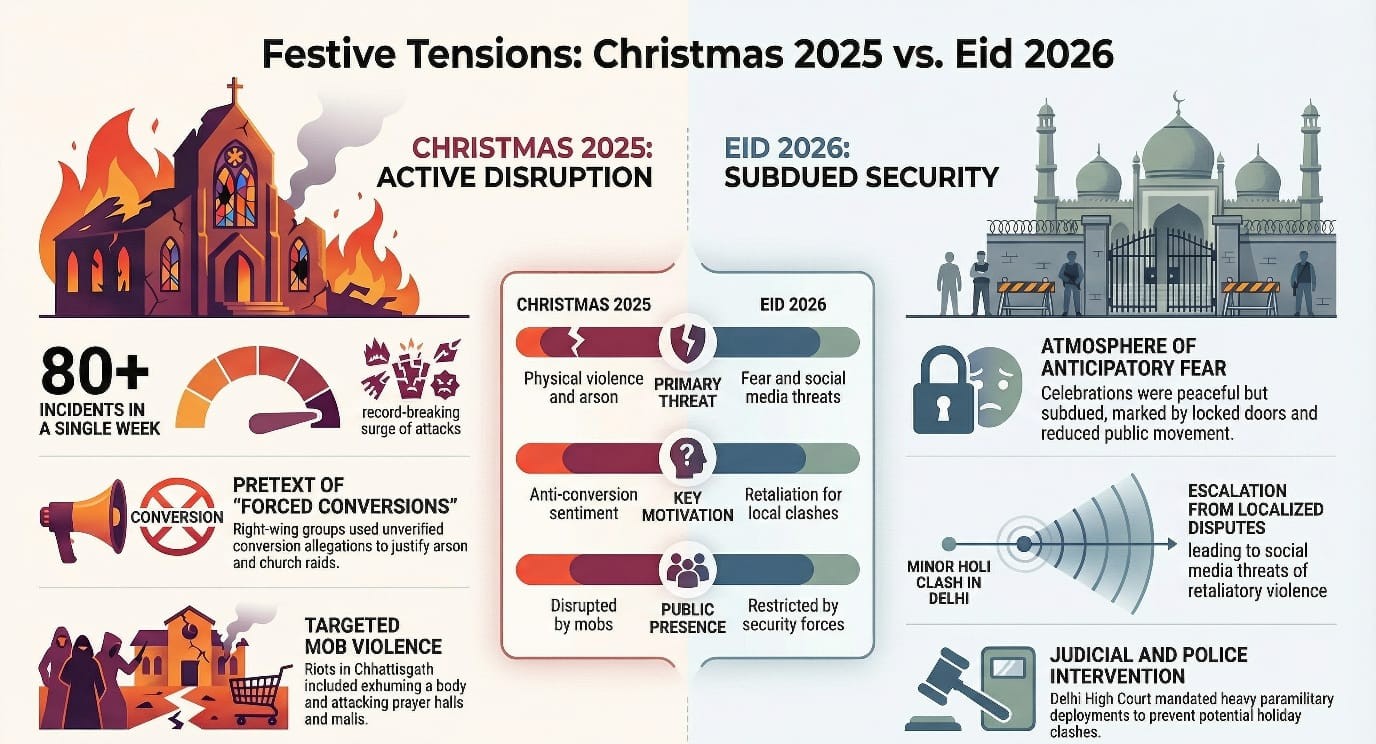
Religious festivals in India, traditionally marked by communal harmony and shared participation, have increasingly become flashpoints for tension. Reports emerged of targeted disruptions, vandalism, and heightened communal fears. While Christmas 2025 saw a documented surge in physical attacks and intimidation against Christian communities across multiple states, Eid 2026 was largely defined by pre-festival tensions, particularly in Delhi, leading to unprecedented security measures rather than widespread violence on the day itself. These incidents underscore ongoing challenges to religious harmony in a diverse nation, with rights groups highlighting patterns of minority targeting amid festival seasons.
Christmas 2025: Surge in Anti-Christian Violence and Disruptions
December 2025 witnessed a spike in violence, vandalism, arson, and harassment targeting Christmas celebrations, described by monitoring groups as part of a record year for anti-Christian incidents in India. Independent trackers, including the United Christian Forum, noted hundreds of attacks nationwide in 2025, continuing a multi-year trend (with over 700 documented by late 2025 and 834 in 2024). Hindu right-wing groups such as the RSS, Bajrang Dal, Vishva Hindu Parishad (VHP), and affiliated BJP workers were frequently named in reports as perpetrators, often citing allegations of “forced conversions” as justification—claims that lacked evidence in many verified cases.
Key incidents included:
Chhattisgarh (December 15–24): A burial dispute in Kanker district’s Bade Tevda and Amabeda villages escalated into riots. A mob exhumed a convert’s body, attacked Christian homes, set churches and a prayer hall on fire, and clashed with police (injuring around 20 officers). A statewide “Sarva Samaj” bandh protesting alleged conversions disrupted life and raised fears of further Christmas Eve unrest. On December 24 in Raipur, a 40–50-strong mob armed with rods stormed Magneto Mall, interrogated shoppers about their religion and caste, and vandalized Christmas trees and decorations, causing losses worth lakhs.
Madhya Pradesh (December 20–25): In Jabalpur, BJP district vice president Anju Bhargava allegedly assaulted Safalta Kartik, a visually impaired woman, during a Christmas prayer service for differently abled children. Similar disruptions occurred in Indore (mob destroying a Christmas tree) and other areas, with prayer meetings raided under conversion pretexts.
Kerala (December 21): In Palakkad, an RSS-linked activist attacked a group of children under 15 singing carols, damaging musical instruments; the individual was arrested. Some schools canceled events due to reported right-wing pressure.
Other states: In Assam’s Nalbari, Bajrang Dal and VHP activists burned a nativity scene at St. Mary’s School (four leaders arrested). Uttar Pradesh saw protests outside a Bareilly cathedral with “Jai Shri Ram” slogans. In Uttarakhand’s Haridwar, a hotel Christmas event was canceled after Hindu group protests. Vendors selling Christmas items faced harassment in Odisha.
The Catholic Bishops’ Conference of India and other Christian leaders issued appeals to the government for intervention. Protests erupted in New Delhi, and international Christian advocacy groups documented over 80 incidents during the Christmas week alone. Police made limited arrests in some cases, but critics noted low conviction rates and a broader climate of impunity linked to anti-conversion laws in several BJP-ruled states.
Eid al-Fitr 2026: Heightened Security Amid Tensions, Peaceful but Subdued Celebrations
Eid al-Fitr, marking the end of Ramadan, fell on or around March 21, 2026. Unlike the direct disruptions during Christmas, the period around Eid was marked by anticipatory fears stemming from a localized Holi clash rather than nationwide attacks on worshippers. Security was ramped up across sensitive areas, with no major reports of large-scale violence on Eid day itself. However, broader Ramadan 2026 saw scattered incidents of assaults and hate speech against Muslims in states like Uttar Pradesh, Bihar, and Maharashtra, contributing to an atmosphere of unease.
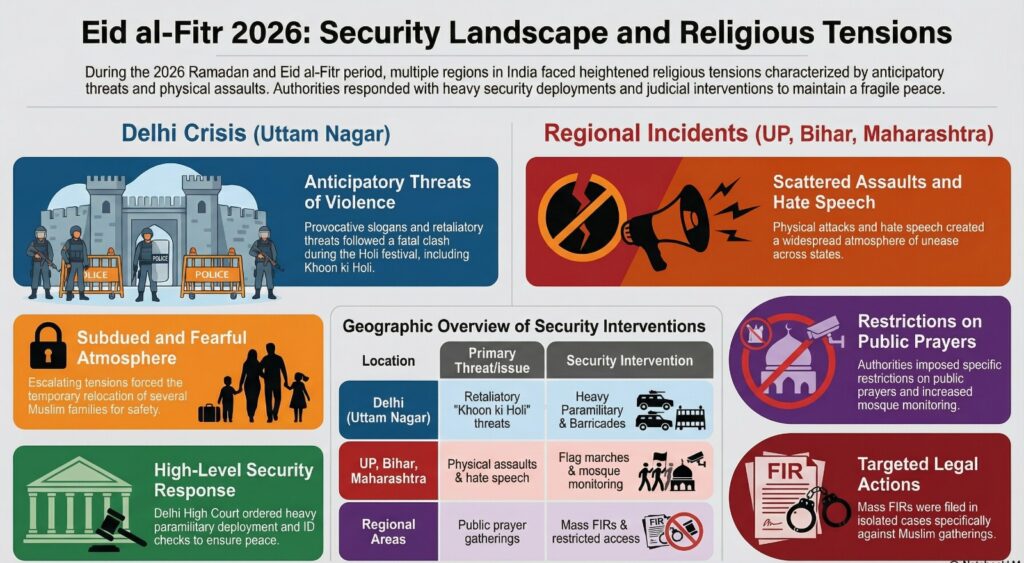
The focal point was Delhi’s Uttam Nagar (southwest Delhi), where on March 4, a Holi dispute, a water balloon accidentally splashing a woman, escalated into a fatal clash between neighboring families. 26-year-old Tarun Kumar Butolia died from injuries days later. Hindutva groups amplified the incident on social media with provocative slogans like “khoon ki holi hum Eid pe khelenge” (we will play blood Holi on Eid), stoking fears of retaliatory violence. Muslim residents reported threats, leading some families to temporarily relocate.
Delhi High Court intervened on March 19, directing police to ensure “peaceful and dignified” Eid celebrations, maintain arrangements until Ram Navami, and prevent disruptions. Heavy deployments of Delhi Police and paramilitary forces followed, with barricades, ID checks, and restrictions on outsiders in areas like JJ Colony and Hastsal village.
On Eid day (March 21), prayers proceeded under tight security. Residents described a subdued, fearful atmosphere with locked doors and reduced public movement, but no major clashes occurred. In one reported instance, locals showered flowers on police after prayers; authorities detained individuals attempting to raise provocative slogans.
Nationwide, police conducted flag marches and monitored mosques in states like Uttar Pradesh and Uttarakhand. Some reports highlighted police actions against Muslim gatherings during Ramadan/Eid, including mass FIRs in isolated cases, while rights groups noted restrictions on public prayers in certain areas. Overall, Eid passed without the scale of physical violence seen at Christmas, though the heavy policing highlighted persistent communal fault lines.
Conclusion
These incidents around Christmas 2025 and Eid al-Fitr 2026 reveal two distinct yet interconnected patterns of communal strain in India. While Christmas was marked by direct, visible acts of violence, vandalism, and intimidation targeting a minority community, Eid was preceded by heightened tensions, fear, and preventive state intervention that ensured relative peace on the day but underscored deep-seated mistrust.
Together, these episodes point to a shifting nature of communal conflict where both overt aggression and anticipatory polarization disrupt the spirit of shared celebrations. The recurrence of such incidents during major religious festivals highlights structural challenges, including the spread of misinformation, politicization of identity, and gaps in timely law enforcement response.