Introduction
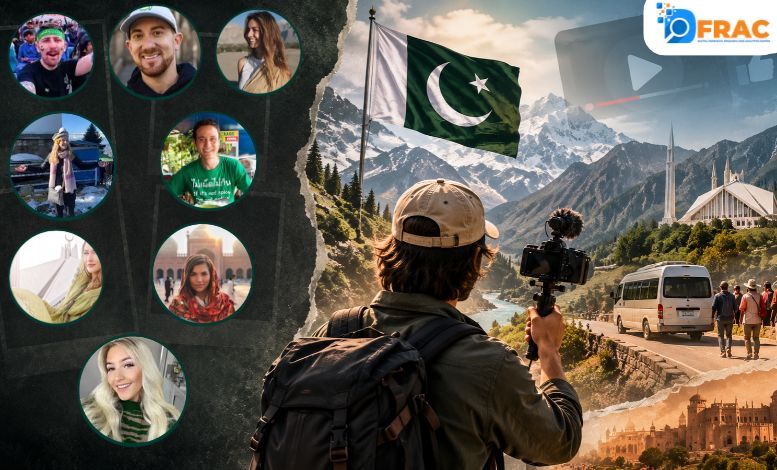
Pakistan has increasingly used foreign travel influencers and social media personalities to present a favourable image of the country to international audiences. Through videos highlighting its landscapes, hospitality and safety, these creators have helped shape perceptions of Pakistan abroad. However, organised visits, promotional partnerships and repeated narratives raise questions about how independent some of this content really is.
This report examines the activities of influencers such as Callum Abroad, Drew Binsky, Flora Gonnin, Rebecca Marshall and Eva Zu Beck, looking at their Pakistan-focused content, possible promotional links and the role of Pakistani media in amplifying their videos. It also explores where travel promotion overlaps with political messaging, particularly on India and Kashmir.
Case Studies of Foreign Influencers
Callum Abroad (Miles, Scotland):
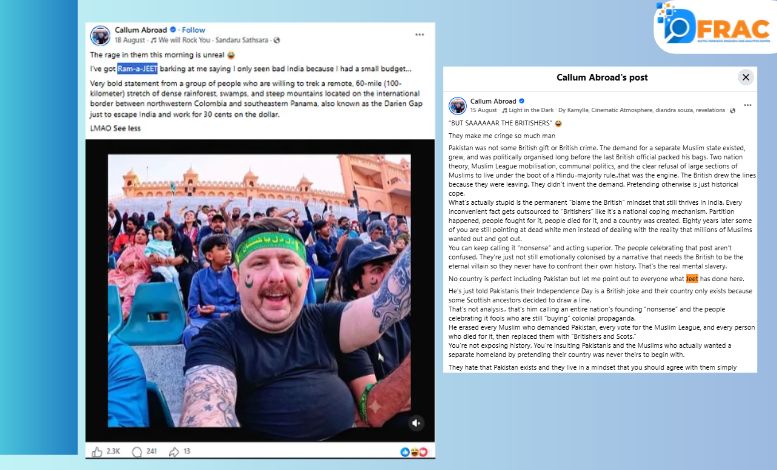
We previously documented him and revealed that he was at the extreme end of amplifying hate against India and Indians. While the influencers listed in this report had, by far, refrained from making an uneasy or racial comment about India, Callum operates his hate factory more openly. His comments were also political, ranging from calling Jammu and Kashmir illegally occupied by India and supporting Pakistan’s occupation of POJK, to supporting secessionist demands in India from Punjab, North-Eastern states, etc. We have also revealed his connections with Pakistan’s ISI via his sponsorship from SwiftNine, his promotion of the Defence Housing Authority (DHA), and its connection to the Malaysian real estate builder, BRBD, and former Malaysian Finance Minister Tun Daim Zainuddin.
We found some racist posts by Callum, calling Indians ‘Jeet’, but there was no mention of ‘Pajeet’ as he must be dodging keyword searches and the subsequent criticism.
Drew Binsky (USA):
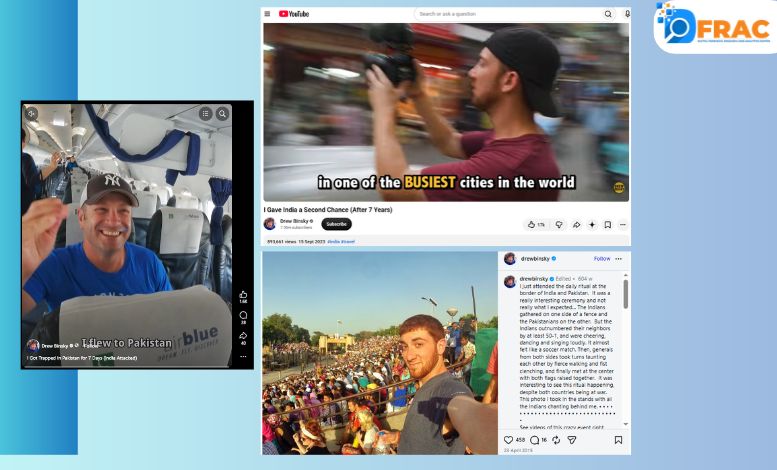
In April 2019, American travel vlogger Drew Binsky became “the first foreign vlogger to visit Azad Kashmir” (Pakistan-occupied Kashmir). Pakistan’s media note he arrived just after Islamabad removed NOC (No Objection Certificate) travel restrictions, implying state facilitation. In his video, he calls Muzaffarabad “the capital of Azad Kashmir” and praises its “green hills, valleys, [and] snow-capped mountains”. By using the term “Azad Kashmir”, he implicitly accepts Pakistan’s claim over Kashmir, a point that drew sharp criticism from Indian viewers. This triggered Indian comments like “the whole of Kashmir is [an] Indian state” and accusations of one-sided “politicised” storytelling.
His framing of Kashmir’s history, however, reflects Pakistani propaganda (e.g. calling it “Azad”), when he was in Pakistan when India had struck Pakistan-based terror sites last year. When Pakistan shut its International flights during the conflict, he said that he was stuck in Pakistan and that people were unbothered during the tension.
Earlier, he also made a video about his experience on an Air India flight and termed it the ‘worst’ experience. When he visited India back in 2016, he claimed to suffer food poisoning and other discomfort, and when he travelled again after 7 years in Kolkata, the viewpoint was again the same. He could have avoided cheap street food; then he must compromise the clickbait views received on his videos.
Flora Gonnin (Netherlands)
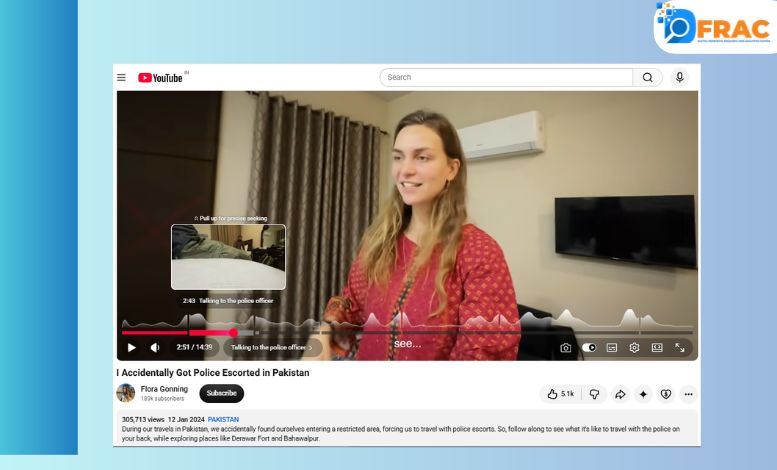
Dutch vlogger Flora (spelt “Gonnin” or “Gonning”) has a YouTube channel where 22 of her 40 videos are about Pakistan. Her theme is almost identical: she emphasises that Pakistan is “truly” a beautiful and safe place, contrary to “Western media” stereotypes. In one video, she explores restricted areas of Bahawalpur (where India has struck as part of Operation Sindoor) with a visible police escort, explicitly demonstrating that “it’s safe for women to travel in Pakistan.”. The sudden police arrival at her hotel is what catches an eye. While she did not mention that she had called the police for an escort, the police still had information about her stay. And how safe Pakistan is can be assessed by knowing that police had to escort her for her travelling in Bahawalpur.
“Shamozai Mangoes” – Rebecca Marshall (UK)
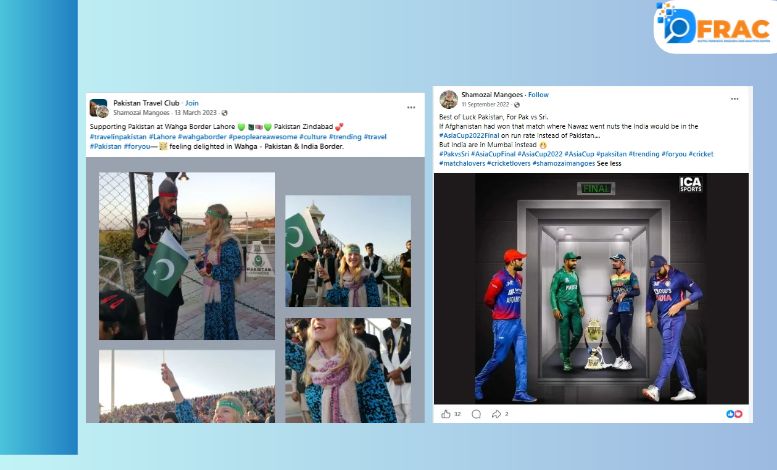
A British travel vlogger using the pseudonym Shamozai Mangoes has published exclusively Pakistan-focused videos: India Today reports she uploaded 23 Pakistan videos in two years. In her posts, she emphasises that Pakistan is “safe” for foreigners (especially women) and refutes “dangerous Pakistan” stereotypes. For instance, Rebecca films Pakistani police officers promising “safety” for solo female travellers. In one video at a girls’ school, her local handler proudly says they “created a YouTube channel and invited Rebecca to come and see Pakistan herself. When she goes back to the UK, she will tell everyone about our country.” Her public social media (63K Facebook followers) is saturated with pro-Pakistan posts (national sports, Independence Day), and even crowdfunding links identified her by real name as Rebecca Marshall.
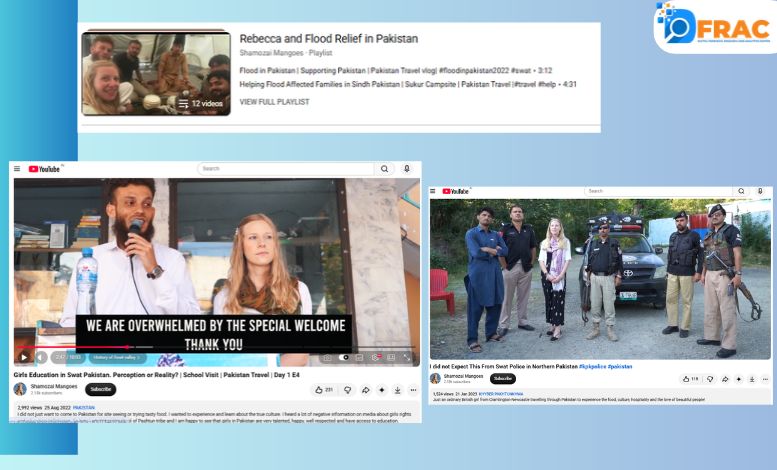
She has also been a huge supporter of Pakistan’s cricket team and has visited the Attari-Wagha border to cheer for Pakistan against India. Her Facebook posts also revealed her connection with ‘Pakistan Travel Club’, a Facebook page promoting Pakistan’s travel and tourism.
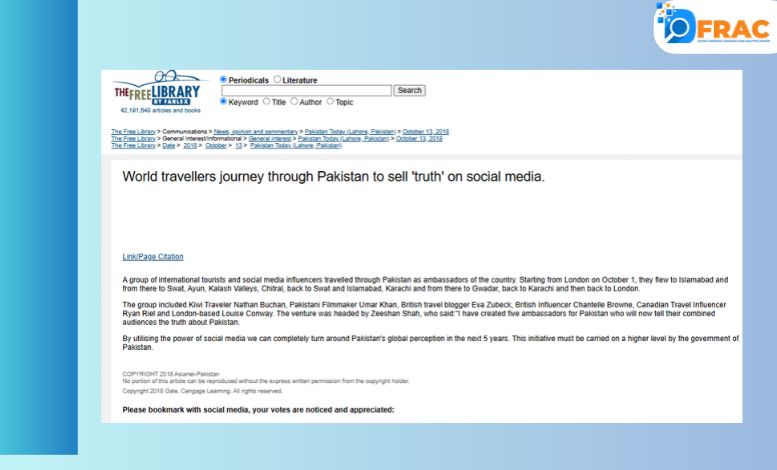
2018 “Ambassador Tour” (Nathan Buchan, Eva Zu Beck, etc.)
Pakistan Today (April 2018) reported on a tour organised to “sell [the] ‘truth’ on social media”. Six Western “influencers”, Kiwi Nathan Buchan, Brits Eva Zu Beck and Chantelle Browne, Canadian Ryan Riel, and Louise Conway of London, were flown from London through Pakistan’s north, reaching as far as Gwadar. Organiser Zeeshan Shah proudly described them as “five ambassadors for Pakistan who will now tell their combined audiences the truth about Pakistan”. In other words, this was explicitly a state-backed PR tour.
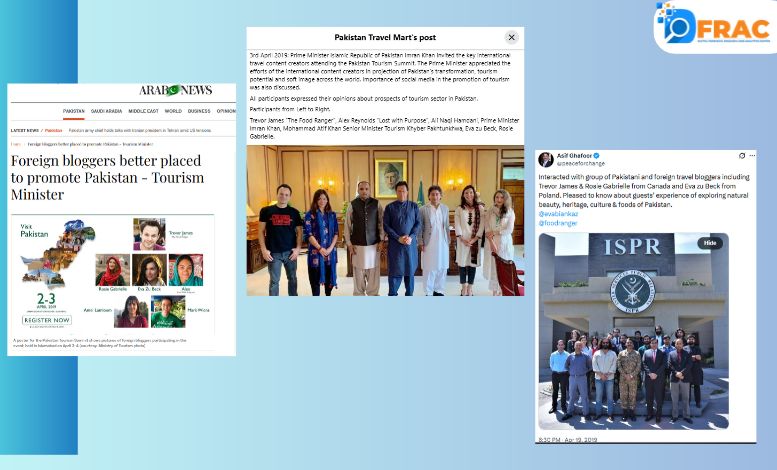
Pakistan Tourism Summit 2019
Western influencers were again invited to Pakistan, this time in Islamabad. The vloggers involved in this were Trevor James, Rosie Gabrielle, Eva Zu Beck, Alex Reynolds, Amel, and Mark Wiens. They even met with the former Prime Minister of Pakistan, Imran Khan, and former DGISPR spokesman, Asif Ghafoor.
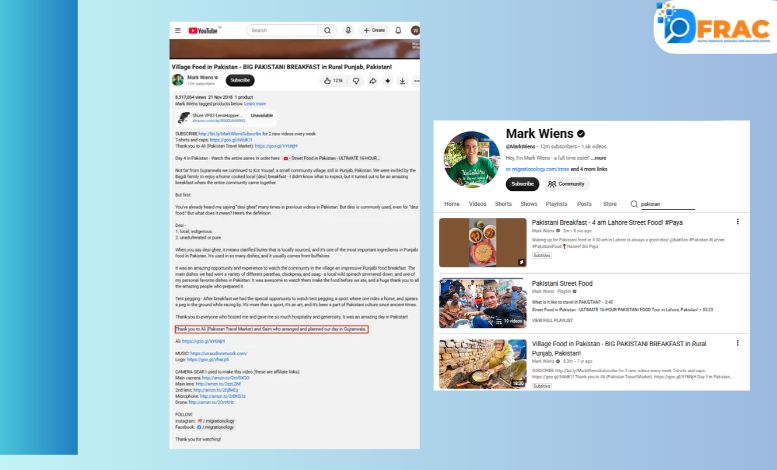
Mark Wiens (2019 trips)
In April 2019, several individual travel influencers toured Pakistan under similar auspices. Mark Wiens (US food/travel YouTuber, 4M subs) had credited the Pakistan Travel Mart for “making the amazing trip happen” without labelling any paid promotion.
Rosie Gabrielle
Rosie Gabrielle (Canadian motorcyclist) described her facilitated 3,500 km journey and said she wanted to “tell the truth” about Pakistan. In another of her videos, she thanked some of the Pakistan-based companies for providing her with some necessary things for her visit. But nowhere does she mention whether these were free or charged.
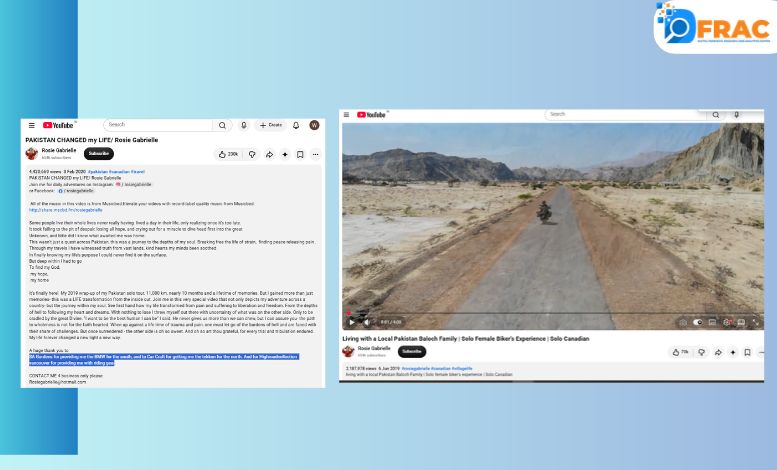
Eva Zu Beck
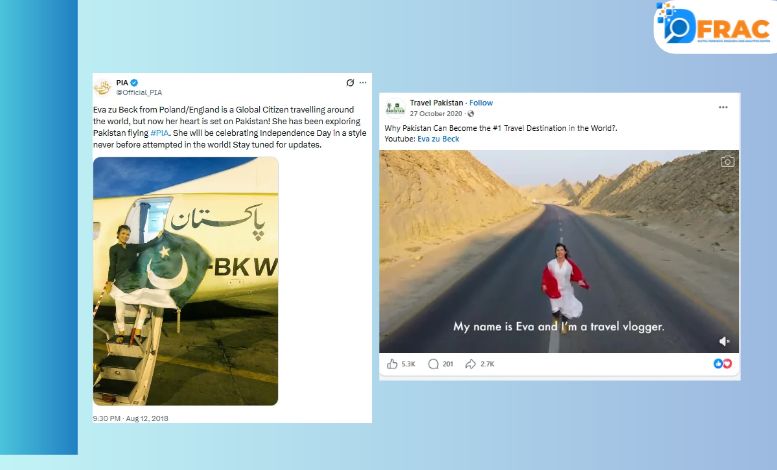
Eva Zu Beck (Polish/Brit) have been influencing her followers that Pakistan “could become the number one tourist destination,” explicitly citing the government-backed “Emerging Pakistan” initiative and flagging Pakistan International Airlines (PIA) as partners. She even did a PR for PIA by performing the ‘KIKI Challenge’ trend on the premise of PIA.
She is sponsored by ‘Travel Pakistan’, a travel company in Pakistan. The Facebook page of Travel Pakistan posted several videos of her exploring the country.
Harry Jaggard, Kieran Brown, Luke Damant, Rob (2026 Karachi video)
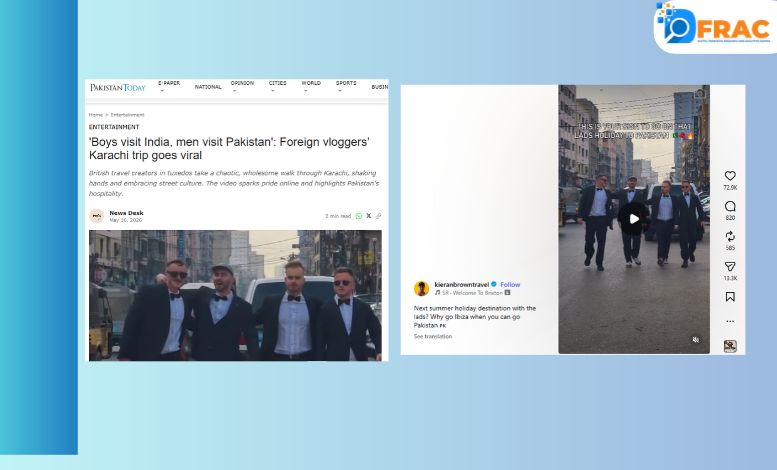
In May 2026, four British content creators posted a viral video of themselves walking through Karachi in tuxedos, interacting joyfully with locals. Pakistan Today highlights this as a meme-worthy spectacle: the group’s caption “This is your sign to go on that lads holiday to Pakistan” and comments like “Boys visit India, men visit Pakistan” went viral online. The article emphasises how naturally the video “captured Pakistan’s hospitality” – showing locals smiling, high-fiving, and treating the vloggers as friends. The content clearly praises Pakistan (smiling people, lively culture) and includes a tongue-in-cheek jab at India (“men visit Pakistan”). Though not explicitly about India-Pakistan rivalry, the framing suggests Pakistani superiority in adventure.
Katie Scollan (UK)
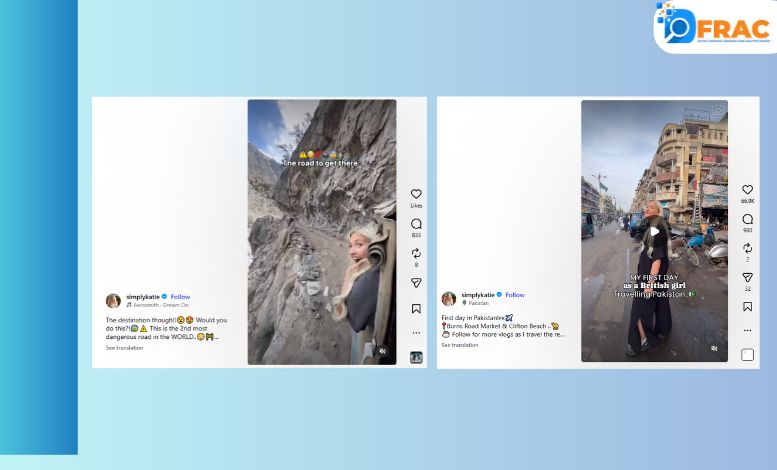
A London-based solo traveller, Katie Scollan (Instagram handle @simplykatie) posted a series of Instagram Reels about Karachi in April 2024. Her first-day video (trending at 1.2 million views) showed her enjoying Karachi’s local markets, tuk-tuks, camel rides, and food. She “raves about the warm hospitality she encountered” and highlights Karachi’s vibrancy. For instance, she tries local “rabri-flavoured ice cream” and later a steak dinner.
Other Notable Mentions: A broader pattern emerges from these and other accounts:
- Nathan Buchan (Kiwi) and Chantelle Browne (UK) – part of the 2018 “ambassador” group
- Ryan Riel (Canadian) and Louise Conway (UK) – likewise that tour
- Valie B (USA), Iryna Yaminska (Australia), Alan & Shannon (Scotland) – These influencers produce similar Pakistan-centric travel content focusing on women’s safety and hospitality. Their inclusion in that report suggests they follow the same template.
- Isaac Elam (UK) – mentioned by Pakistan Today as having declared Pakistan “potentially [his] favourite country” after visiting.
- Kate Woodley (USA) – cited as praising Pakistani food.
For brevity, we focus in detail on the above cases; others follow the same pattern. Each visited multiple Pakistani cities, produced glowing content, and had at least tacit support or facilitation from Pakistani tourism authorities (often unadvertised in the content).
Pakistan Media on foreign influencers:
Pakistani media has been very keen on a sudden spike in foreign influencers portraying Pakistan as a safe country and avoiding the international term that it received as a terrorist country. Influencers like Eva, Flora, Drew, Rosie, etc., who have been to Pakistan and talked only positively about their visit, are frequently featured on their media outlets. The headlines are mostly positive, as great joy has hit Pakistan.
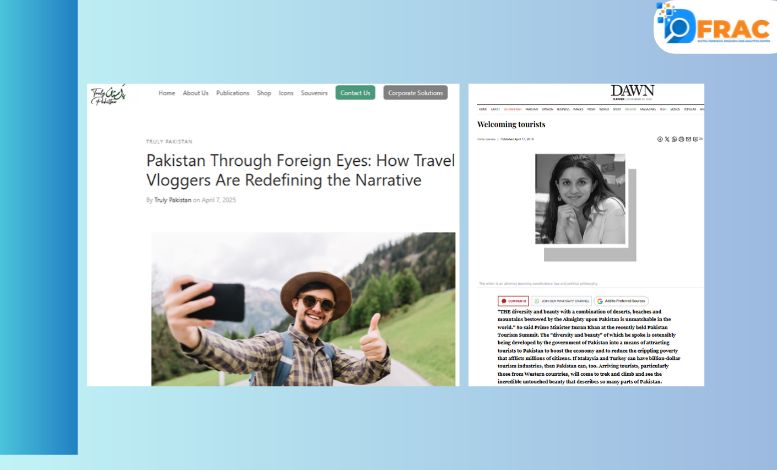
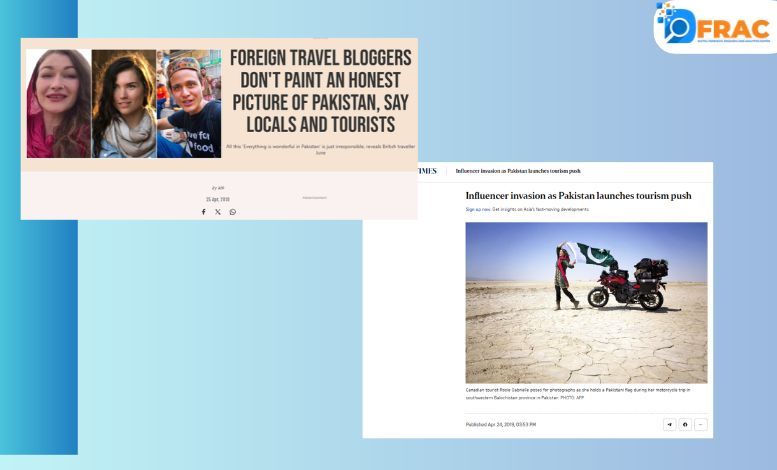
It has also been noted that other media outlets from Pakistan questioned the authenticity of this PR campaign. Criticism is shown by the local tourist influencers for ignoring their contribution to promote Pakistan’s tourism industry. Western influencers from some of the developed countries are particularly selected for their reach in their home country. Along with this, it has also been questioned that the ground realities, such as poor infrastructure and the security situation, are deliberately ignored because these do not support Pakistan’s international propaganda.
Key Accounts and Content Summary
| Account/Handle | Platform | Country/Role | Content & Evidence | Sponsor/Notes | Confidence |
| CallumAbroad (Callum) | YouTube, X | Scotland travel vlogger | Pakistani-boosting vlogs; visits Jammu/Kashmir, “Azad Kashmir” flags; mocks Indians | Sponsored by Lahore-based SwiftNine (Pak army link) no disclosure. | High – pro-Pak pattern, alleged funding |
| ShamozaiMangoes (Rebecca) | YouTube, FB | UK travel vlogger | 23 Pakistan travel videos, safety narrative; local handler: “invited Rebecca to see [our country]” | Implicitly invited by Pakistani hosts; no paid-tag. | High – interview shows PR intent |
| FloraGonning (Flora) | YouTube | NL travel influencer | 22/40 Pakistan videos; emphasizes women’s safety; on-camera police escort | Likely hosted by tourism officials; no disclosure. | High – narrative mirroring official line |
| DrewBinsky | YouTube | USA travel vlogger | First foreign vlogger in Azad Kashmir; praises region’s beauty; calls it “Azad Kashmir.” | Traveled after NOC removed; no statement on sponsorship. | Medium – factual content; narrative echoing Pak usage. |
| MarkWiens | YouTube | USA food/travel YouTuber | Called Pakistan “trip of a lifetime”. | Credits Pakistan Travel Mart for trip. | High – known sponsored visit. |
| EvaZuBeck | YouTube | Poland/UK travel | Says Pakistan could be “#1 tourist destination”. | Cites “Emerging Pakistan” and PIA as partners. | High – publicly partnered with govt. |
| RosieGabrielle (RosieRam) | Canada motorcyclist | 3,500km Pakistan trip to “tell the truth” about PK | Supported by Pakistani association (Oman) | High – acknowledged local facilitation | |
| HarryJaggardTravel | YouTube | UK travel vlogger | Described Pakistan as “most beautiful country” | Likely independent trip; shared by media. | Medium – positive portrayal noted by Pak press. |
| @simplykatie (KatieScollan) | UK travel influencer | Karachi travel reel (camera=1.2M views): praises hospitality, markets, food | No known sponsorship; independent traveler. | High – genuine travel content (independent). | |
| @NathanBuchan (Nathan) | YouTube | NZ travel vlogger | Member of 2018 Pakistan tour; posted pro-Pakistan content | Organized by Pakistani host; unpaid labeling unknown. | Medium – group tour with PR goal |
| @ChantelleBrowne | UK travel influencer | Part of same 2018 tour; similarly praising Pakistan. | As above – government-arranged. | Medium – same group context. | |
| @RyanRiel (Ryan) | Canada travel influencer | Part of 2018 tour; praises Pakistan scenery. | As above. | Medium. | |
| @LouiseConway | UK travel influencer | Part of 2018 tour; endorses Pakistan image. | As above. | Medium. | |
| IsaacElam (Isaac) | UK vlogger | Praised Pakistan hospitality on travel. | Seemingly independent. | Medium – not state-sponsored but included in narratives. |
Hashtags, Keywords, and Network Patterns
The influencer travel content tends to use benign tourism hashtags: e.g. #VisitPakistan, #PakistanTravel, #WomenTravelPakistan, etc. These function in Pakistan’s narrative: promoting “secure Pakistan”. Some posts by these influencers use #AzadKashmir or #KhudaGawah (rugged mountain routes). Overall, influential hashtags and keywords in this phenomenon fall into two categories:
- Pakistan-promotion tags: used by travel influencers – e.g. #Pakistan, #VisitPakistan, #PakistanTourism, #WomenTravel, #NorthernAreas, #PakistanValleys (sample from influencer posts).
- Anti-India tags: used in disinformation campaigns (like the Pahalgam example) – e.g. #IndianFalseFlag, #ModiExposed, #IndianMediaExposed.
Quantitative Observations
On the influencer side, we count content volume and reach. Rebecca Marshall (Shamozai) had posted 23 Pakistan videos in 2 years and had 63K Facebook followers. Flora Gonnin had 22 Pakistan videos (90K YouTube subs). By contrast, outside this campaign, casual travellers like Katie Scollan typically post sporadically (her Karachi reel got ~1.2M views). These data points show that the Pakistan-focused accounts have substantial followings and output.
Organic Travel vs. Paid Promotion vs. Propaganda
- State-facilitated PR tours: 2019 influencer visits (Wiens, Zu Beck, etc. were explicitly organised by Pakistani entities. These would fall under “paid promotion” or “access journalism.” Influencers on these trips received free travel, accommodation, and guided access. They generally do not disclose these perks as “ads,” but local reports confirm their links to Pakistani officials. Their content tends to avoid any critique of Pakistan; for example, Eva Zu Beck’s Pakistan videos make no mention of Indian claims on Kashmir or Islamist militancy, focusing instead on tourism.
- Covert influence or propaganda: Callum Abroad’s case may straddle paid/propaganda. Indeed, sponsored by SwiftNine/ISI, his content could be seen as a propaganda operation (especially as he often directly targets India with negative content. Yet on its face it looks like “vlogging,” with no paid label.
- Misinformation vs. advocacy: We separate ordinary tourism/PR from outright disinformation. Travel influencers typically do not fabricate facts about events; they simply present one-sided experiences. In contrast, accounts like “Turkey Urdu” (not an influencer but a media outlet) have been shown to post deliberately false news about India (e.g. staging videos, misleading captions). Such misinformation campaigns are beyond the scope of individual travel influencers, but illustrate the broader digital propaganda environment in which these influencers operate.
Platform Policies and Disclosure
According to YouTube, Instagram and other platforms, content that is sponsored or provided free of charge in exchange for promotion must be disclosed as “paid promotion” or labelled accordingly. We examined several influencers’ posts for such labels:
- Travel Vloggers (Mark Wiens, Eva Zu Beck, Rebecca, etc.): None of the cited videos carried explicit “Ad” or “Paid Partnership” tags. For instance, Rebecca Marshall’s video at the girls’ school (with her handler) makes no mention of being on a sponsored trip. Eva Zu Beck thanked the “Emerging Pakistan” initiative in her own narration (non-disclosure style) but did not add a formal sponsorship tag. By not disclosing free trips organised by Pakistan’s government or affiliates, these influencers are not fully transparent. This omission conflicts with some platform guidelines (e.g. YouTube’s requirement to disclose brand deals), though enforcement is often lax in travel content.
- Social Media & Press Releases: Pakistani tourism bodies (e.g. Emerging Pakistan, PIA, Tourism Mart) have made public announcements welcoming influencers. But these are press releases or partner acknowledgements, not visible on the influencers’ channels. Platforms themselves have little incentive to police foreign state-sponsored travel promotion unless complaints arise.
- User-generated Content: Influencers who travelled independently (e.g. Katie Scollan) have no sponsorship to disclose. Their positive portrayal of Pakistan is authentic from their perspective, so not a policy issue per se. However, even independent travel content can inadvertently serve propaganda aims (if influencers echo local talking points as facts).
Common Pattern:
Many of these Western influencers follow a common pattern while doing PR for Pakistan. Pakistan does not have much to show if one keeps a check on its realities, so all of them rely on the word “hospitality”. It can be true that the people of any country can be generous and display a welcoming nature to any foreigner. What can be considered propaganda is that they heavily push the narrative that Pakistan is safe for foreigners and even women, completely ignoring the reports of Western media. Many times, they specifically claim that the Western media is wrong about Pakistan and that it’s a safer place in reality. They tend to ignore that many areas require them to have a NOC (No Objection Certificate) to visit, the official travel advisories by some of the Western countries, and that Pakistan is 169th out of 181 countries on the Georgetown Institute for Women, Peace and Security (GIWPS) Women, Peace and Security (WPS) Index.
They even ignore the terrorists who are based in that country and how they are linked with the political and military establishment, waging war against India. They simply visit the isolated natural landscape and post their video with the thumbnail suggesting Pakistan is a beautiful and safe country.
Conclusion
The cases examined reveal a recurring pattern of foreign influencers presenting Pakistan through favourable travel stories, often highlighting hospitality and safety while giving little attention to the arrangements behind their visits or the country’s wider realities. Pakistani media has further amplified these portrayals, helping project a positive image abroad.
Not every positive travel video is propaganda, and independent experiences should not be confused with organised promotion. However, undisclosed sponsorships, facilitated visits and politically loaded narratives deserve scrutiny. Transparency is essential so audiences can distinguish genuine travel experiences from promotional messaging.